Cable pullover
Also called cable pullovers, straight-arm cable pulldown, straight-arm pulldown, cable lat pullover.
What is a cable pullover?
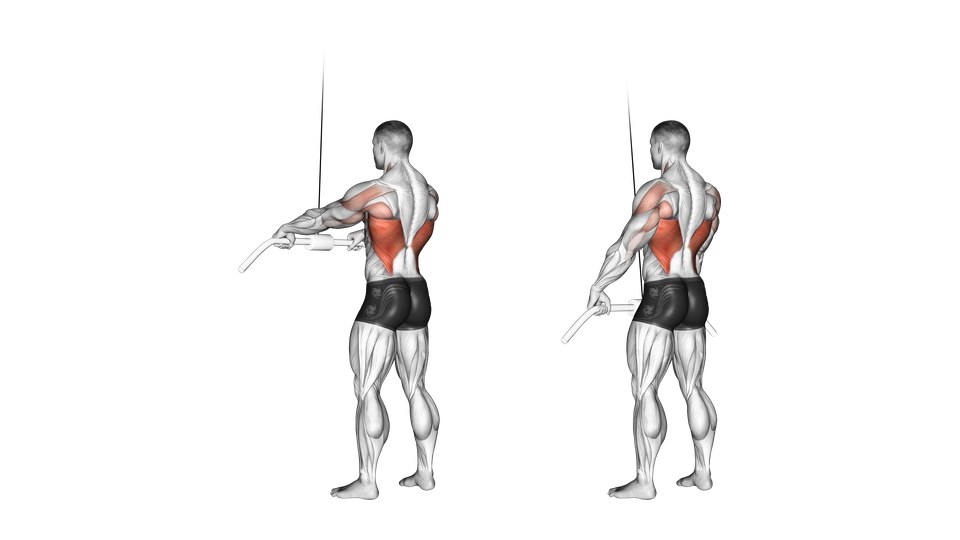
The cable pullover, also called a straight-arm pulldown, is a standing cable exercise that moves a high-pulley bar from in front of the shoulders down toward the thighs. It mainly trains the latissimus dorsi while the elbows stay nearly fixed.
How do you perform a cable pullover?
Set up
- Attach a bar to the high pulley, take an overhand grip around shoulder width and step back until the cable is taut.
- Hinge forward slightly with soft knees, brace your torso and hold the bar in front of your shoulders with your arms almost straight.
Execution
- Sweep the bar down in an arc toward your thighs by moving at the shoulders, keeping the elbow angle steady.
- Finish before your torso rises or your shoulders roll forward to create extra range.
- Let the bar return slowly until your arms are in front of your shoulders again, then repeat from the same hinge.
Common mistakes
Turning it into a bent-arm pulldown
Changing the elbow angle adds an arm pull and turns the movement into a different cable exercise. Keep only a small fixed bend.
Standing up to move the bar
Torso extension adds momentum. Choose a load that lets the same slight hinge stay in place.
Forcing the bar behind the thighs
The useful endpoint is where the upper arms reach the torso. Stop before the shoulders roll forward or the body moves around the cable.
Where it fits in a session
Use it as direct lat work after heavier rows or pulldowns, or as a low-grip-demand back exercise.
Keep the hinge, attachment and endpoint consistent when comparing loads.
Muscles worked
Primary
Secondary
Schematic surface view. Some muscles are partly visible or not shown.
The latissimus dorsi is the main target as the upper arms move down toward the torso. The posterior deltoid and teres major assist that shoulder-extension path.
Variations
- Rope straight-arm pulldown — Uses a rope so the hands can separate near the thighs.
- Dumbbell pullover — Lies across or along a bench and moves one dumbbell over the head instead of using a high cable.
- Machine pullover — Uses pads or a lever to guide the upper arms through the same shoulder-extension pattern.
Frequently asked questions
What muscles does the cable pullover work?
It mainly trains the latissimus dorsi. The posterior deltoid and teres major assist as the upper arms move toward the torso.
Is a cable pullover the same as a straight-arm pulldown?
These names commonly describe the same standing high-cable movement. This guide uses a bar and keeps the elbows nearly fixed.
Should your arms be completely straight?
A small elbow bend is fine. Keep that angle steady so the movement continues to come from the shoulders rather than turning into a bent-arm pulldown.
How far should the bar come down?
Bring it toward the thighs until the upper arms reach the torso. Stop before you have to stand up, roll the shoulders forward or bend the elbows more.
Sources
- Jeno SH, Varacallo MA. Anatomy, Back, Latissimus Dorsi. StatPearls. https://www.ncbi.nlm.nih.gov/books/NBK448120/
- Syros A, Rizzo MG. Anatomy, Shoulder and Upper Limb, Teres Major Muscle. StatPearls. https://www.ncbi.nlm.nih.gov/books/NBK580487/
- Elzanie A, Varacallo MA. Anatomy, Shoulder and Upper Limb, Deltoid Muscle. StatPearls. https://www.ncbi.nlm.nih.gov/books/NBK537056/