
Cycling
Also called stationary cycling, exercise bike, indoor cycling.
What does stationary cycling do?
In this guide, cycling means pedalling an upright stationary exercise bike, which is the movement mapped to this exercise in RepCount. You sit on the saddle and turn the pedals continuously while the bike stays in place. It is cardio rather than a lift that isolates one muscle: the quadriceps, hamstrings, glutes and lower-leg muscles share the pedal cycle. Stationary cycling can serve different kinds of sessions, so this guide covers using the bike rather than prescribing a workout.
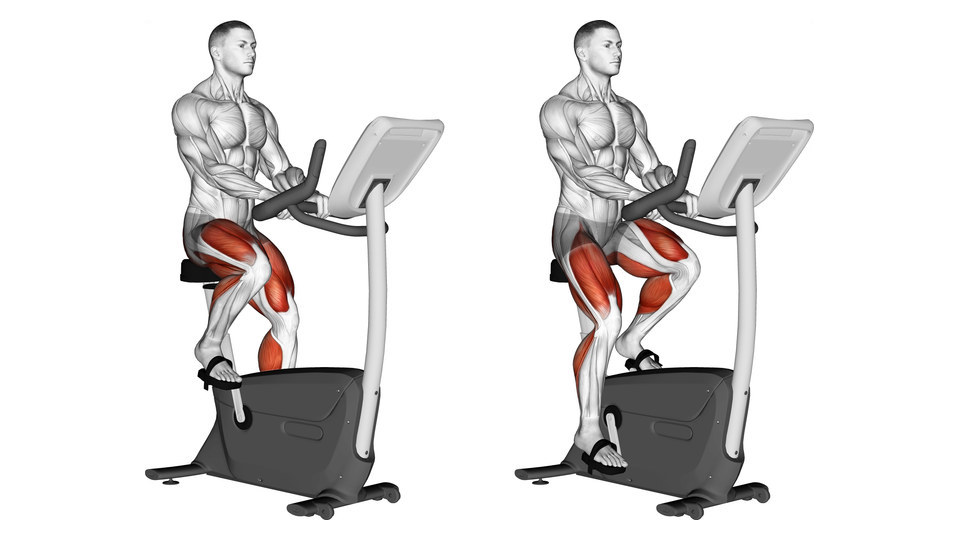
How do you use a stationary bike?
Set up
- Adjust the saddle so your knee stays slightly bent at the bottom of the pedal circle, with the handlebars within easy reach.
- Sit on the saddle, place the front half of each foot on a pedal, and secure the straps if the bike has them.
Execution
- Begin pedalling while seated, keep your torso steady, and rest your hands lightly on the handlebars.
- Let your knees travel forward as the pedals circle, without rocking your hips or reaching for the bottom of the stroke.
- When you are finished, let the pedals come to a complete stop before removing your feet and getting off.
Common mistakes
Leaving the saddle at the wrong height
A knee that remains tightly bent at the bottom suggests the saddle is too low; rocking the hips or reaching for the pedal suggests it is too high. Readjust it before continuing rather than adapting your movement to the bike.
Leaning heavily on the handlebars
Loading the bars through straight, tense arms can pull the shoulders up and make the chosen reach awkward. Keep your hands relaxed and move the handlebars or saddle if you cannot reach them comfortably.
Taking the feet off while the pedals are moving
The crank can carry an unsecured pedal around after you decide to stop. Let both pedals settle before releasing straps or stepping away.
Where it fits in a session
Wherever stationary cycling fits in the session. Whether it accompanies lifting or stands on its own depends on what that session is for.
Follow the plan for the session rather than treating one bike setting as universally correct. Duration, speed, cadence, resistance, intensity, zones, intervals and progression are intentionally not prescribed here.
Muscles worked
- quadriceps
- hamstrings
- gluteus maximus
- gastrocnemius and soleus
- tibialis anterior
Stationary cycling is cardio rather than a resistance exercise aimed at one muscle. The muscles are unranked because they contribute at different points in the pedal cycle, and bike setup changes their relative activity. The quadriceps and hamstrings coordinate the thigh, while the gluteus maximus, calves and tibialis anterior also take part as the pedals turn.
Variations
- Recumbent stationary bike — Places the seat behind the pedals and supports the back rather than using the upright position shown here.
- Indoor cycling bike — Uses a road-bike-like saddle and handlebars while remaining fixed in place.
- Air bike — Adds moving handles so the arms push and pull while the legs pedal.
Frequently asked questions
What muscles does stationary cycling work?
The quadriceps and hamstrings coordinate the thigh through the pedal cycle. The gluteus maximus, gastrocnemius, soleus and tibialis anterior also contribute as the hip, knee and ankle move. It is still primarily cardio rather than a way to isolate one of those muscles.
How high should the saddle be?
Start with a height that leaves your knee slightly bent when the pedal is at the bottom. If your hips rock to reach the pedal, lower the saddle; if the knee stays tightly bent throughout the bottom of the circle, raise it. Make small adjustments until you can pedal without either compensation.
Where should my feet sit on the pedals?
Place the front half of each foot securely on its pedal rather than balancing on the toes or arch. If the bike has straps, fasten them so the feet stay in place without feeling pinched.
Is stationary cycling the same as outdoor cycling?
Both use a repeating pedal cycle, but a stationary bike fixes the frame in place. Outdoor riding also involves steering, balance, road position and changing conditions, none of which this machine-use guide covers.
How long or how hard should I use a stationary bike?
That depends on why cycling is in the session. A warm-up, a cool-down, a general cardio session and preparation for an event require different choices. Follow the plan for that session rather than treating one duration, effort or machine setting as correct for everyone.
Sources
- Lima da Silva JC, et al. Quadriceps and hamstring muscle activity during cycling as measured with intramuscular electromyography. Eur J Appl Physiol. 2016. https://pmc.ncbi.nlm.nih.gov/articles/PMC4983295/
- Bouillon L, Baker R, Gibson C, Kearney A, Busemeyer T. Comparison of trunk and lower extremity muscle activity among four stationary equipment devices: upright bike, recumbent bike, treadmill, and ElliptiGO. Int J Sports Phys Ther. 2016. https://pmc.ncbi.nlm.nih.gov/articles/PMC4827362/
- Jobson SA, Hopker J, Arkesteijn M, Passfield L. Inter- and intra-session reliability of muscle activity patterns during cycling. J Electromyogr Kinesiol. 2013. https://pubmed.ncbi.nlm.nih.gov/23022477/