
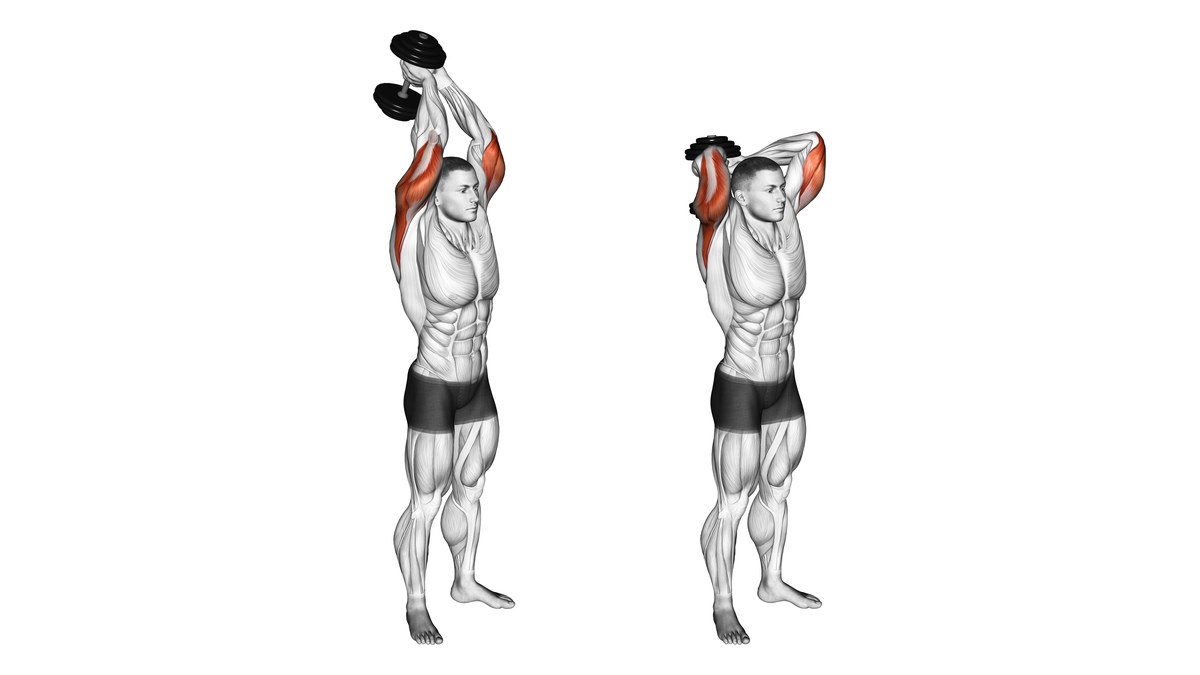
Dumbbell triceps exercises and a simple routine
Useful dumbbell triceps exercises include overhead extensions, lying extensions and kickbacks. Choose one extension you can control, then decide whether you need extra work alongside your existing presses. Without a bench, a standing two-handed overhead extension can fill the direct triceps slot; a floor press is an optional addition if your plan needs pressing.
The useful choice is the version you can set up securely and repeat. A heavier number means little if you're changing the movement to lift it.

Choose dumbbell triceps exercises for your setup
Start with the equipment you have and the position you can hold comfortably. The linked guides show the exact dumbbell versions below.
| Exercise | Equipment | When to choose it |
|---|---|---|
| Overhead dumbbell extension | One dumbbell, held in both hands | A direct triceps exercise without a bench, if you can control the overhead setup |
| Incline dumbbell extension | Two dumbbells and an adjustable bench | A lying extension with your back supported; record the bench setting |
| Dumbbell kickback | One dumbbell and a bench for support | Optional extra work with the upper arm beside your torso |
| Dumbbell floor press | Two dumbbells and floor space | Pressing work for chest and triceps when your plan needs it |
A floor press and an extension fill different roles. In an extension, the elbow bends and straightens while the upper arm stays nearly still. A press also moves the upper arm and involves the chest and shoulders.
Build one routine around an extension
Use this as a small triceps addition to an existing plan. Choose the overhead or incline extension for the middle row, then include the optional rows only where they fit. These are example working sets, not a trial-tested optimal workout.
| Exercise, in order | Working sets | Reps per set | Rest |
|---|---|---|---|
| Floor press, only if pressing isn't already covered | 2 | 8–15 | 2–3 minutes |
| Overhead or incline dumbbell extension | 2 | 10–15 | 1–2 minutes |
| Bench-supported kickback, optional | 1–2 per side | 12–20 per side | 1–2 minutes after both sides |
With no bench, use the standing overhead extension and leave out the kickback. Include the floor press only if needed. With a bench, you can swap the incline extension into the same slot and consider the kickback later. You don't need both extensions to complete the routine.
Practise each chosen movement with a lighter weight before its working sets. Start with enough control to finish with roughly two good reps available and put the weight down securely. Take longer rests if you need them to repeat that standard.
Begin with one occurrence in your week. For example, add the extension after Monday's presses, then assess how you perform on your next upper-body day before adding another occurrence. Keep it if you're progressing and recovering; reduce the extra work if it interferes with the rest of your plan.
Currier and colleagues' 2023 review found muscle growth with several combinations of weight, sets and weekly frequency. That leaves room to adapt a plan; it doesn't establish this table as the best one.
Choose overhead or lying by the position you can repeat
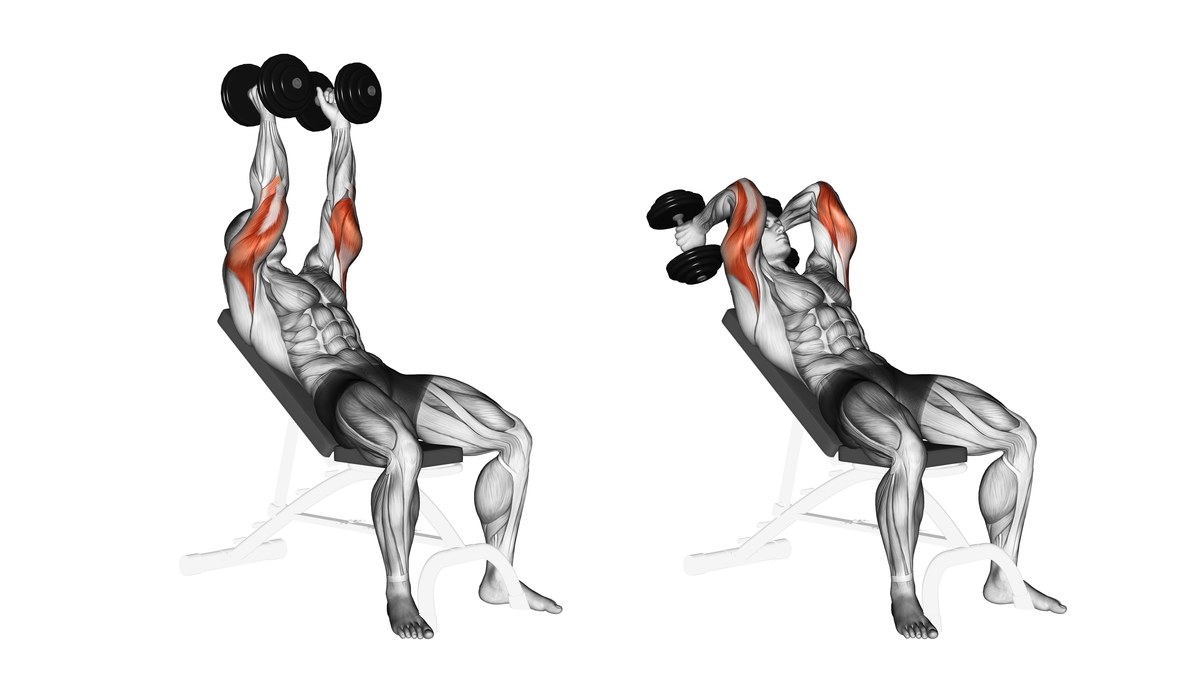
The overhead dumbbell extension needs no bench. The incline version supports your back but needs two dumbbells and an adjustable bench. Choose between them by the setup and elbow movement you can control.
For the overhead version, both hands support one end of the dumbbell. Keep the weight clear of your head as your elbows bend, and avoid leaning backward to finish. Use a dumbbell you can bring into position and lower afterward; check that any adjustable plates are secure. The overhead dumbbell guide covers the hand position and finish.
For the incline version, hold a separate dumbbell in each hand with palms facing each other. Lower beside your head at a depth you can control, keeping your back against the pad. Keep the bench angle consistent. Don't force either variation through pain.
There's a reason to consider an overhead position, but the equipment matters. Maeo and colleagues (2023) found greater triceps growth with overhead than neutral-arm extensions in 21 adults over 12 weeks. They used cables. That trial didn't compare overhead and lying dumbbell extensions, and its growth difference isn't a promise for either dumbbell exercise here.
Keep kickbacks controlled if you include them
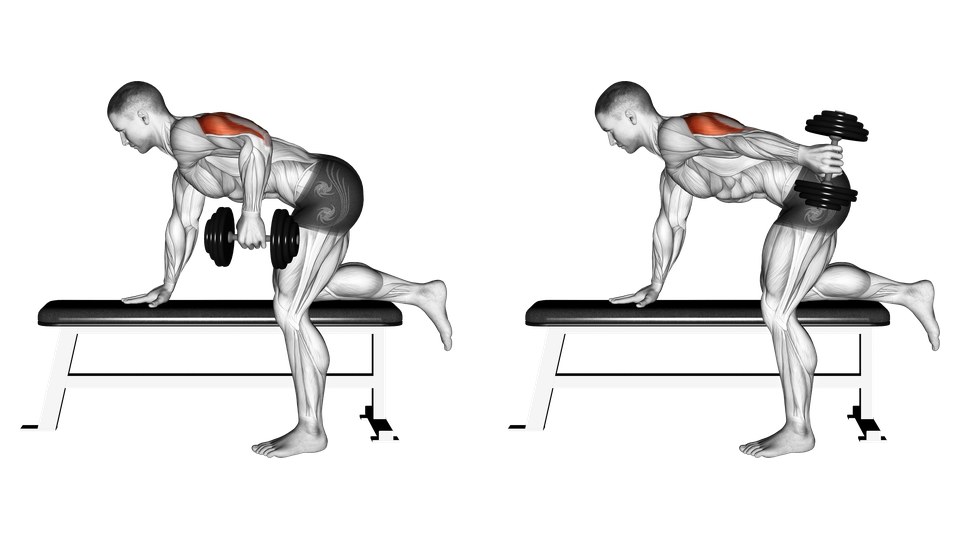
A kickback is optional extra work after your extension. The linked version uses a bench to support one hand and knee, so it isn't the no-bench substitute in this routine.
Keep the working upper arm beside your torso and straighten the elbow without swinging the shoulder. With a dumbbell, the leverage changes as the forearm rises toward the straight-arm position. Choose the load for that finish, rather than the easier bent-elbow start. Follow the kickback guide for the full setup.
Account for pressing before adding more triceps work
Chest and shoulder presses already involve elbow extension, so direct extensions aren't your triceps' only work. If your plan contains pressing, leave out this routine's optional floor press and try the extension alone first.
There's no need to convert every press into an exact fraction of a triceps set. Record direct sets separately from presses and use your performance to judge the addition. If your extension reps keep falling or your next pressing session suffers, check rest and load before adding another exercise.
For a complete chest-led session, use the chest and tricep workout. For a weekly home-training structure, use the dumbbell workout plan. This article helps you choose the triceps work within a plan; the triceps exercise hub lists other equipment options.
Add reps before increasing the dumbbell
Keep the same weight until every working set reaches the top of its range at a similar effort and with the same movement. For the two-set extension, an example is 12 and 11 reps, then later 15 and 15. That's a progression example, not a timetable.
Once both sets reach 15, try the smallest available increase. If you can't manage ten controlled reps, return to the previous weight. For kickbacks, reach the target on both sides before increasing, using the lower-performing side as your reference.
A 2026 trial by Kassiano and colleagues found greater triceps growth when load progressed than when load and reps stayed fixed in young women without recent resistance training. Both approaches produced growth. The study doesn't tell us how much an experienced lifter would gain from this routine.
If your dumbbells are too light and you can't increase them, try extending the extension range to 15–20 reps while keeping the sets challenging and controlled. That's an adjustment to this template. If the upper target remains easy, seek heavier equipment rather than adding easy sets indefinitely.
Keep the exercise name and loading convention consistent
Log the weight of one dumbbell throughout this routine. A 12 kg dumbbell held in both hands is 12 kg; two 6 kg dumbbells are logged as 6 kg. A simultaneous two-arm rep counts once. For kickbacks, record reps per side rather than adding left and right together.
Keep the overhead extension, incline extension and kickback under separate names. Changing the bench angle or moving from one shared dumbbell to two separate dumbbells changes what you're comparing.
In RepCount, create a routine manually and add the exercises you've chosen. Set the working-set counts, and put the rep ranges and loading convention in the exercise notes. Then log the weight and reps you actually complete. For example: Standing overhead extension. 2 × 10–15. One dumbbell held in both hands; log its weight.
If the exact variation isn't in your library, create a custom exercise with that name. Get RepCount for iPhone or Android to keep the routine and your completed sets together.
Frequently asked questions
Which dumbbell triceps exercise should I start with?
An overhead dumbbell extension is a practical starting choice if you can position one dumbbell securely and move it behind your head under control. An incline dumbbell extension is an alternative with back support if you have an adjustable bench. Choose one you can repeat consistently.
Can I train triceps with dumbbells without a bench?
Yes. The standing two-handed overhead dumbbell extension needs one dumbbell and no bench. A dumbbell floor press adds pressing work if your plan needs it. The bench-supported kickback and incline extension in this article are optional choices for a different setup.
Are overhead dumbbell extensions proven better than lying extensions?
The Maeo study cited here compared overhead and neutral-arm cable extensions, not overhead and lying dumbbell extensions. It found greater growth with the overhead cable position, but it doesn't establish a superiority ranking for the dumbbell versions.
Do I need direct triceps exercises if I already press?
Presses already involve the triceps, so check your existing chest and shoulder work before adding more exercises. If you want direct triceps work, try a small amount of one extension and assess your progress and recovery. The sample routine's optional press isn't an instruction to duplicate pressing you already do.
How should I log dumbbell triceps exercises in RepCount?
For this routine, enter the single dumbbell's weight for a two-handed overhead extension, and the weight per dumbbell when using a pair. Count a simultaneous two-arm repetition once. Save the convention and setup in RepCount's notes, and keep different variations under separate exercise names.