
Incline dumbbell triceps extension
Also called incline tricep extension, incline dumbbell tricep extension.
What is an incline dumbbell triceps extension?
An incline dumbbell triceps extension is an elbow-straightening exercise done with your back on a tilted bench and one dumbbell in each hand. Lower the weights beside your head, then straighten your arms while keeping your upper arms pointing up. It trains the triceps brachii. This guide uses two separate dumbbells, rather than one weight held in both hands.
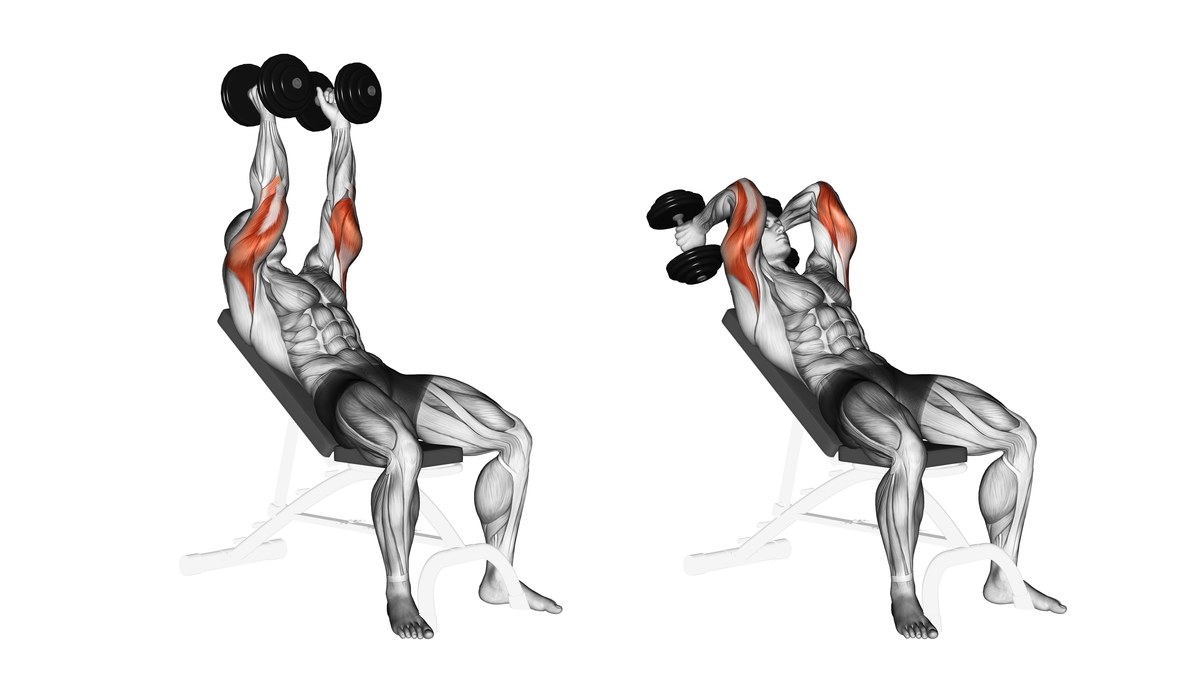
How do you perform an incline dumbbell triceps extension?
Set up
- Choose light dumbbells and lock the bench at a moderate incline. Sit down with the weights on your thighs, then lean back with your back supported and both feet planted.
- Bring the weights above your shoulders, keeping a separate dumbbell in each hand. Face your palms toward each other and straighten your arms without lifting your back from the pad.
Execution
- Bend both elbows to lower the dumbbells beside your head, keeping your upper arms aimed upward.
- Stop at a depth you can control, leaving room between the weights, your head and the bench.
- Straighten your elbows to return the weights above your shoulders without driving your upper arms forward into a press.
- Repeat with the same arm position. Finish by bringing the dumbbells to your chest, then sit up and settle them on your thighs before putting them down.
Common mistakes
Turning the return into an incline press
If your upper arms swing forward on each return, reduce the load and keep them aimed upward while your elbows straighten.
Dropping into the bottom position
Slow the last part of the descent so you can change direction without bouncing or hitting the bench. Shorten the descent if you cannot keep control.
Choosing weights you cannot put down under control
Use dumbbells light enough to bring back to your chest and thighs at the end. Practise the finish before starting a working set.
Where it fits in a session
Use it as triceps work in an upper-body or arm session.
Start with a load that lets you repeat the same path on both sides and finish the set under control. Keep the bench setting consistent when comparing your sessions.
Muscles worked
Primary
Secondary
- None listed in this guide
Schematic surface view. Some muscles are partly visible or not shown.
The triceps brachii straightens the elbow. This names the main muscle's role in the movement, without ranking its long, lateral and medial heads.
Variations
- Triceps extensionThe broader guide covers lying and overhead extensions; this page fixes the setup to an inclined bench and two dumbbells.
- Overhead triceps extensionThe linked guide uses a standing EZ-bar, with the weight lowered behind the head.
Frequently asked questions
What muscles does the incline dumbbell triceps extension work?
The main target is the triceps brachii, which straightens your elbow. Its long, lateral and medial heads all contribute to elbow extension; this guide does not rank them.
What angle should the bench be?
Begin with a moderate incline between flat and upright. Check with light dumbbells that your back stays on the pad and the weights can pass beside your head. The illustrated angle is one setup choice, not a required number.
Is this the same as a lying dumbbell triceps extension?
The elbow action is the same, but this version raises the backrest instead of using a flat bench. Keep the exercises separate in your training notes so you can compare the same setup.
Do I hold one dumbbell or two?
Use two, with a separate dumbbell in each hand and your palms facing inward. Holding one dumbbell in both hands is a different setup and is not the version pictured here.
How far should I lower the weights?
Lower only as far as you can keep your upper arms aimed upward and control the return. Leave clearance beside your head and above the bench. A weight touching your body is not the goal.
Sources
- Manpreet S. Tiwana, Margaret A. Sinkler and Bruno Bordoni. Anatomy, Shoulder and Upper Limb, Triceps Muscle. StatPearls, updated August 28, 2023. https://www.ncbi.nlm.nih.gov/sites/books/NBK536996/