
Overhead dumbbell triceps extension
Also called two-hand dumbbell triceps extension, overhead dumbbell tricep extension.
What is an overhead dumbbell triceps extension?
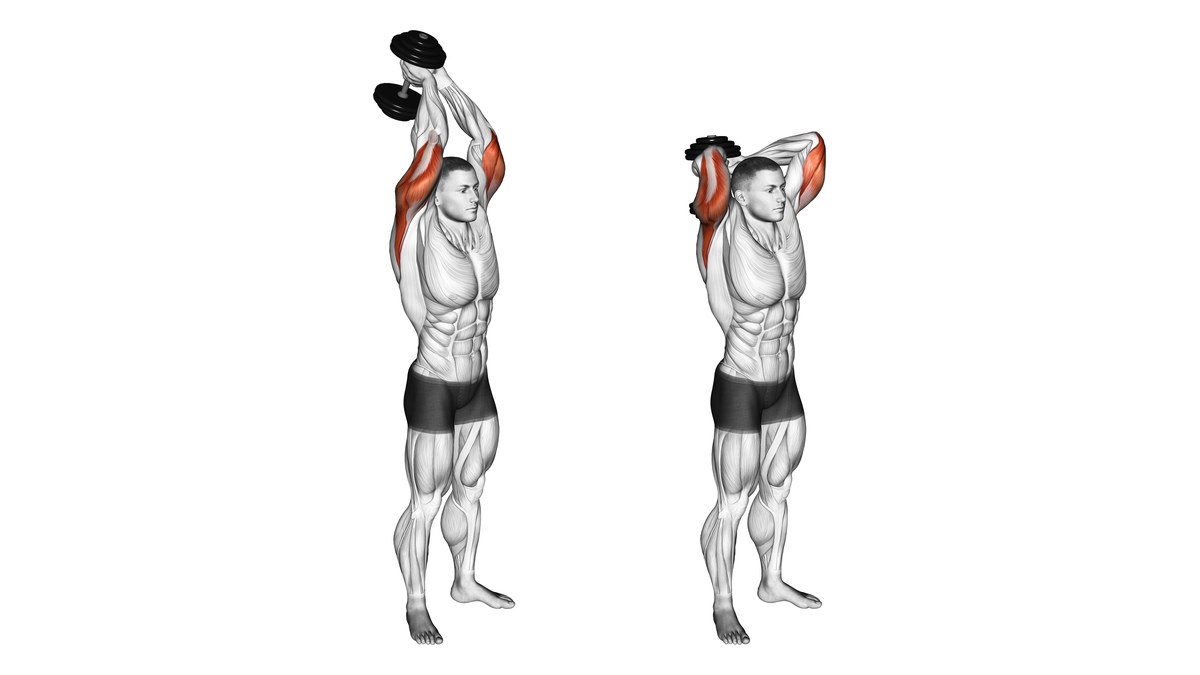
An overhead dumbbell triceps extension uses one dumbbell held in both hands above the head. You bend the elbows to lower it behind your head, then straighten the arms. This guide teaches the standing version with both hands supporting the same end of the dumbbell.
How do you perform an overhead dumbbell triceps extension?
Set up
- Choose a dumbbell you can position overhead securely. Stand with your feet comfortably apart and cup both hands under one end, checking that the dumbbell and any adjustable plates are secure.
- Bring the weight above your head with help if needed. Keep your torso upright and your upper arms beside your head, with the elbows pointing generally upward.
Execution
- Bend both elbows and guide the dumbbell down behind your head without dropping it onto your neck.
- Stop at a depth you can control while keeping your torso upright and your upper arms near their starting position.
- Straighten both elbows to lift the dumbbell overhead again without leaning backward.
- Finish by lowering the weight carefully to the front of your body with both hands; use help for the handoff if needed.
Common mistakes
Using a weight that is difficult to get into position
Choose the load for the whole set, including the overhead entry and exit. A lighter dumbbell or controlled handoff is preferable to struggling above your head.
Leaning backward to raise the dumbbell
Keep the torso upright. Reduce the weight or depth if you cannot extend the elbows without arching back.
Forcing both elbows tightly together
Keep a comfortable elbow spacing rather than squeezing the upper arms against the head. Maintain control as the weight moves behind you.
Where it fits in a session
Use it where your session calls for triceps accessory work.
Choose the load for controlled repetitions from setup through the last return. Keep the same movement as the set becomes harder; reduce the weight if you have to change the path.
Muscles worked
Primary
Secondary
- None listed in this guide
Schematic surface view. Some muscles are partly visible or not shown.
The triceps brachii extends the elbow; no individual head is ranked.
Variations
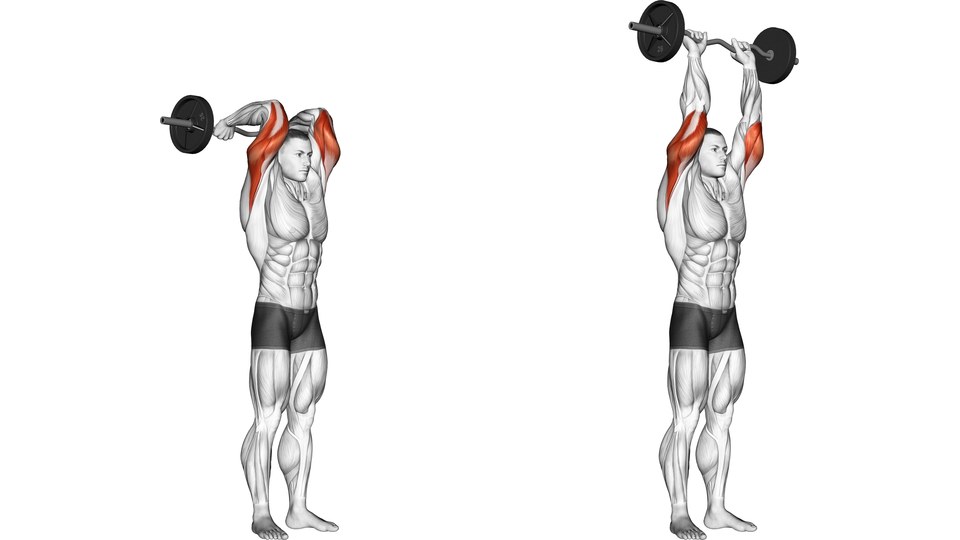
- Barbell overhead triceps extensionUses a bar held with two hands rather than one dumbbell cupped at an end.
Frequently asked questions
Do you use one dumbbell or two?
One dumbbell held with both hands. A separate dumbbell in each hand, or a one-arm extension, is a different setup and is not the version shown here.
Can you do it seated?
Yes. A seated version keeps the shared dumbbell and overhead elbow movement. Sit securely with the feet supported and leave room behind your head; do not assume that sitting removes the need to control your torso.
How far should the dumbbell go behind your head?
Lower only as far as you can keep the weight secure, clear of your head and under control. You do not need to reach a fixed spot on your back.
How close should the elbows be?
Use a comfortable spacing with the upper arms beside the head. Avoid forcing the elbows to touch or letting them move widely as a way to finish a repetition.
What muscles does it train?
The triceps brachii straightens the elbow. The overhead position does not turn this into a shoulder press: keep the upper arms near their starting position and move through the elbows.
Sources
- Tiwana MS; Sinkler MA; Bordoni B. Anatomy, Shoulder and Upper Limb, Triceps Muscle. StatPearls. https://www.ncbi.nlm.nih.gov/sites/books/NBK536996/