
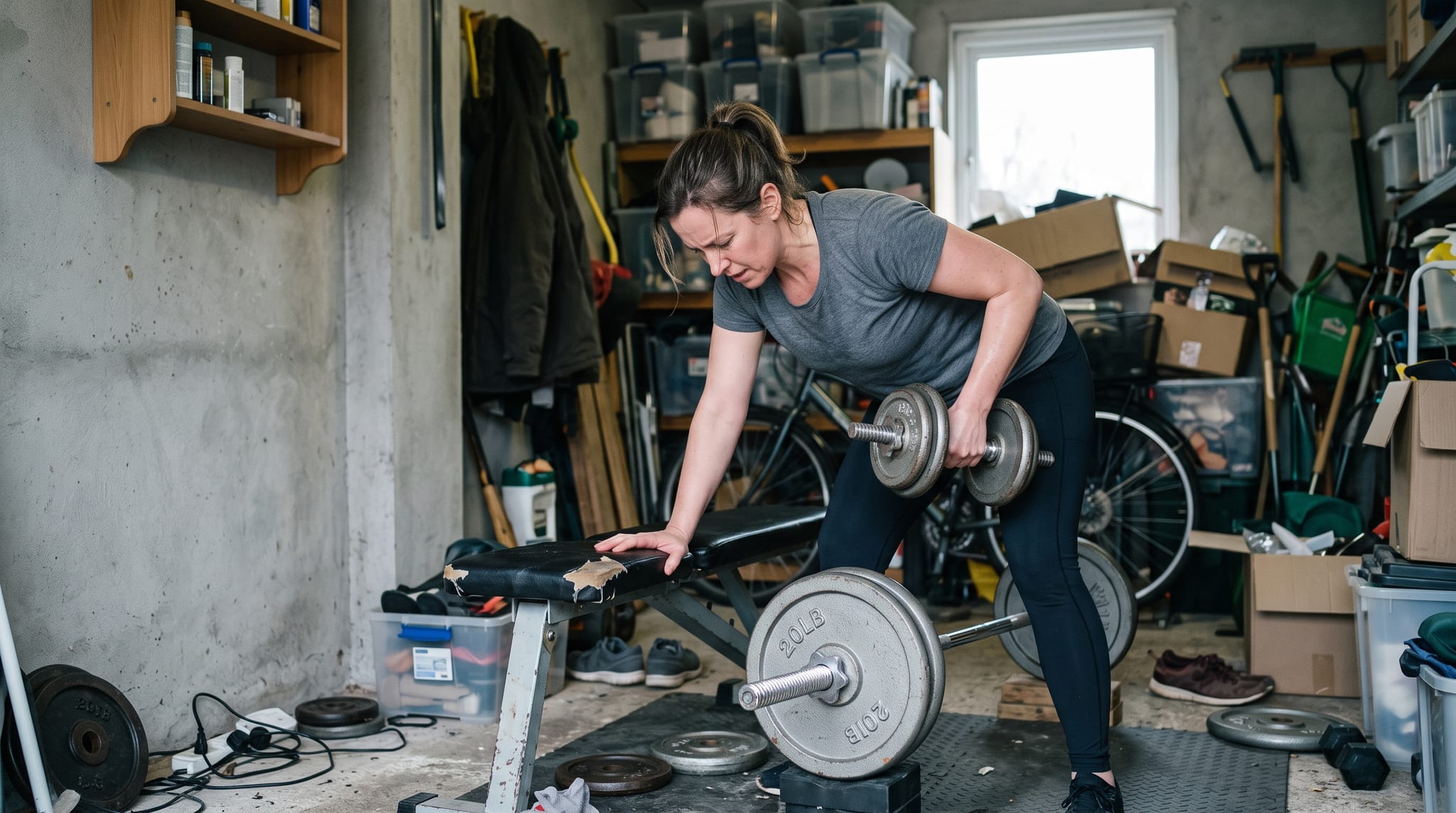
Postpartum strength training: how to progress
Postpartum strength training should progress from what you can manage now, with small changes guided by healing and your response to exercise. Start with a version you can control, then adjust support, range of motion, reps or weight separately. Record how the work felt as well as what you lifted.
That last part matters. Eight squats with hand support and eight unsupported squats are different sessions, even if the numbers in the log look identical. A useful training record keeps that difference visible.
For a repeatable starting template, the postpartum workout plan puts these decisions into two short strength sessions.
When can postpartum strength training start?
There isn't one starting date for every birth or every exercise. Gentle movement after an uncomplicated delivery and returning to demanding lifting are different decisions.
ACOG's guidance on exercise after pregnancy allows an early return to activity after a healthy pregnancy and uncomplicated vaginal delivery when you feel ready. After a caesarean birth or complications, ACOG recommends asking your obstetrician when it's safe to restart. Stop exercise if it causes pain.
The 2025 Canadian postpartum activity guideline supports light activity early, with a gradual return to more demanding exercise once incisions or tears have healed sufficiently and activity doesn't increase postpartum bleeding. It calls for progression based on the individual and their symptoms.
An appointment on the calendar doesn't establish your starting weight. Follow any restrictions from your maternity team, particularly after surgery or complications, and ask about the activities you actually want to do. "Can I begin light resistance exercise?" is more useful than assuming "exercise is fine" covers a heavy barbell session.
The examples below are for planning strength work when it's appropriate for your recovery. They aren't a rehabilitation prescription or a timetable for the first weeks after birth.
Does postpartum core training need to target the transversus?
The transversus abdominis is one part of the abdominal wall. Training it can be part of a return to movement, but finding an exercise labelled "deep core" doesn't tell you whether that exercise suits your current recovery.
The POGP's advice after childbirth includes gentle abdominal work, then options such as a heel slide or allowing one bent knee to move out to the side while the pelvis stays still. It also describes progressing these movements gradually. That gives you ways to practise before attempting a more demanding dead bug.
Be wary of treating the abdominal gap as your whole training score. Beamish and colleagues' 2025 review found low-certainty evidence that abdominal training reduced the distance between the abdominal muscles. A 2026 updated review found no significant improvement in that measurement from exercise focused on the transversus compared with minimal or no intervention. Those findings don't support a promise that a particular exercise will "close the gap."
Nor do they justify banning abdominal exercise indefinitely. In Gluppe and colleagues' 2023 trial, a curl-up program improved abdominal strength without worsening the gap in women six to twelve months postpartum. That population matters: the trial doesn't establish readiness for curl-ups immediately after birth.
Pelvic floor training deserves its own attention. Beamish's review found better evidence for reducing the odds of urinary incontinence with pelvic floor muscle training. Technique includes letting the muscles relax fully between contractions, as the POGP explains. If you can't comfortably contract and relax, get help with pelvic floor relaxation rather than simply squeezing harder.
Change one part of the exercise at a time
Make the next step small enough that you can tell what changed. You don't need to increase weight to make an exercise more demanding.
These are practical coaching examples, not a tested postpartum sequence. Choose the adjustment that fits the exercise and any advice you've been given.
| Adjustment | What it might look like | What to keep consistent |
|---|---|---|
| Support | Use slightly less hand assistance during a squat | Depth, reps and added weight |
| Range of motion | Squat a little lower, or slide a heel a little farther | Support and number of reps |
| Repetitions | Add a controlled rep to a set | Setup, range and weight |
| Load | Try a slightly heavier dumbbell | Exercise version and intended reps |
For example, begin a bodyweight squat with a stable support and a comfortable depth if that is the version you can manage. Write down the support and depth. When that version is repeatable without new or worsening symptoms, you could try less assistance while keeping everything else the same.
For an incline push-up, the height of the hand support is part of the exercise. Lowering it makes the task more demanding. Record the surface you used, rather than logging "push-up" and losing the detail that explains your performance.
Reps are another option. An illustrative target might be two sets of six to eight controlled reps, stopping with a few more comfortable reps available. If that is already too demanding, reduce it. You don't have to finish the target to make the session count.
When you reach the top of a chosen range comfortably and can repeat it, consider a small load increase. You may need fewer reps with the new weight. There is no universal kilogram jump or weekly increase that proves you're recovering correctly.
Adding another set is a separate increase in work. Leave it out while testing a new weight or exercise version. Changing everything together makes it harder to understand an uncomfortable response.
Check your response after the session too
How an exercise feels during a set is only part of the decision. Check again later and before the next session, particularly after trying something more demanding.
Selman and colleagues' 2022 rehabilitation commentary emphasises monitoring for delayed symptoms when returning to sport. Its progression suggestions are expert rehabilitation guidance, not proof that a particular waiting period makes every strength exercise safe.
Use a simple question: did this session make pain, pelvic pressure, leakage or other recovery symptoms worse? If so, don't increase the next session simply because you completed the reps. Record what changed and choose a more manageable version or seek advice.
A demanding day outside training belongs in that decision too. You can repeat an easier session, do less work or rest. The log should help you choose an appropriate session, not become another target you have to obey.
A session log can show progress without a weekly deadline
Progress is easier to judge when the exercise setup stays consistent. The example below shows possible decisions for someone already ready for this squat variation. The numbers are illustrative, and the sessions aren't assigned to consecutive days or weeks.
| Session | Actual work | Note that explains the numbers | Possible next decision |
|---|---|---|---|
| A | Two sets of six bodyweight squats | Light hand support; same chair depth; controlled and comfortable | Repeat the setup |
| B | Two sets of seven | Same support and depth; comfortable during and after | Consider one more rep |
| C | Two sets of eight | Same setup; no new symptoms during or after | Repeat before changing difficulty |
| D | Two sets of six holding 2 kg | Same depth; new load; stopped with comfortable reps available | Assess the response, then repeat |
Session D has fewer reps than session C. That isn't automatically a setback: the weight changed. Equally, completing more reps with a shallower squat wouldn't prove greater strength. Context makes the comparison useful.
If less hand support is your next goal, change that instead of adding the dumbbell. And if symptoms appear, the next entry may be an easier variation. You haven't failed a progression schedule. You've recorded information that changes the plan.
Use RepCount's set notes to keep the useful context
RepCount lets you record free text notes on individual sets on both iOS and Android. Put the detail beside the set it describes, rather than relying on memory to explain a number next week.
Start by adding the exercises you're using to a routine. Create a custom exercise if one isn't in your list, and give different variations names you can recognise. A "supported chair squat" entry makes a clearer reference than mixing it indiscriminately with another squat version.
During training, record the actual reps and any added weight. Use Notes on the relevant set for details such as:
- "Chair squat, light hand support; stopped after six because movement felt less controlled."
- "Hands on kitchen counter; eight reps felt comfortable; no leakage or pelvic pressure."
- "Stopped at rep five because of pelvic heaviness. No further sets of this exercise today."
Write or update the note for today's set. Check any carried-forward text before saving, especially when the note describes symptoms. An old "felt comfortable" note is a poor record of a set you stopped early.
Keep later observations in the workout's Notes, for example: "Evening check: new pelvic heaviness after today's session; return to previous version and arrange advice." Record observations plainly, without trying to diagnose their cause.
Set notes can also hold your own effort description, such as "a few more reps available." This is free text you enter. RepCount doesn't assess postpartum recovery, interpret symptoms or prescribe the next increase.
When planning the next session, compare the exercise version and notes alongside the numbers. A useful question is "Can I repeat this comfortably?" before "Can I beat it?"
Know when to hold, step back or get help
Leakage, pelvic heaviness, bulging or pain are reasons to stop the provoking exercise and reassess it. NHS Fife's abdominal exercise guidance recommends stepping back or contacting a physiotherapist when progressing causes these problems. Persistent or recurring symptoms warrant individual advice.
| What you notice | A useful next action |
|---|---|
| The current version feels controlled, with no new symptoms during or after | Repeat it, or consider one small change |
| A harder version brings on symptoms | Stop that version; use an easier option only if comfortable |
| Symptoms recur, persist, or affect daily activities | Arrange a pelvic health assessment or speak to your maternity team |
| Exercise increases postpartum bleeding | Stop and contact your maternity team before continuing |
If abdominal "doming" is persistent, uncomfortable or difficult to control, reduce the movement and ask a pelvic health physiotherapist to assess it.
Some symptoms need urgent care rather than a training adjustment. Stop and seek urgent medical help for heavy bleeding, chest pain, trouble breathing, fainting or severe abdominal pain. The CDC's maternal warning signs can occur during the year after birth. Don't wait for a note or your next workout to address them.
Keep the next training decision small and specific. Repeat what works, record what changes, and get help when symptoms need an assessment. RepCount for iOS and Android can keep the numbers and set notes together while you rebuild a routine that fits your recovery.
Frequently asked questions
When can I start postpartum strength training?
The starting point depends on healing, symptoms and the type of delivery. Gentle movement can begin earlier than demanding lifting after an uncomplicated birth. After a caesarean or complications, ask your maternity team when and how to restart. A six-week appointment is not a universal clearance for every exercise or weight.
How do I know when to increase weight after pregnancy?
Consider a small increase when the current exercise is repeatable with controlled movement, comfortable breathing and no new or worsening symptoms during or after training. Keep the exercise setup consistent and change one variable at a time. More weight is an option, not a requirement for every session.
Will transversus abdominis exercises close diastasis recti?
There is no guaranteed exercise cure. Reviews report mixed findings on the distance between the abdominal muscles, and a 2026 review found no significant benefit from exercise focused on the transversus for that measurement. Comfortable movement, strength and function are useful goals; persistent concerns deserve an individual assessment.
What should I write in RepCount's per-set notes?
Use the Notes field on the relevant set to record the setup, effort and what happened during that set. For example: 'Hands on kitchen counter; eight controlled reps; no leakage or pressure.' Check any carried-forward text so the note describes today's set. Later observations can go in workout Notes.
Should I push through leakage or pelvic heaviness?
Stop the exercise that brings on leakage, pelvic heaviness, bulging or pain. Use a more manageable version where appropriate, and get advice from a pelvic health physiotherapist or your maternity team if symptoms persist or recur. Heavy bleeding, chest pain or trouble breathing need urgent medical attention.