Bodyweight squat
Also called air squat, unweighted squat, body squat.
What is a bodyweight squat?
A bodyweight squat is an unloaded squat performed with both feet on the floor. You lower by bending your hips, knees and ankles, then stand again without holding or wearing extra weight. It trains the quadriceps, gluteus maximus and adductor magnus, with the soleus assisting at the ankle. A barbell back squat, goblet squat or dumbbell squat uses the same general pattern but adds an external load and is a different exercise variation.
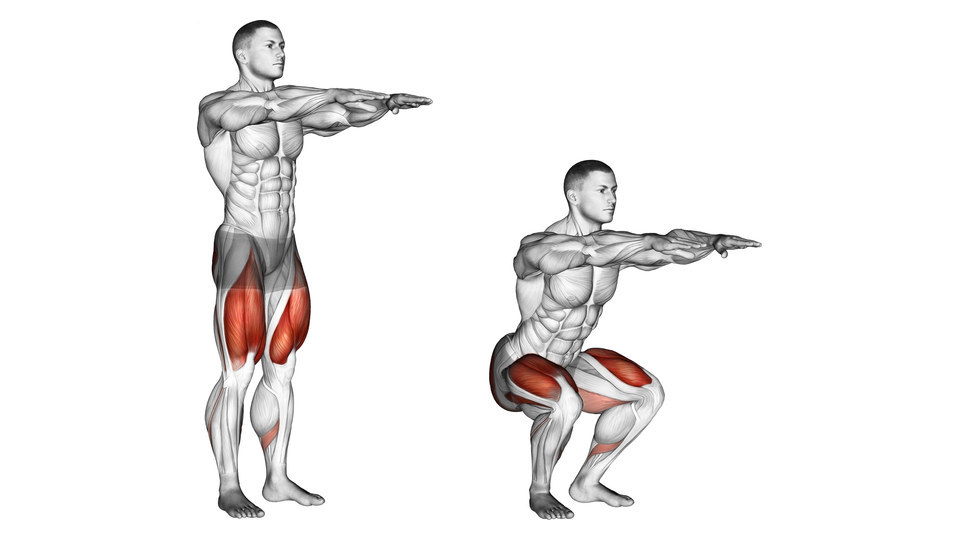
How do you perform a bodyweight squat?
Set up
- Stand with your feet around shoulder width and turn your toes slightly out to a comfortable angle.
- Keep your whole foot on the floor, stand tall, and reach your arms forward for balance.
Execution
- Bend your hips, knees and ankles together to lower between your feet, letting your knees follow the direction of your toes.
- Go only as low as you can while keeping your whole foot down and the movement controlled.
- Push the floor away and straighten your hips and knees to stand, then reset before the next rep.
Common mistakes
Letting the heels or inside edges of the feet lift
That makes the base less stable and shifts your balance as you descend. Shorten the range or adjust your stance until the whole foot can stay in contact with the floor.
Letting the knees collapse toward each other
The knees no longer follow the feet, which makes it harder to keep a consistent path. Let them move in the same direction as the toes.
Chasing the depth shown in the illustration
The picture shows one person's deep bottom position, not a required depth. Stop sooner if going lower lifts your heels, tips you off balance or makes you lose control.
Folding the chest toward the floor
Some forward lean is normal, but dropping the chest turns the descent into a balance problem. Keep looking ahead and let the hips and knees share the movement.
Where it fits in a session
Use it wherever an unloaded squat fits the session: as the main lower-body movement in a bodyweight workout, as technique practice or before a loaded squat.
Choose a range you can repeat with the whole foot down and the same balance from rep to rep. If the movement needs to be easier, hold a stable support or squat to a higher target. If you intentionally add a dumbbell, kettlebell or barbell, log the matching loaded variation rather than this bodyweight record.
Muscles worked
- quadriceps
- gluteus maximus
- adductor magnus
- soleus
The quadriceps extend the knees while the gluteus maximus and adductor magnus help extend the hips; the soleus assists as the ankle moves. Exact demands change with stance, depth and trunk angle, so this list describes the standard movement rather than promising the same distribution in every squat. The hamstrings may be active, but they are not listed as a target because agreement across the movement-specific check sources puts them outside the main muscle list.
Variations
- Assisted bodyweight squat — Hold a stable rail or suspension straps for balance while keeping the same unloaded squat pattern.
- Box squat to a bench — Use a stable bench or box as a clear depth reference, sitting lightly before standing again.
- Goblet squat — Hold a dumbbell or kettlebell at the chest, adding an external load to the squat.
- Barbell back squat — Rest a barbell across the upper back and squat inside a rack; the added load changes both setup and demand.
Frequently asked questions
What muscles do bodyweight squats work?
The quadriceps extend the knees, while the gluteus maximus and adductor magnus help extend the hips as you stand. The soleus assists at the ankle. Stance, depth and torso position can change how the work is distributed, so no single muscle ranking fits every person or rep.
How deep should a bodyweight squat be?
Use the deepest range in which your whole foot stays down and you can reverse the movement under control. The illustration shows a deep squat, but that endpoint is not a pass-fail standard. Ankle, hip and knee motion all contribute to depth, and individual proportions and mobility differ.
Can my knees move past my toes?
Yes. The knees normally move forward as the hips, knees and ankles bend, and how far they travel depends on your stance and proportions. Focus on keeping the whole foot down and letting each knee follow the direction of its toes rather than forcing the shins to stay vertical.
Why are the arms held forward?
Reaching forward helps balance the hips moving back and can make an unloaded squat easier to control. The arms are not providing resistance; they are simply a counterbalance.
Is a bodyweight squat the same as a barbell squat?
They share the basic squat pattern, but they are not the same exercise record. A bodyweight squat has no external load and needs no rack. A barbell back squat adds a bar across the upper back, along with a rack, safety setup and bracing demands that do not belong in this beginner guide.
How can I make a bodyweight squat easier?
Hold a stable rail or suspension straps for balance, or squat to a firm bench or box that limits the range. Keep the same foot contact and knee direction, then lower the target or use less hand support when the movement feels controlled.
Sources
- Straub RK, Powers CM. A Biomechanical Review of the Squat Exercise: Implications for Clinical Practice. Int J Sports Phys Ther. 2024. https://pubmed.ncbi.nlm.nih.gov/38576836/
- Lee TS, Song MY, Kwon YJ. Activation of back and lower limb muscles during squat exercises with different trunk flexion. J Phys Ther Sci. 2016. https://pmc.ncbi.nlm.nih.gov/articles/PMC5276771/
- Sato T, et al. Relationship among the COM Motion, the Lower Extremity and the Trunk during the Squat. Prog Rehabil Med. 2024. https://pubmed.ncbi.nlm.nih.gov/39132411/