Dead bug
Also called deadbug, dead bugs.
What is a dead bug?
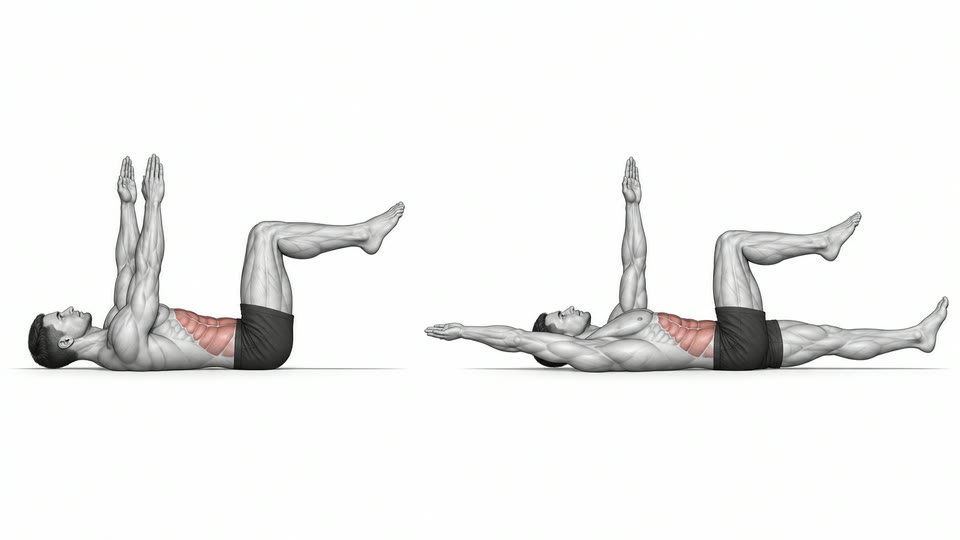
A dead bug is a floor exercise in which you reach one arm and the opposite leg away from your body while keeping your torso still. You return to the start and change sides. The abdominal muscles work while the limbs move.
How do you perform a dead bug?
Set up
- Lie on your back with your head resting on the floor. Raise your arms toward the ceiling and bring your knees above your hips, bent to about a right angle.
- Gently tighten your abdomen so your lower back rests against the floor without forcing it down. Keep breathing in this position.
Execution
- Reach one arm overhead while straightening the opposite leg away from you. Move only as far as you can without lifting your lower back or turning your pelvis.
- Bring the arm and leg back to their starting positions together.
- Repeat with the other arm and leg, moving slowly enough to keep your torso quiet.
Common mistakes
Reaching all the way to the floor at any cost
Shorten the reach when your back begins to arch. The hand and heel do not need to touch down.
Rushing the change of sides
Return to the starting position before extending the next pair of limbs.
Holding a long breath
Keep a gentle brace that still allows you to breathe; shorten the set if you cannot.
Where it fits in a session
Use it during a warm-up or alongside other trunk exercises.
Choose a reach you can repeat while breathing and holding your back position. Extend farther before adding external resistance.
Muscles worked
Primary
Secondary
- None listed in this guide
Schematic surface view. Some muscles are partly visible or not shown.
Variations
- Heel-tap dead bug — Keeps the knees bent and lowers one heel at a time, with the arms pointing upward.
- Leg-only dead bug — Keeps both arms still while you extend one leg at a time.

Frequently asked questions
Does the lower back have to stay down?
For this version, keep gentle contact with the floor. If reaching farther lifts your back, shorten the movement or try heel taps with bent knees.
Should the head come off the floor?
Keep the head resting comfortably. Lifting it is an additional variation, not a requirement for coordinating the opposite arm and leg.
How do you count dead bugs?
Count each arm-and-opposite-leg reach as one repetition, or count a left-right pair. Choose one convention and keep it consistent in your training log.
Sources
- Souza GM, Baker LL, Powers CM. Electromyographic activity of selected trunk muscles during dynamic spine stabilization exercises. 2001. https://pubmed.ncbi.nlm.nih.gov/11689975/
- William Flynn; Paula Vickerton. Anatomy, Abdomen and Pelvis: Abdominal Wall. 2023. https://www.ncbi.nlm.nih.gov/books/NBK551649/