
Incline push-up
Also called incline push up, elevated push-up, bench push-up.
What is an incline push-up?
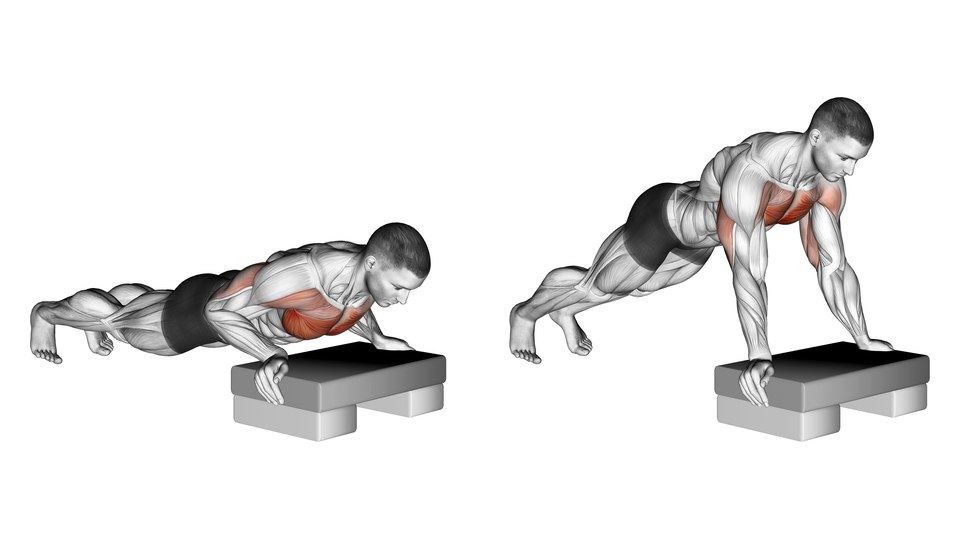
An incline push-up is a bodyweight press performed with your hands on a stable bench or box and your toes on the floor. Keep your body in one line as you lower your chest toward the raised surface, then press back to straight arms.
How do you perform an incline push-up?
Set up
- Face a stable bench or box that will not slide, and place your hands just outside shoulder width.
- Walk your feet back onto your toes until your arms are straight and your head, hips and heels form one line. Brace your midsection.
Execution
- Bend your elbows diagonally back and lower your chest toward the raised surface while your body moves as one unit.
- Stop when your chest is close to the surface, or sooner if you cannot keep the same body line.
- Press through your hands until your elbows are straight, then settle before the next repetition.
Common mistakes
Using a surface that can move
A sliding or tipping support makes the hand position unreliable. Test the bench or box before starting.
Letting the hips sag or rise
The movement stops being a straight-body push-up when the hips move separately from the shoulders and heels.
Leading with the head
Reaching the chin forward creates the appearance of depth while the chest and torso remain high.
Where it fits in a session
As the main bodyweight press when floor push-ups are not yet repeatable, or as a lighter pressing variation later in a session.
Choose a surface height that lets you reproduce the same body line and range. Move to a lower stable surface only while those repetitions remain controlled.
Muscles worked
Primary
Secondary
Schematic surface view. Some muscles are partly visible or not shown.
The chest drives the press while the front of the shoulders assists and the triceps straighten the elbows.
Variations
- Higher incline push-up — Uses a taller stable surface when the low-box version does not yet allow controlled repetitions.
- Lower incline push-up — Uses a shorter stable surface as a step toward the floor version.
- Kneeling incline push-up — Keeps the hands raised but places the knees on the floor to shorten the body lever.
Frequently asked questions
What muscles do incline push-ups work?
They mainly train the pectoralis major, with the anterior deltoids assisting at the shoulders and the triceps straightening the elbows.
How high should the bench or box be?
Use a height that lets you lower the chest toward the surface without the hips sagging or rising. A taller surface is an option when a lower one does not yet allow that shape.
Should your chest touch the bench?
It does not have to. Bring the chest close to the surface while the body stays aligned, and stop earlier if contact would require the head to reach forward or the hips to sag.
Are incline push-ups easier than floor push-ups?
They are commonly used as the step before a floor push-up. Start high enough to control the full repetition, then lower the hand support gradually as that becomes repeatable.
Can you use a chair for incline push-ups?
Use only a support that is stable, broad enough for both hands and unable to slide or tip. A sturdy bench or box is the standard setup covered here.