
Dumbbell biceps exercises and a simple workout
Start with a standing dumbbell curl and finish with a hammer curl. That gives you a palms-up curl and a thumbs-up curl with the same pair of weights. If you have an adjustable bench, you can do incline curls in place of the standing curls.
The two exercises can land at different points in the rep range. If your dumbbells give you 12 standing curls and nine hammer curls, you’ve got a starting point for both. Track them separately and build from the reps you can do today.

A two-exercise dumbbell biceps workout
Use this as a starting template. Pick one curl for the first row and finish both sets before moving on to hammer curls.
| Exercise | Working sets | Reps per arm | Rest between sets |
|---|---|---|---|
| Standing dumbbell curl or incline dumbbell curl | 2 | 8–15 | About 2 minutes |
| Standing hammer curl | 2 | 8–15 | About 2 minutes |
Take a few easy practice reps before your first working set. Finish each set when you think you could do about two more reps with the same range of motion. If your last rep starts with a shove from your hips or ends with the weight dropping to your side, finish a rep earlier next time.
If you train one arm at a time, do both sides before taking the full rest. Two minutes is a starting point. If your first set goes well and the second ends early because your grip is still tired, give yourself a little longer between sets next session.
Already doing rows or pulldowns? Put the curls after those exercises and use the four sets in place of any curls you already do that day. Compare sessions with a similar amount of pulling beforehand. Ten curls after a hard set of rows can tell you something different from ten curls when you’re fresh. Back and biceps workout
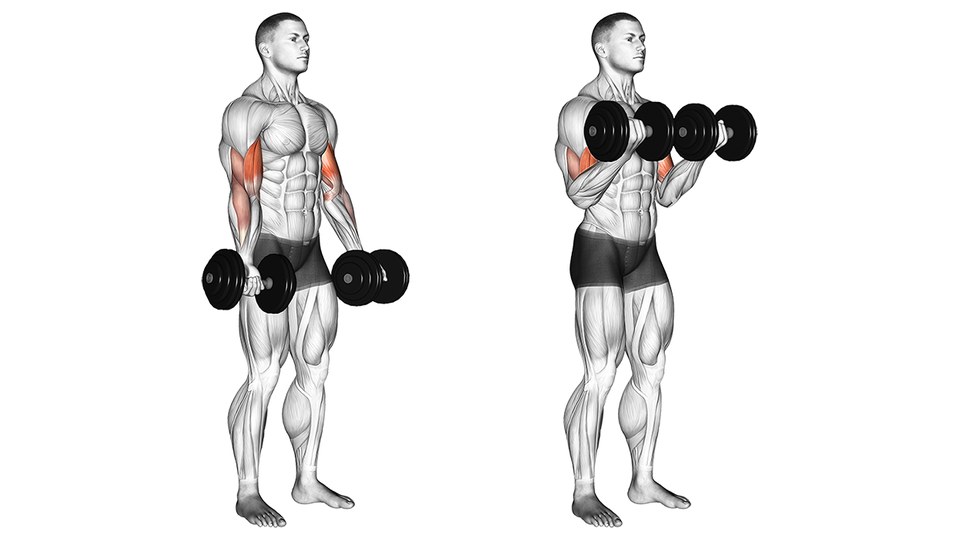
Start with the standing dumbbell curl
Choose this when you want a palms-up curl you can set up anywhere. Stand with a dumbbell at each side and your palms facing forward. Bend your elbows to bring the weights toward your shoulders, keeping your wrists in line with your forearms. Lower until your arms are straight again and start the next rep from there.
The part to watch is the start of the lift. As you tire, it’s easy to lean back a little before the dumbbells leave your sides. If you’re unsure whether you’re doing it, film one set from the side and compare the first and last reps. Use the rep count you can reach while staying upright as your starting point. Standing dumbbell curl guide
Use hammer curls for a palms-in grip
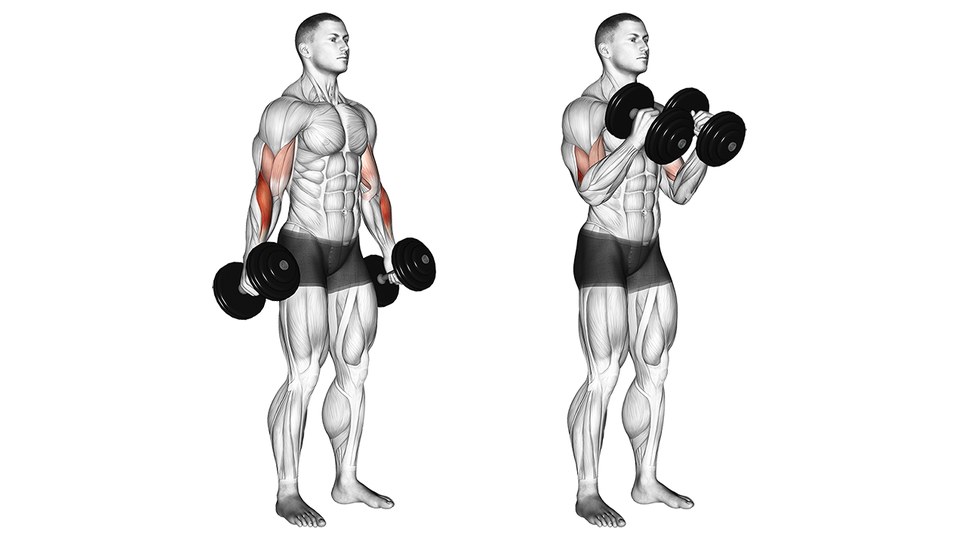
Hold the dumbbells with your palms facing your thighs. Curl with your thumbs leading and keep your palms facing each other as you lift and lower. The biceps still helps bend your elbow, along with the brachialis in your upper arm and the brachioradialis in your forearm.
Hammer curls are the second exercise in this workout. They can also be your first choice if turning your palms up feels awkward. In that case, start with two sets of hammer curls and leave the second row out. Give that grip a few sessions so you can see how it feels and how your reps change. Hammer curl guide
In a 2023 study, the biceps and brachioradialis showed more electrical activity as lifters raised a palms-up cable bar than as they raised a palms-in rope. That tells us how the muscles responded during the lift. Which grip builds more muscle over time with dumbbells remains an open question. Coratella and colleagues, 2023
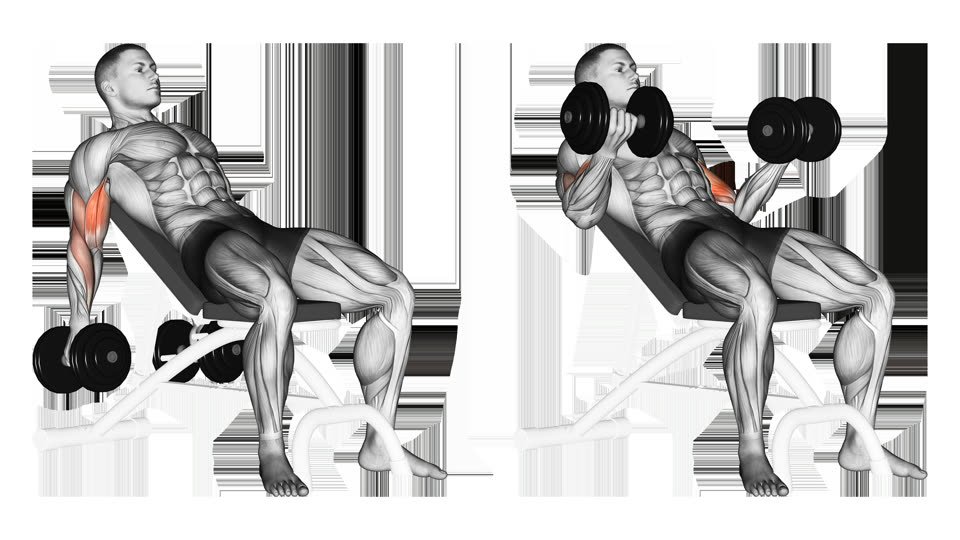
Try incline curls when you have a backrest
Choose the incline curl if you like having a pad to keep your torso in place. Set the backrest to a moderate incline, plant your feet and let your arms hang beside the bench. Because you’re leaning back, your upper arms start slightly behind your torso. Curl with your palms up and your back against the pad. End the lift before your shoulders roll forward to bring the weights higher.
If the bottom position is uncomfortable, raise the backrest a notch and try again. Pick an angle that lets you lower each rep smoothly. Record the bench setting so you can use it again. If you’re switching from standing curls, let the first incline session establish a new rep count. Incline dumbbell curl guide
Does that change where you gain muscle? In a 12-week study, 21 untrained adults did incline dumbbell curls with one arm and preacher dumbbell curls with the other. MRI showed more biceps brachii growth on the incline side and more brachialis and brachioradialis growth on the preacher side. Total growth across the elbow flexors showed no clear difference. Standing curls weren’t part of the trial, so choose between standing and incline curls by the setup you can use comfortably and consistently. Kobayashi and colleagues, 2026
What changes without a bench?
Do both exercises standing and keep the sets, reps and rest in the table. Your upper arms start beside your torso on the palms-up curl, and you keep yourself upright without the backrest. The hammer curl uses the same setup either way.
If you’d like some support and have a sturdy chair, try a concentration curl in the first slot. Sit with your feet apart and brace the back of one upper arm against the inside of your thigh. Do your set on one side, then the other. Give it its own entry in your log. Concentration curl guide
Add a rep before you add weight
Say you use 8 kg per hand for standing curls and get 12 reps on the first set and nine on the second. Next time, see if you can get 12 and 10. The extra rep can come on either set. It counts as progress if you can lower the weight to the same point and finish with roughly the same effort.
Once you get 15 on both sets with about two reps to spare, try the smallest weight increase you have. Start near the lower end of the range again. If the next pair is too heavy for eight controlled reps, go back to the previous pair and build a few more reps there before you try the jump again. Apply that rule to each curl on its own. Your hammer curl might be ready for more weight while your palms-up curl still has reps to gain.
If you have one fixed pair
If it’s a little too heavy, start with the controlled reps you can do. Six good reps give you something to build on if you have room to add one over time. If you need momentum from the first rep, use a lighter dumbbell for that curl when you can.
If it’s getting too light, extend the range to 15–20 and see how the sets feel. In a study of trained men, both lighter, higher-rep training and heavier, lower-rep training increased elbow-flexor thickness. That gives you room to use a lighter pair for challenging sets. Twenty is a practical target for this template. If you’re getting there with several reps to spare and the sets are already longer than you want, a heavier pair will give you more room to progress. Schoenfeld and colleagues, 2015
Log enough to repeat the workout
Enter the weight of one dumbbell and the reps you did per arm. If you lift two 8 kg dumbbells together for 12 reps, log 8 kg and 12 reps. If you alternate, 12 reps on each arm goes in the same way. Note any difference between sides and use the lower count when deciding whether to move up.
In RepCount, save the two exercises in a routine and use the exercise notes for details you’ll want next time, such as bench notch 3, both arms together. Keep standing, incline and hammer curls under separate names so each exercise has its own history. RepCount for iPhone · RepCount for Android
Frequently asked questions
Do I need to do both standing and incline curls?
Pick one for the palms-up slot and use it for a few sessions. Standing curls are the simplest option with a pair of dumbbells. Try incline curls if you have an adjustable bench and prefer bracing your back against a pad.
Do hammer curls work your biceps or your forearms?
Both. Your biceps helps bend the elbow, and so does the brachioradialis on the thumb side of your forearm. The brachialis in your upper arm also contributes. The palms-in grip is what makes it a hammer curl.
Should I curl both dumbbells together or alternate?
Either works. Curling both arms together makes reps easy to count. Alternating can make it easier to watch what each arm is doing, and each side gets a short break while the other works. Keep the same pattern when comparing sessions.
Can I turn my palms up as I lift?
Yes. Start with your palms facing your thighs and turn them up as you curl. You can also start palms forward and hold that grip throughout. Choose whichever feels comfortable and use it consistently while you build reps.
What if one arm tires before the other?
If you’re curling one arm at a time, start with the side that usually gets fewer reps and match that count on the other side. Use the first side to decide when you’re ready to add a rep or move up in weight.