
Concentration curl
Also called dumbbell concentration curl, seated concentration curl, one-arm concentration curl.
What is a concentration curl?
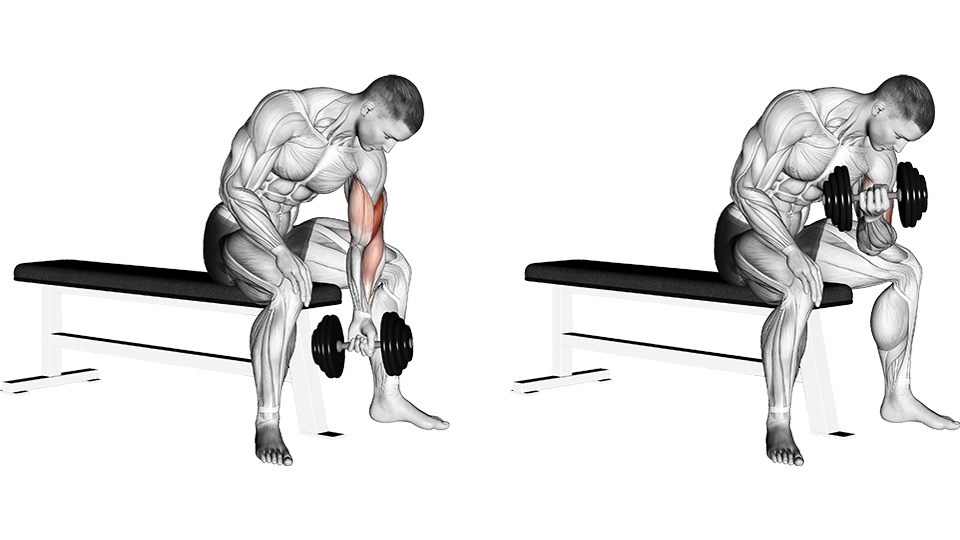
A concentration curl is a seated, one-arm dumbbell curl with the back of the upper arm braced against the inner thigh. The support keeps the upper arm still while the elbow bends, making it a strict way to train the biceps brachii along with the brachialis and brachioradialis.
How do you perform a concentration curl?
Set up
- Sit near the edge of a bench with your feet apart, hold a dumbbell in one hand, and lean forward from the hips.
- Brace the back of that upper arm against your inner thigh, let the arm hang almost straight with the palm facing forward, and support yourself with the free hand on the other leg.
Execution
- Curl the dumbbell toward the same-side shoulder while keeping your upper arm against your thigh and your wrist straight.
- Stop when the elbow reaches its natural end range without the shoulder rolling forward.
- Lower under control until the arm is straight, finish the set, then switch sides.
Common mistakes
Balancing the point of the elbow on the knee
That is an unstable, uncomfortable contact point. Brace the back of the upper arm against the broad part of the inner thigh so the elbow can bend freely.
Lifting the upper arm away from the thigh
Once the upper arm moves, the shoulder helps carry the dumbbell and the strict curl turns into a swing. Use a lighter dumbbell if the brace will not stay put.
Folding the wrist toward the shoulder
Wrist movement changes the finish without adding elbow flexion. Keep the knuckles in line with the forearm throughout the rep.
Cutting the lowering short
Shortening the bottom makes successive reps smaller and makes progress harder to compare. Lower until the elbow is straight before the next curl.
Where it fits in a session
Near the end of a pull or arm session, after heavier rows, pulldowns and curls.
The braced position leaves little room to move a weight you cannot curl cleanly. Choose a dumbbell that lets the upper arm stay planted and both sides use the same range.
Muscles worked
Primary
Secondary
Schematic surface view. Some muscles are partly visible or not shown.
The palm-up curl trains all three elbow flexors. The biceps brachii is listed first because it both flexes the elbow and holds the forearm in supination. The brachialis flexes the elbow from every forearm position, and the brachioradialis remains active during elbow flexion with the palm up, neutral or down.
What lifters actually do
Just over one in five regular RepCount users has logged concentration curls, but the exercise appears in only about one workout in sixty. It is typically logged for about three sets inside a session of seven or eight exercises. Hammer curls appear in about 36% of those sessions, pulldowns in about 28%, dumbbell curls in about 22%, cable rows in about 21% and barbell curls in about 20%, placing concentration curls alongside the rest of a pull or arm session rather than at its centre.
Most often trained alongside
Share of concentration curl sessions that also include each exercise.
- Hammer curl35.6%
- Pulldowns28.1%
- Dumbbell biceps curl21.6%
- Cable row21.4%
- Barbell biceps curl19.8%
Figures come from workouts tracked in RepCount.
Scientific studies on concentration curls
Research involving concentration curls gives some useful perspective on muscle sensation and strength training. It does not establish that this curl produces more biceps growth than other versions.
A strong feeling in the biceps is not a reliable measurement of activation or growth. Concentration curls have been included in a program that improved elbow-flexion strength, but the study combined two curl exercises and cannot identify the contribution of either one alone.
Does feeling the biceps work tell me how much it is doing?
In a study of 13 male soccer players with resistance-training experience, participants rated which muscles they felt working during six upper-body exercises, including the dumbbell concentration curl. Those ratings did not clearly correlate with electrical muscle-activity measurements for any of the exercises.
The ratings and EMG were collected in separate sessions, and the sample was small. The study did not test whether deliberately focusing on a muscle changes later growth. It does suggest that sensation alone is a poor way to rank exercises: feeling a stronger squeeze does not demonstrate that a concentration curl is better than another curl.
Sources
Have concentration curls been tested in a training program?
A four-week study assigned 12 previously untrained adults to a training or non-training group. The six who trained performed both supinating dumbbell curls and concentration curls twice per week. Their improvement in maximal isometric elbow-flexion force was greater than the control group’s. Upper-arm circumference did not clearly increase.
This was a small study designed mainly to test muscle-measurement technology. Because both curls were in the same program, it cannot show how much benefit came from the concentration curl or whether it would outperform a standing curl. It also does not establish an optimal set count or repetition range.
What was measured?
The researchers measured force against a fixed dynamometer and recorded muscle activity before and after training. They also calculated a cumulative strength estimate from the training logs; that was not a directly tested one-repetition maximum, so it is not used as a strength benchmark here. Arm circumference is not an isolated measurement of biceps muscle size.
Variations
- Cable concentration curl — Uses a low cable instead of a dumbbell, keeping resistance through more of the range.
- Standing concentration curl — Hinged forward with the free hand supported, while the working arm hangs without a thigh brace.
- Hammer concentration curl — Uses a neutral, thumb-up grip instead of the standard palm-up grip.
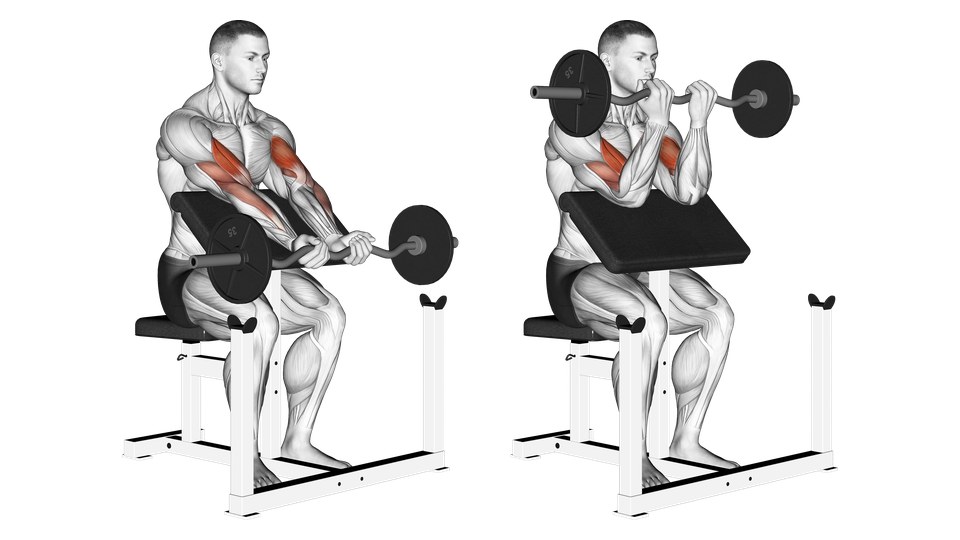
- Preacher curlSupports the whole upper arm on an angled pad and can be performed with one arm or both.
Related tools
Frequently asked questions
What muscles do concentration curls work?
They train the three elbow flexors: biceps brachii, brachialis and brachioradialis. The palm-up grip gives the biceps two jobs at once — flexing the elbow and holding the forearm in supination — while the other two muscles assist with elbow flexion.
Why is it called a concentration curl?
The name describes the strict, one-arm setup: you sit, lean over the working arm and brace it against the inner thigh. It does not mean you need a special tempo or a stronger mind-muscle connection for the exercise to work.
Where should I place my elbow for a concentration curl?
Put the back of the upper arm against the inner thigh, just above the elbow. Avoid balancing the point of the elbow directly on the knee; the broad contact on the thigh is steadier and lets the joint move freely.
Should I straighten my arm at the bottom?
Yes. Lower until the elbow is straight, without letting the shoulder drop or the dumbbell touch the floor. A full, repeatable range makes it easier to compare one set with the next.
Are concentration curls better than standing dumbbell curls?
They are stricter, not automatically better. Bracing the upper arm makes it harder to swing the dumbbell, while a standing curl is faster to set up and lets both arms work together. Use the version whose form you can repeat and progress.
How common are concentration curls?
Just over one in five regular RepCount users has logged them, but they appear in only about one workout in sixty. They are usually accessory work in a larger pull or arm session rather than the main lift.
Sources
- Tiwana MS, Charlick M, Varacallo MA. Anatomy, Shoulder and Upper Limb, Biceps Muscle. StatPearls, NCBI Bookshelf. https://www.ncbi.nlm.nih.gov/books/NBK519538/
- Plantz MA, Bordoni B. Anatomy, Shoulder and Upper Limb, Brachialis Muscle. StatPearls, NCBI Bookshelf. https://www.ncbi.nlm.nih.gov/books/NBK551630/
- Lung BE, Ekblad J, Bisogno M. Anatomy, Shoulder and Upper Limb, Forearm Brachioradialis Muscle. StatPearls, NCBI Bookshelf. https://www.ncbi.nlm.nih.gov/books/NBK526110/
- Sevilmiş E, Atalag O, Baytaş E, Henselmans M, Balyan M, Binboğa E. The Disconnect Between Soccer Players’ Perceived and Actual Electromyographic-Measured Muscle Activation. 2024. https://journals.sagepub.com/doi/10.1177/00315125241279086
- Brümmer T, Lu H, Yang H, Baier L, Braun C, Siegel M, Marquetand J. Training adaptations in magnetomyography. 2025. https://pubmed.ncbi.nlm.nih.gov/40344791/