
Dumbbell biceps curl
Also called dumbbell bicep curl, dumbbell curl, standing dumbbell curl, supinated dumbbell curl.
What is a dumbbell biceps curl?
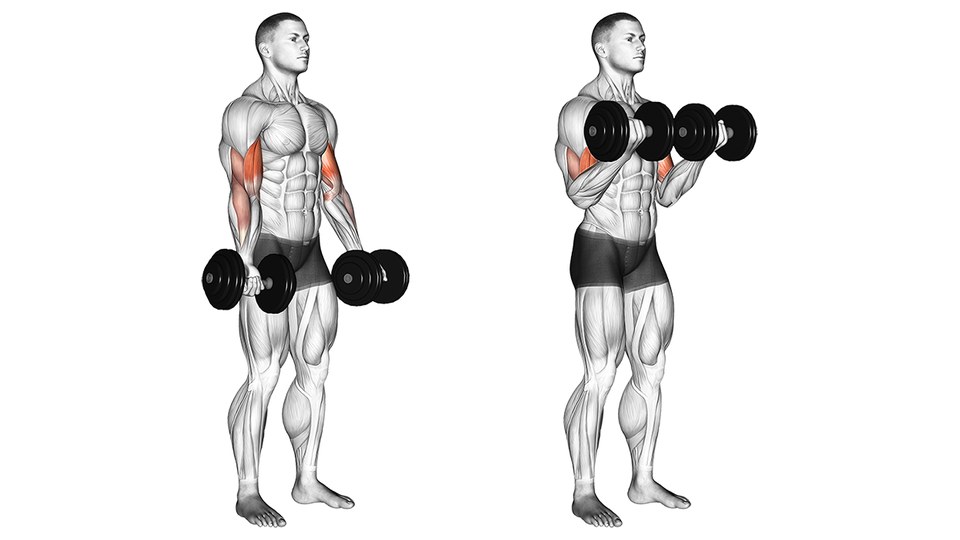
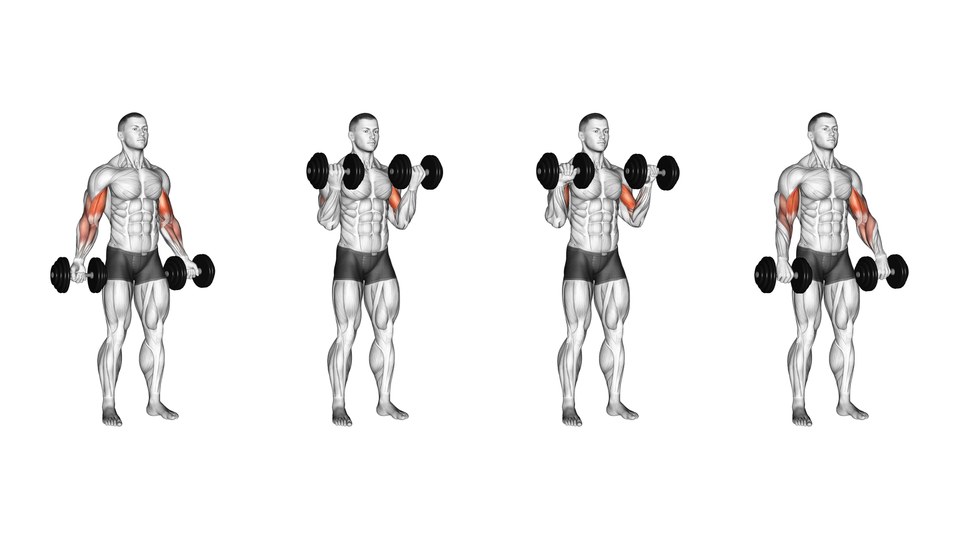
A dumbbell biceps curl bends the elbow against a dumbbell held with the palm facing up. It trains the biceps brachii alongside the brachialis and brachioradialis. The biceps also turns the palm upward, so the grip suits both of its forearm actions. You can hold that grip throughout or rotate from palms-in as you curl, and lift both arms together or alternate them. Those are options; the illustration shows one combination.
How do you perform a dumbbell biceps curl?
Set up
- Stand with a dumbbell in each hand, feet about hip width apart and palms facing forward.
- Brace lightly with your shoulders back and down and your upper arms beside your ribs.
Execution
- Bend your elbows to curl the dumbbells while keeping your upper arms still and your palms facing up.
- Stop with the dumbbells in front of your shoulders, keeping your wrists straight.
- Lower under control until your arms are straight.
Common mistakes
Starting the rep with a swing of the hips
The swing carries the dumbbell through mid-range, which is the part of the curl that was going to limit the set. The rep still gets logged; the elbow flexors did less work for it, and the number in your log stops meaning what it meant last month.
Swinging the elbow forward to finish the rep
A little forward drift at the very top, with the forearm no higher than vertical, is normal. Past that the upper arm is doing the lifting: the front of the shoulder carries the dumbbell and the elbow flexors are shortening without much load on them. It looks like a bigger rep and is a smaller one.
Flicking the wrist back at the top to finish the rep
It moves the last few degrees of the lift into the wrist, so the forearm and the grip end the set before the elbow flexors do, and it puts a loaded dumbbell on a bent wrist for the part of the rep where it is furthest from your body.
Curling with the dumbbells drifting out to the sides
A dumbbell tracking away from the body gives the load a longer lever on the shoulder and pulls the elbow out, which is the first step toward the elbow drifting forward. Keep the dumbbell in the plane it started in.
Where it fits in a session
Near the end of a pull or upper-body session, after the rows and pulldowns have already taken the elbow flexors through part of their work.
Small muscle group, short range, almost no systemic cost, so this handles frequency better than a compound does: two or three hard sets a couple of times a week is easier to repeat than one long session of curls. Load is the whole constraint: the heaviest dumbbell you can curl with a still elbow is the right one, and the next one up is not a heavier curl, it is a different exercise with your hips in it.
Muscles worked
Primary
Secondary
Schematic surface view. Some muscles are partly visible or not shown.
The biceps is the main target of this palm-up curl, with the brachialis and brachioradialis also bending the elbow. Anatomy supports their roles; it does not assign a percentage of the work to each. The cable-grip study below found higher biceps and brachioradialis electrical activity with palms up during lifting, but did not measure brachialis activity or muscle growth.
What lifters actually do
Most regular RepCount users have logged a dumbbell curl at some point, and it turns up in roughly one workout in thirteen, which is the profile of a staple accessory rather than a main lift. The more interesting thing the logs show is that lifters largely do not choose between curl grips: more than a quarter of the workouts containing a dumbbell curl contain a hammer curl as well, run alongside it in the same session rather than instead of it. The rest of the company it keeps is back work, with pulldowns in about 28% of those sessions, cable rows in about 20% and pull-ups in about 15%. It is arm work at the end of a pull day, about three sets deep, in sessions of around seven exercises.
Most often trained alongside
Share of dumbbell biceps curl sessions that also include each exercise.
- Pulldowns27.8%
- Hammer curl27%
- Cable row20.4%
- Pull up14.5%
Figures come from workouts tracked in RepCount.
Scientific studies on the dumbbell biceps curl
The useful questions are what a palm-up grip changes, whether an incline or preacher setup is better, and how the bottom of the repetition is loaded. The studies use different equipment and measurements, so a result from one curl does not automatically settle the others.
A palm-up curl is a reasonable way to train the biceps, but activation studies do not prove a growth advantage over every other grip. Shoulder position and the point where a curl is hardest are separate choices. Keep a repeatable range rather than assuming that more stretch always means more loading or growth.
Does a palm-up grip work the biceps more?
In ten competitive bodybuilders, a palm-up cable curl produced higher biceps electrical activity during lifting than a neutral or palm-down grip. The difference was not clear during lowering. This supports using supination, meaning a palm-up forearm, when emphasizing the biceps.
It does not prove that palm-up dumbbell curls grow more muscle. The study used cables with different attachments and did not measure growth or the brachialis. The brachioradialis also showed higher activity with the palm-up grip during lifting, so the result does not support treating each grip as belonging to only one muscle.
Study details: what electrical activity can tell us
Coratella and colleagues had each participant perform six repetitions at a load they could lift eight times, keeping the upper arms beside the torso. Surface electrodes measured electrical signals, not each muscle’s share of force. The grip was fixed within each condition; the experiment did not compare holding the palms up with rotating them during a dumbbell curl.
Are incline or preacher curls better than standing curls?
There is no single winner in the studies reviewed here. In an acute study of 22 trained men, standing and incline dumbbell curls showed similar biceps activation patterns, while preacher curls concentrated more activity earlier in the lift. That experiment measured one repetition per exercise, not subsequent growth.
A separate eight-week trial in 63 young women found more growth near the top of the upper arm with incline curls, and more near the elbow with preacher curls. It did not include standing curls, and regional arm thickness is not the same as growth of an individual biceps head.
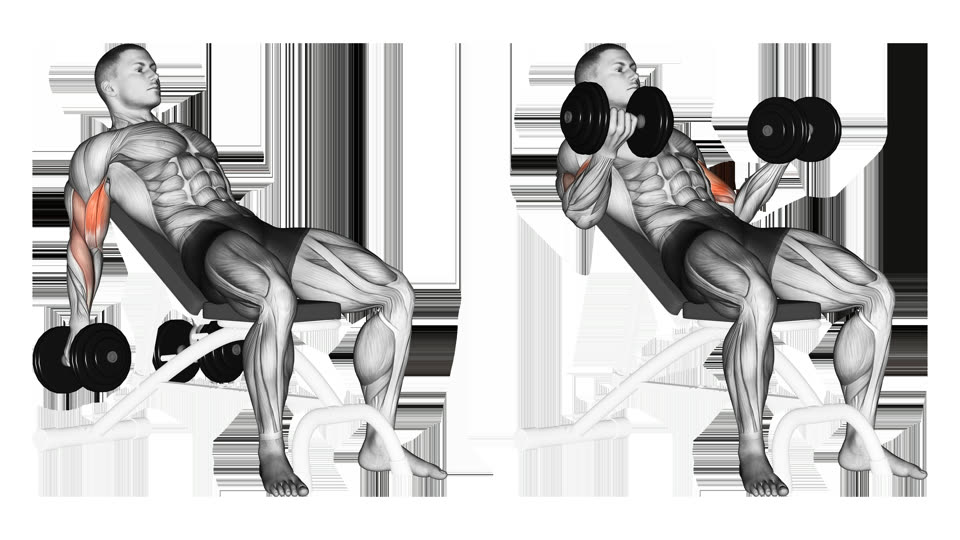
An incline bench moves the upper arm behind the torso and lengthens the biceps at the shoulder. But a dumbbell hanging beneath the elbow still creates little turning force at that joint. The position that stretches a muscle and the position that loads it hardest are not necessarily the same.
Study details: separating position from resistance
Kassiano’s trial found region-specific thickness differences and greater strength gains in the curl each group practiced. It cannot rank either variant against standing curls. Its complete abstract was read.
A 2026 cable trial in 24 men who completed training matched the resistance pattern while comparing neutral and extended shoulder positions. It found similar elbow-flexor thickness gains over ten weeks. This challenges the assumption that moving the arm farther behind the body always adds growth, but remains a cable comparison in beginners.
Does research prove you must straighten the elbow on every rep?
A preacher-curl trial in 19 untrained women compared the lower and upper halves of the movement. After eight weeks, the lower half produced greater biceps growth near the elbow, but no clear advantage at the middle of the muscle or in the sum of the two measured areas.
This was not a full-range-versus-partial comparison. The preacher pad also places the upper arm differently from a standing curl, changing where the dumbbell resists elbow bending. The result cannot tell us that fully straightening each standing repetition is essential, or that partials are always better.
Returning to a consistent bottom position remains useful for comparing reps and loads over time. That is the coaching reason for the full-range cue here; it is not a claim that this exact technique has beaten every alternative in a growth trial.
Variations
- Incline dumbbell curlSeated on an incline bench with the upper arms behind the torso, lengthening the biceps at the shoulder. The dumbbell is still lightly resisted at the elbow when it hangs directly beneath it.
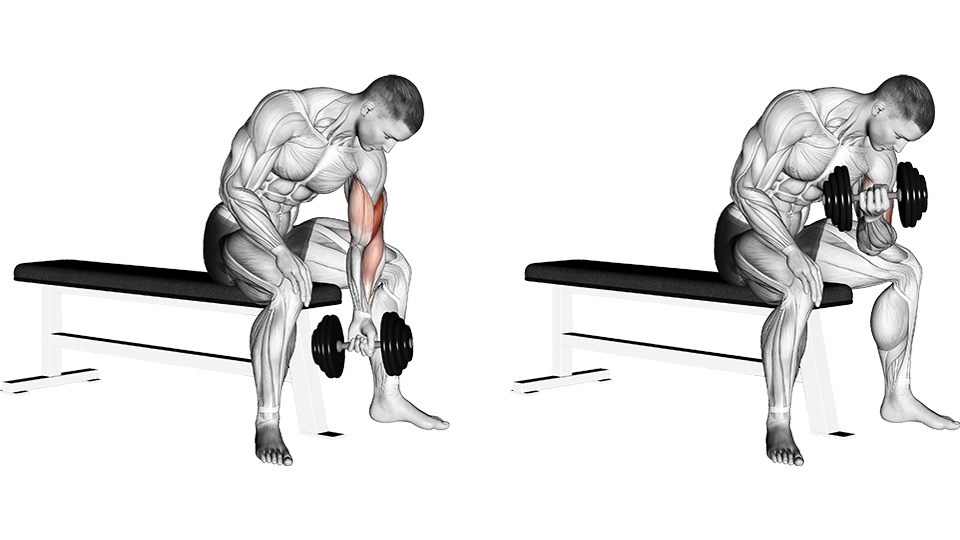
- Concentration curlSeated, one arm at a time, elbow braced against the inner thigh. The most restrictive version of the movement and the hardest to cheat.
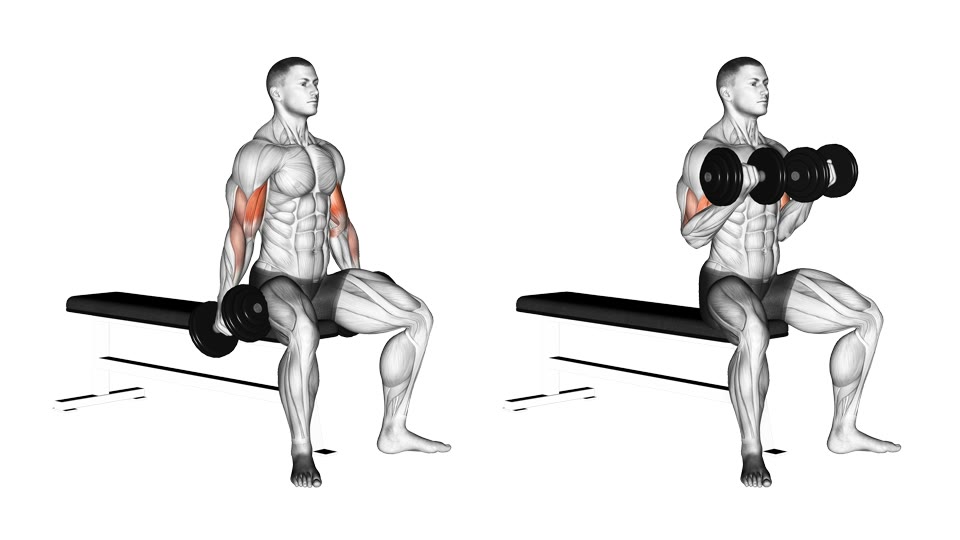
- Seated dumbbell curlSame movement without the option to swing the torso, which is the most common fault standing.
- Alternating dumbbell curl — One arm curls at a time rather than both together, giving each arm a short break between repetitions.
- Zottman curlCurls up with the palm up and lowers with the palm down, so the forearm gets the lowering half in a pronated position.
Related tools
Frequently asked questions
What muscles does a dumbbell biceps curl work?
The biceps brachii first, with the brachialis and brachioradialis working alongside it. All three are involved in every curl grip, and the palm-up grip is what puts the biceps in front. The brachialis is a pure flexor that works from any forearm position and provides no rotation of the forearm at all. The brachioradialis flexes the elbow from any forearm position, palm up, neutral or palm down. The biceps flexes the elbow and is also the forearm's most powerful supinator, which is the part the palm-up grip is asking it to do while it curls.
Is the dumbbell curl really a biceps exercise?
Yes. The biceps bends the elbow and turns the forearm palm-up, and the brachialis and brachioradialis work alongside it. A palm-up cable curl produced greater biceps activity than neutral and palm-down grips during lifting in one small study. That supports the exercise’s emphasis, but does not establish that other curl grips fail to train the biceps or produce less growth.
Should I keep my palms up the whole time or rotate as I curl?
Either is a practical option. Fixed palms-up and a gradual turn from palms-in are different forearm movements; the fixed-grip cable study does not establish which dumbbell version produces more growth. Pick one that feels comfortable and keep the same approach through the set so your repetitions stay comparable.
Should I curl both arms at once or alternate?
Either, again. Both at once finishes the set faster and gives you a symmetrical brace to work against. Alternating gives each arm a rest between reps, which usually means the later reps are cleaner, at the cost of taking about twice as long.
Should I straighten my arms at the bottom?
Straightening the arms gives you a consistent bottom position for tracking repetitions and load. A slight bend keeps some resistance at the elbow, so it is a trade rather than a universal error. When the dumbbell hangs directly beneath the elbow, its turning force at that joint is small. An incline bench lengthens the biceps at the shoulder but does not automatically change that bottom-position leverage. The preacher-curl range study below did not test full versus partial standing curls.
Are dumbbell curls and hammer curls the same exercise?
The same movement with a different grip, and RepCount's logs suggest lifters do not treat them as alternatives: more than a quarter of the workouts that contain a dumbbell curl contain a hammer curl as well, run alongside it rather than in place of it. If your palms turn inward as a set gets heavy, that is worth noticing — you are drifting toward the other exercise rather than finishing this one.
Do I need to curl at all if I already row and do pull-ups?
Pulling work trains the elbow flexors, so nobody who rows and does pull-ups has untrained arms. A row or a pull-up starts with the elbow straight and finishes somewhere around a right angle, so what the curl adds is the far end of elbow flexion, plus the ability to load the elbow flexors without also needing your back and your grip to be fresh. Whether that is worth two sets of your session is a judgement about what you want, not a physiological requirement.
Is a 20 kg dumbbell curl good?
There is no reliable public dataset of curl weights by bodyweight and training age, so anyone who answers that with a confident number is guessing. The things that actually settle it are whether you can complete your target reps with the elbow still and the torso quiet, and whether the weight has moved at all over the last few months. A clean lighter curl that is going up beats a heavier one that has been the same since spring.
How many sets and reps should I do?
This is a small muscle group with a short range and almost no recovery cost, so it takes frequency well: a couple of hard sets a few times a week does more than one long session of curls. Rep range matters less than whether the elbow stays put, which in practice rules out the heaviest weights most people reach for.
Sources
- Tiwana MS, Charlick M, Varacallo MA. Anatomy, Shoulder and Upper Limb, Biceps Muscle. StatPearls, NCBI Bookshelf. https://www.ncbi.nlm.nih.gov/books/NBK519538/
- Plantz MA, Bordoni B. Anatomy, Shoulder and Upper Limb, Brachialis Muscle. StatPearls, NCBI Bookshelf. https://www.ncbi.nlm.nih.gov/books/NBK551630/
- Lung BE, Ekblad J, Bisogno M. Anatomy, Shoulder and Upper Limb, Forearm Brachioradialis Muscle. StatPearls, NCBI Bookshelf. https://www.ncbi.nlm.nih.gov/books/NBK526110/
- Coratella G et al. Biceps Brachii and Brachioradialis Excitation in Biceps Curl Exercise: Different Handgrips, Different Synergy 2023. https://pmc.ncbi.nlm.nih.gov/articles/PMC10054060/
- Oliveira LF et al. Effect of the shoulder position on the biceps brachii emg in different dumbbell curls 2009. https://pmc.ncbi.nlm.nih.gov/articles/PMC3737788/
- Kassiano W et al. Distinct muscle growth and strength adaptations after preacher and incline biceps curls. 2025. https://pubmed.ncbi.nlm.nih.gov/39809454/
- Pedrosa GF et al. Training in the Initial Range of Motion Promotes Greater Muscle Adaptations Than at Final in the Arm Curl 2023. https://pmc.ncbi.nlm.nih.gov/articles/PMC9960616/
- Larsen S et al. The effects of shoulder extension angle on elbow flexor hypertrophy in the cable curl exercise 2026. https://www.frontiersin.org/journals/physiology/articles/10.3389/fphys.2026.1750722/full