
A back and biceps workout you can progress
A back and biceps workout can be built around one vertical pull, one row and two curls. The session below uses a lat pulldown, seated cable row, incline dumbbell curl and hammer curl. Repeat the same versions so you can compare your reps before deciding to add weight.
Check your existing plan first. If it already includes rows, pulldowns and curls on upper-body days, use this session to replace that work rather than adding another full workout on top.

Start with this four-movement back and biceps workout
Use the table as an adaptable starting session. These are working sets, with warm-ups done separately. The gym version needs an overhead pulldown station, a low cable row, dumbbells and an adjustable bench.
| Exercise, in order | Working sets | Reps per set | Rest between sets |
|---|---|---|---|
| Lat pulldown | 3 | 8–12 | 2–3 minutes |
| Seated cable row | 3 | 8–12 | 2–3 minutes |
| Incline dumbbell curl | 2 | 10–15 | 90 seconds–2 minutes |
| Hammer curl | 2 | 10–15 | 90 seconds–2 minutes |
Start with loads that leave roughly two controlled reps available at the end of each set. Practise the pulls with lighter weights before the working sets, and take a light curl set to check the elbow movement. Those are preparation sets, so don't count them toward the table.
Currier and colleagues' 2023 review found strength and muscle gains across several combinations of load, sets and frequency, with heavier loading favoring strength. It supports having options; it doesn't validate this exact session or make these rep ranges uniquely effective.
Give the pulldown and row different jobs
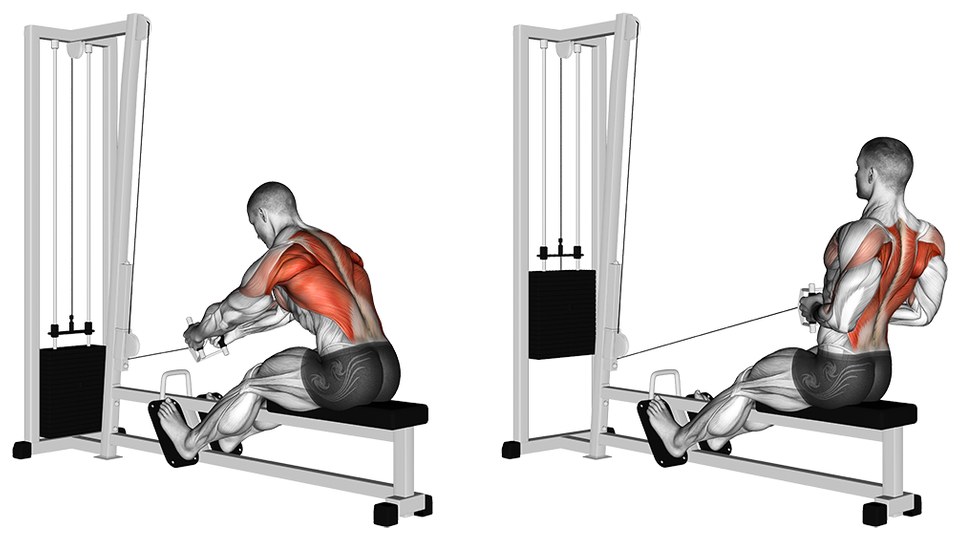
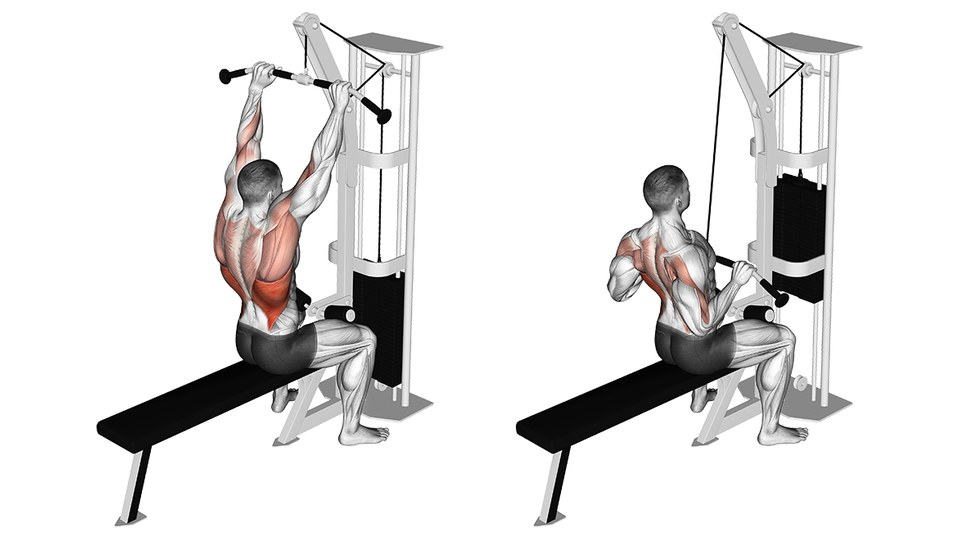
The pulldown brings your upper arms down from overhead; the row brings them backward from in front of you. Both involve the back and elbow flexors. Keeping both movements gives this session two pulling tasks without needing several versions of each.
On the pulldown, keep your backward lean steady and pull in front of your face. On the cable row, keep your torso steady as the handle approaches your midsection, then let your arms reach forward again under control. Choose a handle you can use comfortably and keep it consistent. The linked guides cover the complete setup.
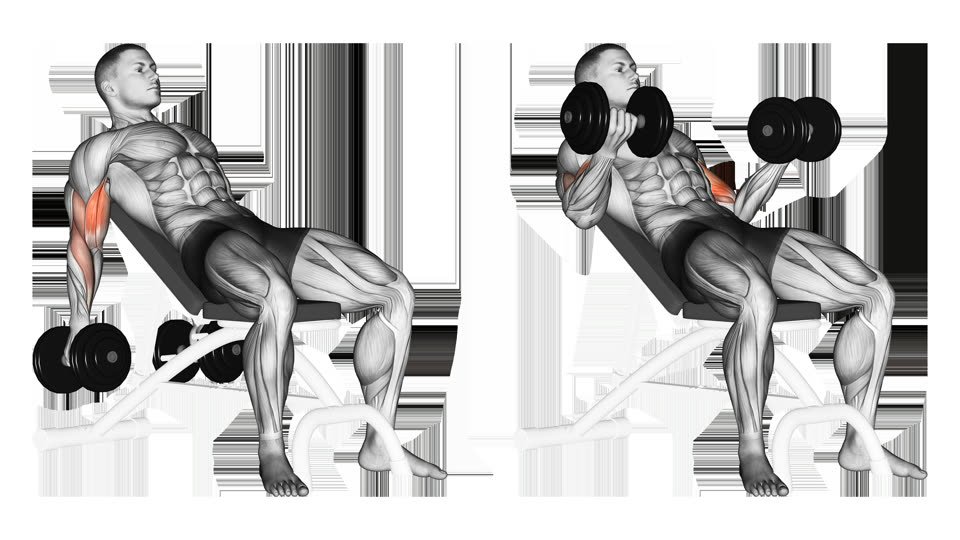
The curls add direct elbow bending after the pulls. The incline curl uses a palms-up grip with your torso supported on the bench. The hammer curl keeps the palms facing each other. These are two grip and setup choices, without a promise that either isolates a particular biceps head.
Put your strength priority first
Start with the pulldown if that's the lift you want to improve most. If row strength matters more, swap the first two exercises. If curl strength is the priority, move the incline curl to the beginning and accept that your pulling performance afterward may change.
Nunes and colleagues' exercise-order meta-analysis (2021) found larger strength improvements in exercises performed earlier in the session. It didn't find a significant pooled difference in muscle growth between compound-first and isolation-first orders. Back first is a useful default here, not a requirement for growing your biceps.
Keep whichever order you choose for the sessions you're comparing. A curl performed fresh and a curl after six pulling sets have different starting conditions.
Replace an exercise when the equipment changes
Swap within the same movement where you can, then establish a new starting weight. Different machines and dumbbell versions don't share a comparable load just because the number is the same.
| Missing equipment | A workable swap | What changes |
|---|---|---|
| Lat pulldown station | Pull-up, or machine-assisted pull-up | Your body moves toward fixed handles; choose assistance if needed to complete controlled reps |
| Low cable row | Two-arm dumbbell row | You hold a bent-over position without a bench; choose the weight for a steady torso |
| Adjustable bench for curls | Standing dumbbell curl | Your torso has no backrest and your arms hang beside you |
For machine-assisted pull-ups, progress by reducing assistance once all sets reach the target. Increase assistance again if you can't reach the bottom of the range.
If you have only dumbbells and no suitable overhead pulling setup, rows and curls still give you a session, but they don't reproduce a vertical pull. The pulldown alternatives guide explains those equipment limits. The back and biceps hubs list further choices.
Fit the session around your other pulling work
Use this as a pull session within a plan that also covers pressing and legs. For example, train push on Monday, this back-and-biceps session on Wednesday, and legs on Friday. The push/pull/legs plan covers the wider structure.
If you're following an upper/lower split or PPLUL split, check both upper-body and pull days before adding anything. Rows and pulldowns already involve the biceps. Four direct curl sets here aren't the whole week's arm work.
For example, if Friday's upper session already includes curls, start Wednesday with the incline curl alone and leave out the hammer curl. Keep direct curl sets and pulling sets recorded separately. There's no need to pretend that each row equals an exact fraction of a curl set.
Judge the amount by your repeated performance and the next session. If reps keep declining, review load and rest, then reduce the added curl work or leave more space between pulling days before adding sets.
Add reps before increasing the load
Keep the same weight until every working set reaches the top of its range with the same movement. On the pulldown, that means three sets of 12 controlled reps before trying the smallest available increase.
For example, 40 kg might give you 12, 11 and 10 reps. Keep 40 kg next time and work toward 12, 12 and 12. Once you reach that, try the next increment and build up again. This is an example of choosing the next load, not a prediction of how quickly you'll improve.
If the increase leaves you below eight controlled reps, go back or use a smaller increment. If you miss your target at the old weight, repeat it after checking your rest and setup. A single poor session doesn't call for another exercise.
Use the table's rests as starting points and take longer when needed. Singer and colleagues (2024) found a possible small muscle-growth benefit from rests longer than 60 seconds, with substantial uncertainty. That doesn't establish one perfect rest duration. Our rest-time guide explains the evidence in more detail.
Save the setup alongside your completed sets
In RepCount, create a routine manually, name it "Back and biceps", and add your chosen exercises in order. Set the working-set counts and put rep ranges in the exercise notes. If a variation isn't in your library, create a custom exercise with a clear name.
Record the cable station and handle, plus the curl bench setting. For this routine, log the weight of one dumbbell when using a pair, and count a simultaneous two-arm rep once. Keep that convention every session.
Then log the weight and reps you actually complete. RepCount's free version supports saved routines, custom exercises and workout logging; you follow the progression rule and choose the next load. Get RepCount for iPhone or Android to keep the session and your training record together.
Frequently asked questions
Which exercises should I combine in a back and biceps workout?
This example uses a lat pulldown, seated cable row, incline dumbbell curl and hammer curl. The pulls train the back with help from the elbow flexors; the curls add direct elbow-flexion work. Start with the listed working sets and reduce curl work if your other sessions already cover it.
Should I train back or biceps first?
Start with the exercise whose strength you most want to improve. Use the pulldown-first order for a back-led session, put the row first for row strength, or move a curl first when curl strength is the priority. Keep the chosen order consistent when comparing sessions. Exercise-order research hasn't found a clear pooled muscle-growth advantage for either compound-first or isolation-first training.
Can I do this workout with only dumbbells?
You can do rows and curls with dumbbells, but they don't reproduce an overhead pulldown. For the vertical pull, use a suitable pull-up bar or an overhead pulley if available. Without either, use a dumbbell back session and account for that equipment limit rather than calling a row the same movement.
How often should I do a back and biceps workout?
Place the session within your existing weekly plan. For example, use it as Wednesday's pull day between Monday's push and Friday's legs. If another upper-body day includes rows, pulldowns or curls, count that overlap before repeating the whole session. The example schedule isn't a required frequency for everyone.
When should I increase the weight?
For this routine, increase the load when every working set reaches the top of its rep range with the same setup and controlled movement. Use the smallest available increase. If you then can't reach the bottom of the range, return to the previous load or use a smaller increment. RepCount can store the routine and completed sets; you choose the next load.