
Hammer curl
Also called neutral grip curl, dumbbell hammer curl.
What is a hammer curl?
A hammer curl is a dumbbell curl performed with a neutral grip: palms facing each other, thumbs up, the dumbbell running front to back. It trains the three elbow flexors — brachialis, brachioradialis and biceps brachii — the same muscles every curl works, in a wrist position many lifters find more comfortable to load.
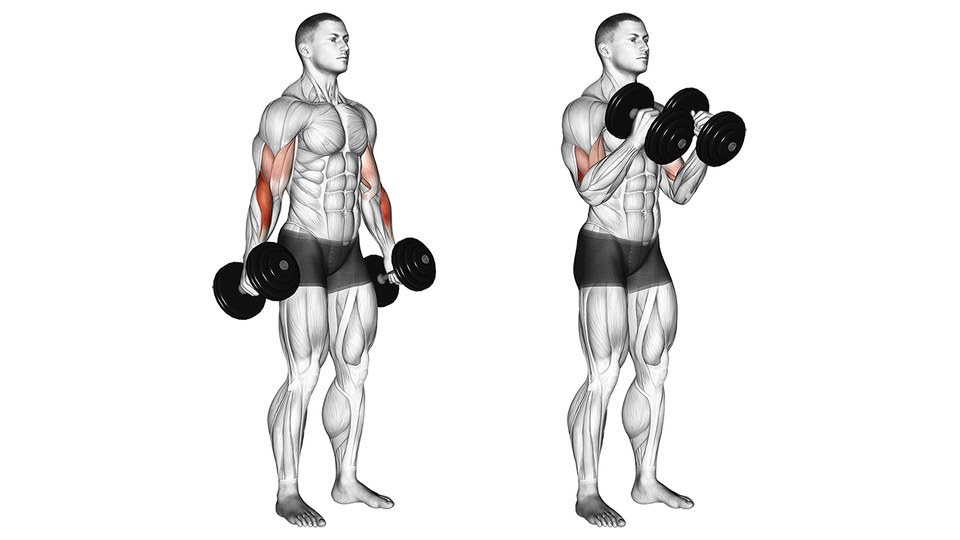
How do you perform a hammer curl?
Set up
- Stand tall with your feet about hip-width apart and a dumbbell in each hand. Let your arms hang at your sides with your palms facing your thighs.
- Brace your midsection, set your shoulders back and down, and keep your wrists straight.
Execution
- Bend your elbows to curl the dumbbells toward your shoulders, keeping your palms facing each other, your upper arms close to your sides, and your torso still.
- Lift until your forearms reach the natural end of their range without swinging or bending your wrists.
- Lower under control until your arms are straight, then repeat with both arms together or one at a time.
Common mistakes
Swinging the torso to start the rep
Momentum moves the dumbbell without asking much more of the elbow flexors. If you need body English to finish a set, the weight is doing your programming for you.
Letting the elbow lead the rep
A little forward travel at the very top is harmless. Once the elbow leads the movement, the front delt takes over and the elbow flexors do less as the range increases.
Choosing hammer curls to hit a specific muscle
No curl grip singles out one elbow flexor; grip changes emphasis modestly at most. Pick the grip that lets you load the movement comfortably and progress it. See the scientific studies ↓
Where it fits in a session
After compound pressing and pulling work, near the end of a session.
Hammer curls are an isolation exercise for a small muscle group, so they do not need to be heavy to be useful, and they respond to being taken close to failure with clean form.
Muscles worked
Primary
Secondary
- None listed in this guide
Schematic surface view. Some muscles are partly visible or not shown.
Listed as co-actors rather than ranked: the evidence does not support ranking these for a neutral grip, and every curl grip works all three.
What lifters actually do
Most regular RepCount users have logged hammer curls at some point, but they appear in only about one in eleven workouts, which is exactly the profile of an accessory: widely tried, modestly used. When they do show up, they are usually the only curl in the session: of the sessions that contain a hammer curl, 60% contain no barbell, dumbbell or concentration curl at all, and the other 40% pair one with it. Those are full sessions of about seven exercises, and the movements the hammer curl most often sits beside are pulldowns, dumbbell curls and cable rows. Lifters treat it as arm work at the end of a pull day.
Most often trained alongside
Share of hammer curl sessions that also include each exercise.
- Pulldowns26.7%
- Dumbbell bicep curl23.2%
- Cable row19.9%
- Barbell bicep curl16.4%
- Pull up14.2%
Figures come from workouts tracked in RepCount.
What the evidence says
Three studies bear on this, and none of them supports the claim. Coratella and colleagues (2023, ten competitive male bodybuilders) found brachioradialis activation higher with a supinated grip than a neutral one during the lifting phase (+6%, p = 0.004), with no difference between neutral and pronated. Kleiber and colleagues (2015, sixteen participants) found brachioradialis highest in pronation, with supinated and neutral not significantly different from each other (p = 0.67). The first two disagree about which grip is highest, and agree that neutral is not it.
The third is the one usually cited in support of hammer curls. Bagchi and Raizada (2019) compared eight curl variations at 70% of one rep max, and hammer curls did come out numerically highest for brachioradialis. But the paper's own conclusion is that "no statistical difference was observed when comparing the muscle activation of Brachioradialis muscle in the eight different biceps curl exercises", and that all eight had the same effect on the brachioradialis. A ranking inside a non-significant comparison is not a finding. The study most often used to prove hammer curls target the brachioradialis concluded that curl variation does not change brachioradialis activation at all.
One point favours the hammer curl over a reverse grip curl: Coratella found biceps brachii activation higher with a neutral grip than a pronated one (+7%, p < 0.001), while supinated was higher still (+12% over neutral, p = 0.006).
Read these carefully. Both samples are small. Neither study measured brachialis, so claims about hammer curls and the brachialis are untested here in either direction. And EMG amplitude during a set is not the same question as which grip builds more muscle over months, which these studies did not ask.
A plausible reading of why anatomy and EMG seem to disagree, offered as reasoning rather than as a finding from these papers: better leverage can mean a muscle needs less activation to produce the same torque, so the position where a muscle works best is not automatically the position where it shows the most electrical activity.
Variations
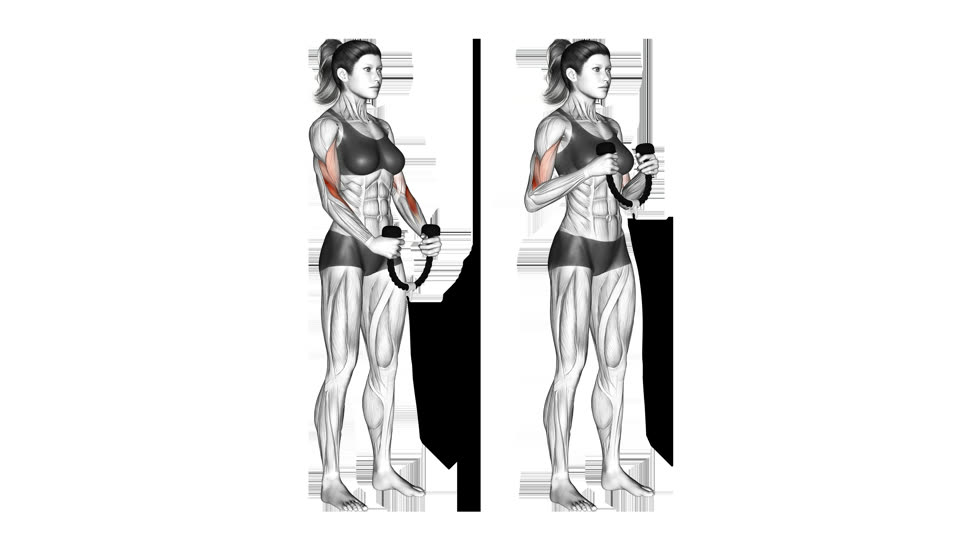
- Rope hammer curl — Cable variant using a rope attachment, which lets the hands sit naturally neutral.
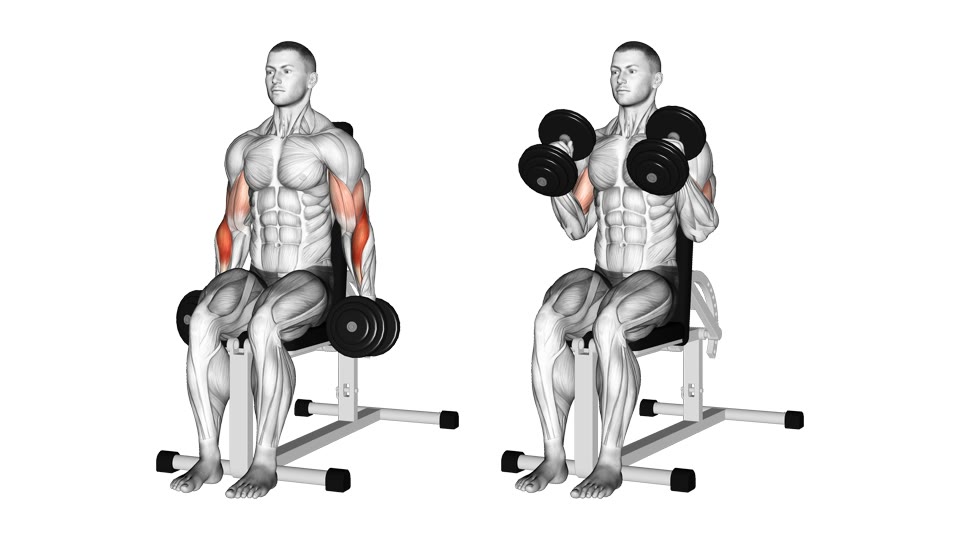
- Preacher hammer curl — Pad fixes the upper arm, so the elbow cannot drift forward.
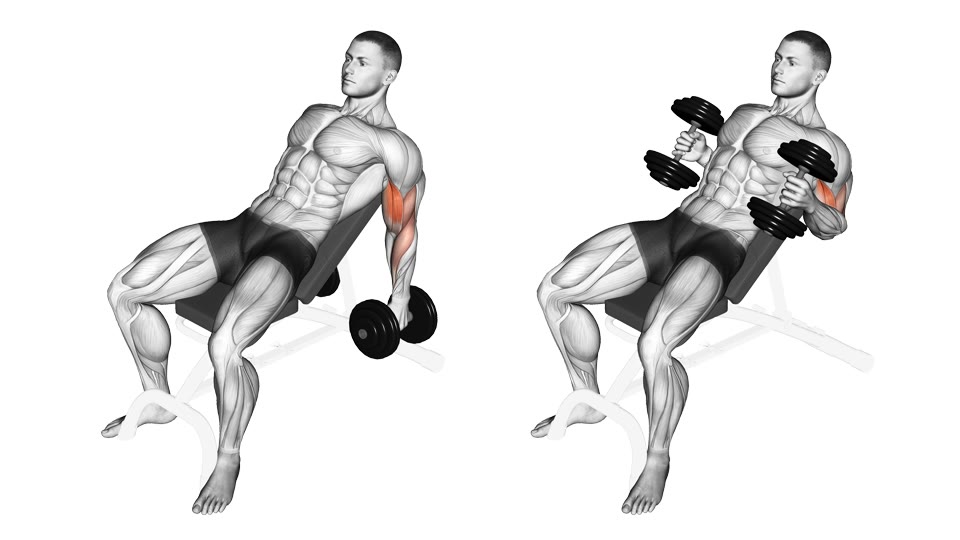
- Cross body hammer curl — Curls the dumbbell across toward the opposite shoulder.
Articles
Related tools
Frequently asked questions
What muscles do hammer curls work?
Hammer curls work the three elbow flexors: brachialis, brachioradialis and biceps brachii. All three are involved in every curl grip. The brachialis is a pure flexor that works from any forearm position, the brachioradialis works from any forearm position, palm up, neutral or palm down, and the biceps brachii contributes to flexion while also being the forearm's main supinator.
Are hammer curls better than regular bicep curls?
Not for biceps activation. In the one study that compared them directly under load, a supinated grip produced higher biceps brachii activation than a neutral grip during the lifting phase. Hammer curls are worth doing because the neutral position does not require holding the forearm in supination under load, and because varying grips lets you train the elbow flexors without repeating the same joint position every session.
Do hammer curls build the brachioradialis?
They train it, but so does every other curl. Three studies bear on the claim and none supports it: one found a supinated grip higher, one found a pronated grip higher, and the one usually cited in favour of hammer curls concluded that all eight variations it tested activated the brachioradialis equally.
Is a 50 lb hammer curl good?
There is no reliable public dataset of hammer curl weights by bodyweight and training age, so anyone giving you a confident number is guessing. What actually determines whether a given weight is appropriate is whether you can complete your target reps with your elbow still and your torso quiet, and whether that weight has moved over the past few months.
Are hammer curls worth doing?
Most regular RepCount users have logged hammer curls at some point, though they appear in only about one in eleven workouts. That is the profile of an accessory, and the logs bear it out: when a hammer curl shows up it is usually the only curl in the session, with no barbell, dumbbell or concentration curl alongside it in 60% of cases. They are accessory work: typically about three sets, in a session of around seven exercises, most often alongside pulldowns, dumbbell curls and cable rows.
Should you straighten your arms at the bottom of a hammer curl?
Yes. A common cue says to stop just short and keep constant tension, but the range you would be giving up is the one that produces the result. In an arm curl study that split the movement in half, training the stretched bottom half produced greater biceps growth and greater full-range strength than training the top half, and a later trial in trained lifters found that lengthened half-reps matched full reps. Straighten the arm; what you lose by stopping short is more than what you gain.
Should I curl both arms at once or alternate?
Either. Nothing in the evidence favours one over the other, so it is a preference rather than a technique point. Curling both at once finishes the set faster; alternating gives each arm a rest between reps. The illustration on this page shows both arms together, which is not a recommendation.
How many sets and reps should I do?
Hammer curls are isolation work for a small muscle group, so they suit being placed at the end of a session and taken close to failure with clean form rather than loaded heavy. The weight matters less than whether the elbow stays put and the arm straightens at the bottom.
Sources
- Coratella G, et al. Biceps Brachii and Brachioradialis Excitation in Biceps Curl Exercise: Different Handgrips, Different Synergy. 2023. https://pmc.ncbi.nlm.nih.gov/articles/PMC10054060/
- Kleiber T, Kunz L, Disselhorst-Klug C. Muscular coordination of biceps brachii and brachioradialis in elbow flexion with respect to hand position. Front Physiol. 2015. https://pmc.ncbi.nlm.nih.gov/articles/PMC4526813/
- Bagchi A, Raizada S. A Comparative Electromyographical Analysis of Biceps Brachii and Brachioradialis during Eight Different Types of Biceps Curl. Indian J Public Health Res Dev. 2019. https://indianjournals.com/article/ijphrd-10-5-141
- Anatomy, Shoulder and Upper Limb, Biceps Muscle. StatPearls. https://www.ncbi.nlm.nih.gov/books/NBK519538/
- Anatomy, Shoulder and Upper Limb, Forearm Brachioradialis Muscle. StatPearls. https://www.ncbi.nlm.nih.gov/books/NBK526110/
- Plantz MA, Bordoni B. Anatomy, Shoulder and Upper Limb, Brachialis Muscle. StatPearls. https://www.ncbi.nlm.nih.gov/books/NBK551630/
- Pedrosa GF, et al. Training in the Initial Range of Motion Promotes Greater Muscle Adaptations Than at Final in the Arm Curl. Sports (Basel). 2023. https://pmc.ncbi.nlm.nih.gov/articles/PMC9960616/
- Wolf M, et al. Lengthened partial repetitions elicit similar muscular adaptations as full range of motion repetitions during resistance training in trained individuals. PeerJ. 2025. https://pmc.ncbi.nlm.nih.gov/articles/PMC11829627/