
Seated cable row
Also called cable row, low cable row, seated row, seated low row.
What is a seated cable row?
The seated cable row is a horizontal pull. You sit facing a low pulley with your feet braced, arms straight, and draw a handle in to your midsection against the cable. It works the muscles that pull the upper arm backwards at the shoulder — the latissimus dorsi and teres major, which also draw it in to your side, and the back of the deltoid — together with the ones that pull the shoulder blades toward the spine, the middle trapezius and the rhomboids. The elbow flexors bend the arm as the handle travels, and the trunk extensors hold your torso upright against the pull. Which handle you use is a preference, not a rule: a close neutral handle keeps the elbows near the ribs, while a wide bar takes them farther out. The research below compares the resulting muscle activity without treating it as a growth ranking. Any illustration can only show one of them, so read the picture as one option rather than as the instruction.
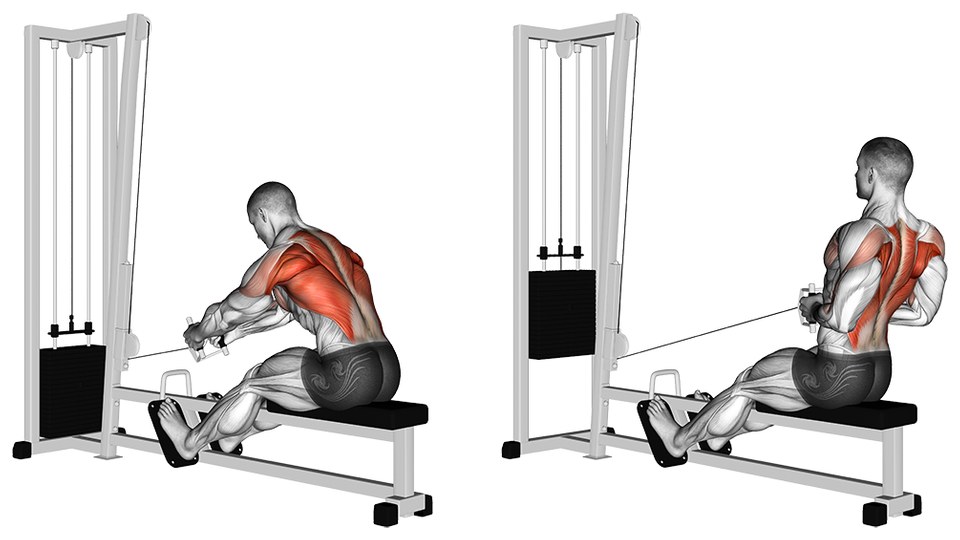
How do you perform a seated cable row?
Set up
- Attach a close neutral handle and sit facing the low pulley with your feet on the foot plate and your knees slightly bent.
- Take the handle and sit tall, far enough back that the plates stay clear when your arms are straight.
Execution
- Start with your arms straight, chest lifted and shoulder blades reaching forward.
- Drive your elbows back and pull the handle to your midsection until your elbows pass your ribs.
- Draw your shoulder blades together without shrugging.
- Return under control to straight arms, keeping your torso upright and your lower back set.
Common mistakes
Heaving the torso backwards to start each rep
The hips and lower back throw the weight and the arms just hold on, so the muscles the exercise is for never see the load they are supposed to. It also loads the lumbar spine into repeated flexion and extension under tension, which is a worse deal than the extra plate is worth. If you cannot start a rep with the torso still, the weight is choosing your programming.
Sitting so close to the pulley that the plates touch down at the front of the rep
Tension drops to zero at exactly the point where the target muscles are longest, so you lose the part of the range with the most to give and you restart each rep with a jerk off a dead stack. Sit further back, or take a shorter handle, until there is clearance at full arm extension.
Shrugging at the finish
Once the shoulders ride up toward the ears the upper trapezius is elevating the shoulder blade rather than the middle fibres and rhomboids pulling it toward the spine. The finish of the row turns into a shrug.
Holding the shoulders locked back and only bending the arms
If the shoulder blades never travel forward at the start and never draw together at the finish, the scapular half of the movement has been deleted and the row becomes a long-lever curl. The muscles between the shoulder blades work through the range you just removed.
Rounding the lower back at the stretch and unrolling to start the pull
This is different from letting the shoulder blades slide forward, and easy to confuse with it. The blades moving on the ribcage is the range you want; the lumbar spine rounding under a loaded cable and then extending to initiate the rep is the lower back doing a rep it was not given.
Mismatching the handle and the elbow path
A wide bar pulled to the navel with the elbows tucked, or a close neutral handle hauled up to the collarbone with the elbows flared, fights the line of the cable and puts the shoulder in an awkward spot at the finish. The handle and the elbow path are one decision, not two.
Where it fits in a session
Early to middle of a pull or upper-body session, alongside a vertical pull rather than instead of one, and before arm work.
A cable loads smoothly through the whole range and there is no bar to bail out from, so this is a movement you can take genuinely close to failure without a spotter, and it holds up well at moderate to higher reps. Sessions that contain one average a little over three sets of it.
Muscles worked
Primary
Secondary
Schematic surface view. Some muscles are partly visible or not shown.
Split by what each muscle does in the movement rather than by an emphasis ranking. The primary list is the muscles that produce the two loaded actions: drawing the upper arm backwards at the shoulder — and, for the latissimus dorsi and teres major, in toward the side — and pulling the shoulder blade toward the spine. The secondary list is muscles working at a different joint, the elbow flexors that bend the arm as the handle travels, or holding a position rather than moving the load, which is what the trunk extensors and the small external rotators of the shoulder are doing here.
Anatomy will not rank the muscles inside the primary list against one another. How much each contributes shifts with the handle, the grip width and how far the elbow stays from the ribs, so a percentage split would be a guess dressed up as a measurement.
What lifters actually do
Just over six in ten regular RepCount users have logged a seated cable row at some point, and it turns up in roughly one workout in thirteen. The movement it sits beside most often is a pulldown: about half of the sessions containing a cable row contain one too, so for a lot of lifters the two are not an either-or. The rest of the company it keeps is arm work and pull-ups: pull-ups in about one in six of those sessions, and hammer curls, dumbbell curls and barbell curls each in more than one in eight. That is a back-and-biceps day. Sets run at about three, in sessions of around seven exercises.
Most often trained alongside
Share of seated cable row sessions that also include each exercise.
- Pulldowns48.1%
- Hammer curl22.3%
- Dumbbell bicep curl19.6%
- Pull up17.6%
- Barbell bicep curl13.7%
Figures come from workouts tracked in RepCount.
Scientific studies on seated cable rows
Handle choice changes more than hand position: it also changes elbow path, the finishing point and often the load you can lift. Studies help describe those differences, but muscle activity during a set is not a measurement of growth.
Narrow rows have produced greater lat activity, while wider rows have produced greater trapezius activity in small laboratory studies. Both still involve several muscles, and these findings do not establish which grip builds more muscle over time.
Do narrow and wide rows work the back differently?
Fourteen trained men performed rows with a narrow triangle handle and a wide bar. The narrow version produced greater lat activity; the wide version produced greater activity in the upper, middle and lower trapezius and the side deltoid. Rear-deltoid activity did not clearly differ.
A separate study of twenty-one adults also found greater lat activity with the elbows nearer the sides and greater trapezius activity with the elbows farther out. That study did find greater rear-deltoid activity in the wider positions. The disagreement matters: grip width does not give a fixed ranking for every back muscle.
What changed between the comparisons?
The fourteen-man study used a separate eight-repetition maximum for each handle, while recording four controlled repetitions. The narrow handle finished at the belly and the wide bar near the lower chest. The other study used the same external load across its rowing variations, based on a pronated-grip isometric test. These were different combinations of grip, elbow position and loading, not grip width in isolation.
Does a row challenge the biceps like a curl?
The twenty-one-person study also compared moving cable rows with a cable preacher curl. Biceps activity was greater during the curl than during any of the rowing variations. Within the rows, underhand and neutral grips produced more biceps activity than the close overhand version.
This supports a distinction between a back exercise that includes elbow flexion and a dedicated curl. It does not establish how much biceps growth either will produce, or prove that every lifter needs to add curls.
Sources
Variations
- Wide-grip seated cable row — A long straight bar with an overhand grip and the elbows out away from the ribs.
- Close neutral-grip seated cable row — The V-handle version, palms facing each other and elbows travelling close to the sides.
- Single-arm cable rowOne handle at a time, which lets the torso rotate slightly and each side reach its own range.
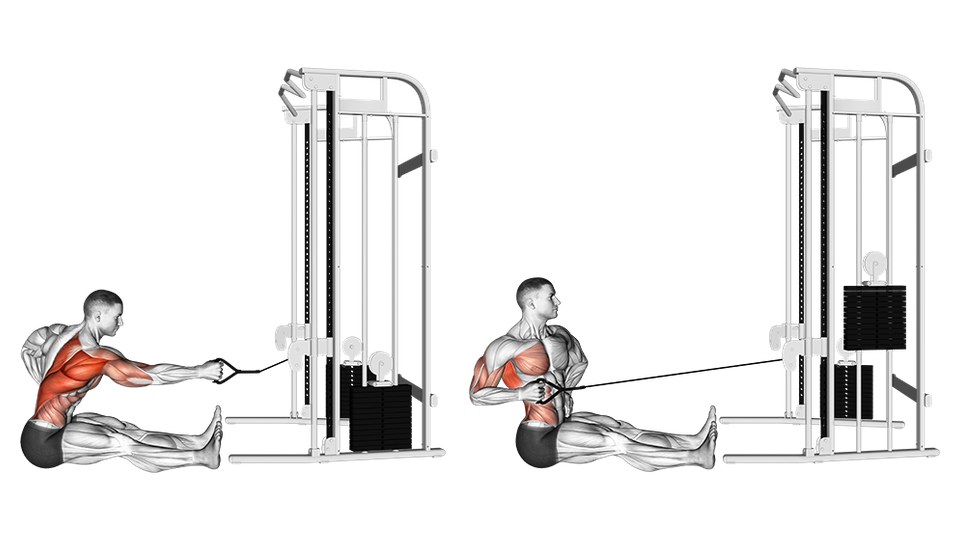
- Rope seated cable row — A rope pulled toward the sternum with the elbows high and the hands separating at the finish.
- Underhand seated cable row — Palms up on a straight bar, which tends to keep the elbows in close on its own.
- Standing cable row — Same pull from a low pulley without the seat, hinged forward with the feet staggered.
Articles
Related tools
Frequently asked questions
What muscles does the seated cable row work?
Two groups at once. At the shoulder, the latissimus dorsi and teres major draw the upper arm backwards and in toward the body, working as a pair. The back of the deltoid extends the arm and pulls it back on the horizontal. At the shoulder blade, the middle fibres of the trapezius and the rhomboids pull the blade toward the spine. The elbow flexors work as well, because the arm bends as the handle comes in: the brachialis flexes the elbow from any forearm position, the brachioradialis is active whether the palm faces up, down or sideways, and the biceps brachii contributes to flexion while being primarily a supinator. The trunk extensors hold your torso up against the cable rather than moving anything.
Is the seated cable row a lat exercise or an upper back exercise?
Both the lats and the muscles around the shoulder blades contribute. Studies of moving repetitions found greater lat activity with a narrow handle and greater trapezius activity with wider, elbows-out versions. Rear-deltoid results were less consistent between studies. These are activity measurements, not percentages of the work or predictions of which muscles will grow most.
Wide grip or close grip on the seated cable row?
Both are useful options. A narrow handle usually brings the elbows near the ribs; a wide bar lets them travel farther out. Research has found differences in muscle activity, but it has not established a superior grip for long-term growth. Choose a handle and elbow path you can control comfortably, and compare your progress using the same setup.
Should you lean back on a seated cable row?
Not as a way of moving the weight. Swinging the torso back and forth lets the hips and lower back throw the handle while the back muscles do less, and it loads the lumbar spine into repeated bending under tension. Whether you sit bolt upright the whole time or allow a small controlled lean forward at the stretch and come back to vertical at the finish is a preference — both are defensible, and the difference between them is much smaller than the difference between either and a heave.
Should your shoulder blades move at the front of the rep?
Yes. Letting the shoulder blades travel forward around the ribcage as the arms straighten is the range the muscles between them work through, and locking the shoulders back for the whole set removes it. That is a different thing from letting your lower back round: the chest stays lifted and the spine keeps its position while the blades slide.
Where should the handle finish?
At your midsection, and where exactly follows from the handle you chose. With a close neutral grip and the elbows near the ribs it lands around the navel; with a wide bar and the elbows out it lands higher on the abdomen. Pulling a wide bar low with tucked elbows, or hauling a narrow handle up to the collarbone, fights the line of the cable and leaves the shoulder in an awkward position at the end of the rep. Either way, stop once your elbows pass your ribs: travel past that point comes from the shoulder rather than from the shoulder blade.
Is the seated cable row worth doing?
Just over six in ten regular RepCount users have logged one at some point, and it appears in roughly one workout in thirteen — the profile of a staple rather than a novelty. About half of the workouts that contain a cable row also contain a pulldown, so plenty of lifters run both rather than choosing between them.
How many sets should I do?
Whatever your programme says, but for reference, workouts in RepCount that include a seated cable row carry about three sets of it, inside a session of around seven exercises. It is one movement in a full back session, not the session.
Sources
- Anatomy, Back, Latissimus Dorsi. StatPearls. https://www.ncbi.nlm.nih.gov/books/NBK448120/
- Anatomy, Back, Rhomboid Muscles. StatPearls. https://www.ncbi.nlm.nih.gov/books/NBK534856/
- Anatomy, Back, Trapezius. StatPearls. https://www.ncbi.nlm.nih.gov/books/NBK518994/
- Syros A, Rizzo MG. Anatomy, Shoulder and Upper Limb, Teres Major Muscle. StatPearls. https://www.ncbi.nlm.nih.gov/books/NBK580487/
- Wu JG, Bordoni B. Anatomy, Shoulder and Upper Limb, Scapulohumeral Muscles. StatPearls. https://www.ncbi.nlm.nih.gov/books/NBK546633/
- Anatomy, Rotator Cuff. StatPearls. https://www.ncbi.nlm.nih.gov/books/NBK441844/
- Anatomy, Back. StatPearls. https://www.ncbi.nlm.nih.gov/books/NBK539746/
- Anatomy, Back, Muscles. StatPearls. https://www.ncbi.nlm.nih.gov/books/NBK537074/
- Anatomy, Shoulder and Upper Limb, Biceps Muscle. StatPearls. https://www.ncbi.nlm.nih.gov/books/NBK519538/
- Plantz MA, Bordoni B. Anatomy, Shoulder and Upper Limb, Brachialis Muscle. StatPearls. https://www.ncbi.nlm.nih.gov/books/NBK551630/
- Anatomy, Shoulder and Upper Limb, Forearm Brachioradialis Muscle. StatPearls. https://www.ncbi.nlm.nih.gov/books/NBK526110/
- Padovan R, Cè E, Longo S, Tornatore G, Trentin C, Esposito F, Coratella G. High-Density Surface Electromyography Excitation of Prime Movers in the Narrow vs. Wide Grip Seated Row Exercise. 2025. https://doi.org/10.5114/jhk/209550
- Vasconcelos CMWA, Lopes CR, Almeida VM, Krause Neto W, Soares EG. Effect Of Different Grip Position And Shoulder-Abduction Angle On Muscle Strength And Activation During The Seated Cable Row. 2023. https://doi.org/10.47206/ijsc.v3i1.190