A five-day PPLUL split with five saved routines
A PPLUL split is five workouts: push, pull, legs, upper, and lower. For this plan, train Monday through Wednesday, rest Thursday, then train Friday and Saturday. Save five routines and repeat that order each week.
Choose this split if five gym visits fit your week and you want dedicated push and pull sessions alongside a second upper-body day. If four sessions are already hard to fit in, an upper/lower split is a more practical starting point. A fifth workout is a scheduling choice, not an automatic upgrade.
Arrange the five sessions around two rest days
Use the schedule below as the starting arrangement. Keep the order when moving the workouts to different days, and retain the break between Legs and Upper.
| Day | Workout |
|---|---|
| Monday | Push |
| Tuesday | Pull |
| Wednesday | Legs |
| Thursday | Rest |
| Friday | Upper |
| Saturday | Lower |
| Sunday | Rest |
Push emphasizes pressing. Pull includes rows, pulldowns, and curls. Legs starts with squat. Upper brings pressing and pulling together, and Lower starts with deadlift. The two lower sessions have different main lifts rather than asking you to repeat the same session twice.
The tables are one complete starting plan. The set counts aren't a claim that this is the maximum workload everyone should do. Run the listed version first so you have something consistent to assess.
Push starts with bench press
Do bench press first, followed by shoulder press and the two accessories. The listed sets are working sets. Warm up separately before the heavier exercises, moving toward the working weight in manageable steps.
| Exercise | Working sets | Reps | Rest |
|---|---|---|---|
| Bench press | 3 | 6-8 | 2-3 minutes |
| Dumbbell shoulder press | 2 | 8-12 | 2 minutes |
| Dumbbell lateral raise | 2 | 12-15 | 1-2 minutes |
| Triceps pushdown | 2 | 10-15 | 1-2 minutes |
Start with weights that leave a couple of clean reps available. If your shoulder press suffers after bench, lower its starting weight rather than swapping the order every session. Compare the same exercise in the same position over time.
Pull leaves deadlift for the lower session
Use rows and pulldowns for Pull. This plan deliberately keeps deadlift out of this workout because Legs follows it the next day.
| Exercise | Working sets | Reps | Rest |
|---|---|---|---|
| Barbell row | 3 | 6-10 | 2 minutes |
| Lat pulldown | 3 | 8-12 | 2 minutes |
| Barbell bicep curl | 2 | 10-15 | 1-2 minutes |
Keep the row controlled. Changing your torso position or adding more momentum each week makes the weight harder to compare. Record the completed reps, even when they fall short of what you intended.
Legs starts with squat
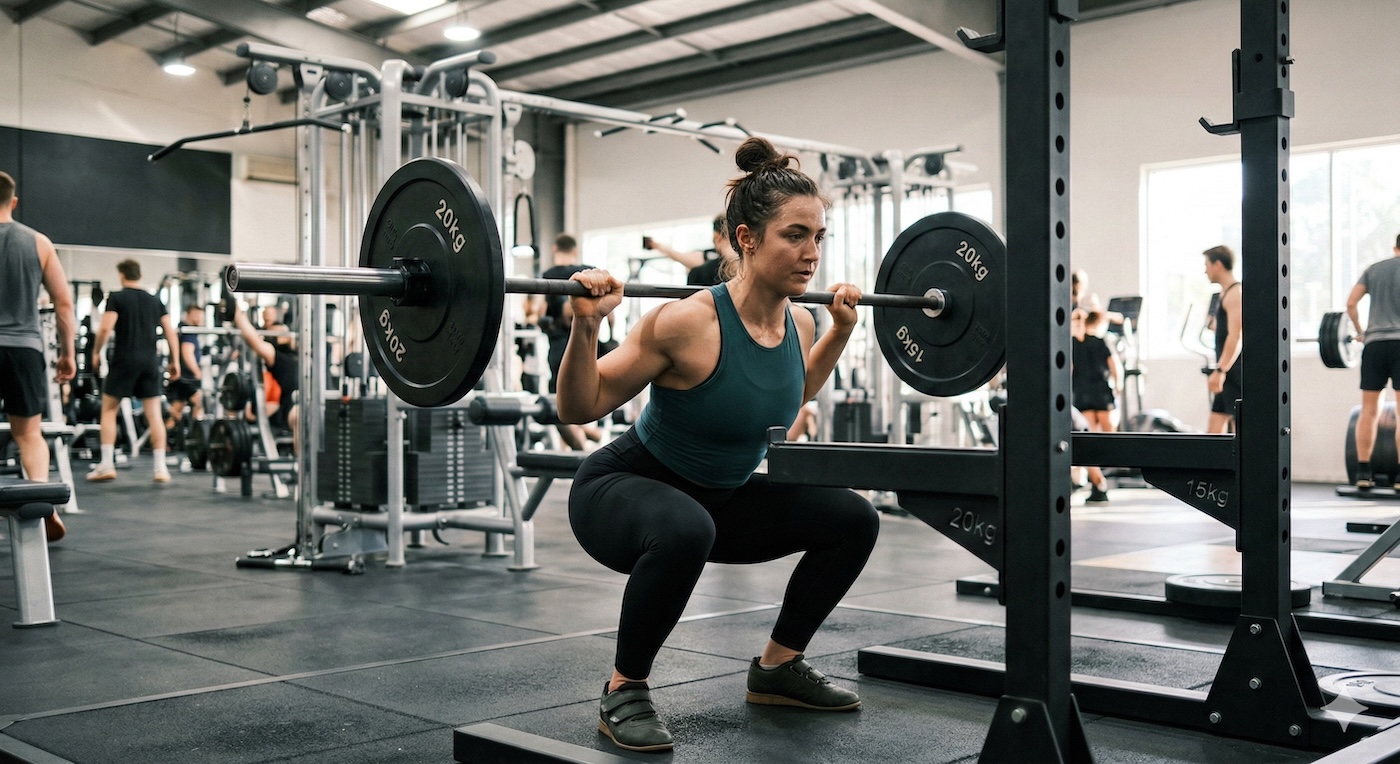
Squat is the main lift on this day. The leg curl and calf raise finish the workout without adding another heavy hinge.
| Exercise | Working sets | Reps | Rest |
|---|---|---|---|
| Barbell squat | 3 | 6-8 | 2-3 minutes |
| Leg curl | 3 | 10-15 | 2 minutes |
| Standing calf raise | 2 | 10-15 | 1-2 minutes |
Take the rest you need to repeat your technique. The rest times are starting points, not a countdown that forces you to begin a squat set before you're ready.
Upper combines pressing and pulling
Use incline dumbbell press, cable row, and pulldown as the main work. Add the optional accessories if you have time and can recover from the listed sessions.
| Exercise | Working sets | Reps | Rest |
|---|---|---|---|
| Incline dumbbell press | 3 | 8-12 | 2 minutes |
| Cable row | 3 | 8-12 | 2 minutes |
| Lat pulldown | 2 | 8-12 | 2 minutes |
| Dumbbell lateral raise, optional | 2 | 12-15 | 1-2 minutes |
| Triceps pushdown, optional | 2 | 10-15 | 1-2 minutes |
Pulldown has two sets here and three on Pull. Keep its targets tied to the routine rather than expecting the two workouts to produce identical numbers. The incline press also has its own progression, separate from Monday's bench press.
Lower starts with deadlift
Do deadlift before leg press and the remaining accessories. Two deadlift sets are the prescription here; don't add sets simply to make the table look longer.
| Exercise | Working sets | Reps | Rest |
|---|---|---|---|
| Deadlift | 2 | 5-6 | 2-3 minutes |
| Leg press | 3 | 8-12 | 2 minutes |
| Leg curl | 2 | 10-15 | 2 minutes |
| Seated calf raise | 2 | 12-20 | 1-2 minutes |
Leg curl appears in both lower workouts with different set counts. Compare this workout with your previous Lower session. Keep warm-up sets separate from the working sets when judging whether you've completed the prescription.
Add reps before increasing the weight
For each exercise, keep the weight until every working set reaches the top of its rep range with consistent technique. Then try the smallest available increase. If the new weight takes you below the bottom of the range, use a smaller jump or return to the previous load.
A three-set bench press at 6-8 reps might progress like this:
| Push session | Weight | Completed reps | Next step |
|---|---|---|---|
| First | 40 kg | 8, 7, 6 | Keep 40 kg |
| Next | 40 kg | 8, 8, 7 | Keep 40 kg |
| Next | 40 kg | 8, 8, 8 | Try the next manageable increase |
Those weights and sessions illustrate the rule. They aren't prescribed starting weights or a promised rate of progress. For deadlift's two sets, both need to reach six reps before increasing the load.
The 2026 ACSM review by Currier and colleagues supports progressive resistance training and found that complete muscular failure wasn't consistently necessary for better outcomes. You don't need to turn every accessory set into a test of how long you can keep moving the weight.
Save five routines without a routine limit
Create Push, Pull, Legs, Upper, and Lower separately in RepCount. The free version has unlimited routines, so all five can stay saved alongside your other workouts.
Get RepCount for iPhone · Get RepCount for Android
These links open the store listings. Enter the workouts manually; they don't import this split or build a weekly schedule.
Add the exercises in table order and enter the working-set count. Save rep ranges and rest times in exercise notes. For bench press, a useful note is: 3 sets of 6-8. Rest 2-3 minutes. Add weight after 8, 8, 8 with consistent technique.
Set routine targets to reference the previous session of that routine if you want Pull and Upper to keep their own pulldown values. Log the reps and weight you actually perform. Detailed exercise-history analysis is a separate Premium feature; saving and following these five routines doesn't require it.
Change the schedule when five days stop fitting
After a missed session, continue with that routine next and keep the order moving. Don't combine two complete workouts to force the calendar back into place. If five visits repeatedly become four, move to the four-day upper/lower plan rather than leaving Lower out every week.
For a busy Upper session, remove the optional accessories first. If several lifts keep slipping, review rest, technique, and workload before adding more exercises. Repeat a weight after one poor session; reduce and rebuild when the same lift keeps going backward.
PPLUL organizes the work. Ramos-Campo and colleagues' 2024 review found similar full-body and split outcomes when weekly volume was matched. That doesn't validate this exact five-day prescription or make it superior to another split.
Start by setting up Push and logging the first session. Then save the other four so the next workout is ready. Download RepCount for iPhone or Android to keep all five routines for free.
Frequently asked questions
What does PPLUL mean?
PPLUL means push, pull, legs, upper, lower. This five-day split starts with three workouts organized by movement or body region, then adds an upper-body workout and a lower-body workout.
Is PPLUL better than upper/lower?
A fifth day doesn't automatically make a plan better. PPLUL spreads the work over five visits, while upper/lower uses four. Choose the schedule you can follow and judge the workload and progression, rather than the name alone.
Can I save five routines in RepCount for free?
Yes. RepCount has unlimited free routines. Create Push, Pull, Legs, Upper, and Lower separately, then enter the exercises and working sets manually.
Should I deadlift on pull day?
In this plan, deadlift belongs on the final Lower day. Pull day is followed by Legs day, so moving deadlift there would change the workload and spacing. Follow the listed order before experimenting with it.
Does the download link import this split?
No. The download links open RepCount's store listings. You create the five routines yourself and use this guide to choose the next workout and decide when to add weight.