
Pull-up
Also called pullup, pull up, overhand pull-up, pronated pull-up.
What is a pull-up?
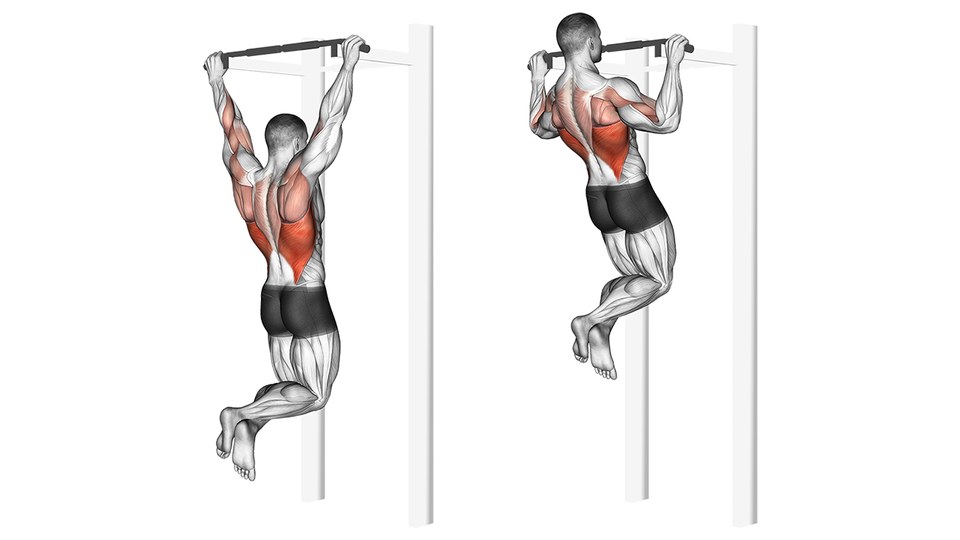
A pull-up is a bodyweight pull to a bar from a hanging start, palms facing away. It trains the latissimus dorsi and teres major, which act together on the upper arm, along with the elbow flexors and the muscles that pull the shoulder blades down and together.
How do you perform a pull-up?
Set up
- Take the bar with your palms facing away and your hands about shoulder width apart or a little wider.
- Hang with straight arms, ribs down and glutes squeezed.
Execution
- Pull your shoulder blades down, then bend your arms and drive your elbows toward your ribs.
- Pull until your chin clears the bar without kicking your legs.
- Lower under control to a straight-arm hang.
Common mistakes
Choosing a grip in order to target a muscle
Grip changes what the arms and the shoulder blades do; it does not decide how much work the lats get. Pick the grip your shoulders and elbows tolerate. See the scientific studies ↓
Kicking the legs to finish the rep
A kip turns a strength exercise into a timing exercise. Nothing wrong with it as its own skill, but a set that needs it is no longer a record of how strong your pull is, which makes it hard to compare week to week.
Counting half reps from the top
Stopping at a bent arm makes the set easier to count and harder to compare. Start every rep from a straight arm so the number means the same thing next week.
Never adding load once the reps get high
Bodyweight is a fixed load, so past a certain number of reps a set stops being strength work and becomes endurance work by default rather than by choice.
Where it fits in a session
Early in a pulling session, while you are fresh. The load is your bodyweight and you cannot drop it, so fatigue costs you reps rather than kilos.
Bodyweight is a fixed load, which makes progression a question of adding reps until adding weight makes more sense. At the other end, a band, a machine or slow negatives train the movement before a full repetition exists, and the pull-down route has an eight-week trial behind it rather than only habit.
Muscles worked
Primary
Secondary
Schematic surface view. Some muscles are partly visible or not shown.
Latissimus dorsi and teres major are listed together rather than ranked. They act on the humerus the same way, their tendons often join near the insertion, and an anatomy reference records EMG studies showing the two activate as a single muscle unit — a surface electrode over the back cannot cleanly assign work to one or the other, so a ranking between them would be a measurement artefact rather than a finding. The rest of the list is drawn from the muscles that pull-up studies actually recorded, in samples of ten to twenty-five people. Treat it as what has been measured, not as a league table.
What lifters actually do
Around 44% of regular RepCount users have logged a pull-up, and it appears in roughly one workout in fourteen. When it does appear it is usually about three sets inside a full session of around seven exercises, and the movements it most often sits beside are cable rows, pulldowns, hammer curls and barbell rows. That is a back-day staple rather than a standalone test, and it keeps company with the cable and machine pulling rather than standing apart from it.
Most often trained alongside
Share of pull-up sessions that also include each exercise.
- Cable row20%
- Pulldowns19.6%
- Hammer curl18.1%
- Barbell row16.5%
- Dumbbell bicep curl15.8%
Figures come from workouts tracked in RepCount.
What the evidence says
Search for how to grip a pull-up and the pages written to answer that question mostly say the same thing: a wider grip loads the lats and takes the biceps out. Some attach numbers — one figure circulating inside AI answer summaries has pull-ups producing 23% more back activation than chin-ups, and 35% less biceps. This is not unanimous, and a couple of the larger guides already say grip makes little difference. But the direction is asserted far more often than it is qualified, and the percentages are not traceable to a study.
A 2026 narrative review in the Journal of Functional Morphology and Kinesiology takes the pull-up literature to be four primary studies, a combined n of about 84, and concludes that "Pull-up and chin-up variants showed broadly comparable latissimus dorsi EMG amplitude across grip configurations". It lists that comparability among the small set of findings in the whole review "supported by multiple, directionally consistent studies", grades it moderate certainty, and turns it into the opposite of the usual advice: grip "can be selected based on secondary goals (e.g., elbow-flexor emphasis), since LD amplitude is broadly comparable across variants".
The individual studies say the same thing in their own words. Dickie and colleagues (2017, nineteen strength-trained men) compared supinated, pronated, neutral and rope pull-ups and concluded that activation "of the shoulder-arm-forearm complex during complete repetitions of pull-up variants are similar despite varying hand orientations". The one difference between grips that reached significance was in the middle trapezius, higher with a pronated grip than a neutral one (60.1 against 37.1 percent of maximum voluntary contraction, P = 0.004). Snarr and colleagues (2017, fifteen resistance-trained men and women) compared bar, suspension-device and towel pull-ups and reported "No significant differences existed within the latissimus dorsi, biceps brachii or posterior deltoid between any of the exercises" — and again the only muscle that moved was the middle trapezius. Youdas and colleagues (2010, twenty-one men and four women) compared the pull-up, the chin-up and a rotating-handle device: the significant differences were pectoralis major and biceps brachii higher in the chin-up, and lower trapezius higher in the pull-up. Latissimus dorsi is not on that list, which is worth stating precisely — the lat means ran from 117% to 130% of maximum voluntary contraction across the three exercises, so they were not identical, they simply did not separate in a sample of twenty-five.
One study asked the question without an electrode. Ortega-Rodríguez and colleagues (2021, fourteen trained men) tested a pull-up one rep max and a reps-to-failure test at each lifter's self-chosen grip and at a narrower biacromial grip. The self-chosen grip averaged 20% wider. One rep max was unchanged (p = .954), reps to failure were unchanged (p = .117), and so was the power-force-velocity profile. If a wide grip really shifted the work onto a different set of muscles, something in that test should have moved.
The paper the wide-grip claim could rest on is Raizada and Bagchi (2019), ten healthy men performing one repetition of each of six grips, and it is the one place this page has to be careful. We could only read the publisher's abstract; the full text was not obtainable. That abstract concludes that a prone wide grip is "a more effective exercise for the activation of upper back muscle-Latissimus Dorsi". But its own results sentence reports only that a prone narrow grip differed significantly from the two wider prone grips, without saying in which direction, and adds that "other pull ups exercises may be similarly effective in activating Latissimus Dorsi". The 2026 review, whose authors read the full paper, records the finding the other way round: "wider pronated grips were associated with a slight reduction in latissimus dorsi EMG amplitude". We cannot adjudicate that from an abstract. What can be said is that the only pull-up study to vary grip width with electrodes attached is ten men doing one repetition per grip, and that its abstract and a peer-reviewed reading of its full text point in opposite directions.
The lat pull-down literature is adjacent rather than on point, and it contains the finding least kind to this page, so here it is. Andersen and colleagues (2014, fifteen men) opened by naming the belief under test: "it is a general belief that a wider grip activates the latissimus dorsi more than a narrow one, but without any broad scientific support". Over the whole movement they found similar activation across narrow, medium and wide grips, and six-rep-max loads were highest with the narrow and medium grips rather than the wide one. But analysing the lowering phase on its own, they did find greater latissimus and infraspinatus activation with the wide grip than the narrow one (p at or below 0.04). That is the one result in this whole set that goes the believers' way, and it is phase-specific. Lusk and colleagues (2010, twelve men) found a pronated grip produced more latissimus activity than a supinated one and recommended a pronated pull-down "irrespective of the grip width". Neither study is a pull-up study.
There is a reason to distrust the percentage genre in general, and it comes from the sources rather than from us. The 2026 review's own limitations section says conventional surface electrodes sample "a relatively small, fixed region" of a muscle as broad and fan-shaped as the lat, and that "Cross-talk from adjacent musculature (e.g., teres major, lower trapezius, and the thoracolumbar paraspinals)" can change the recorded signal independently of what the muscle is really doing. The anatomy says the same from the other side: StatPearls records that the latissimus dorsi and teres major tendons "often join near the insertion site" and that EMG studies show the two "activate as a single muscle unit". Offered as our reasoning rather than as a finding in either source: a claim that one grip delivers 23% more lat than another is being made with an instrument that cannot reliably tell the lat from the muscle beside it that shares its insertion and its job.
So the honest reading is that grip width and hand position are a preference on this evidence, not a prescription. Pick what your shoulders and elbows tolerate and what lets you add reps. The illustration on this page shows a wide pronated grip because a still can only show one grip; it is not a recommendation. Two further caveats, both the review's own. It is explicit that none of the studies it covered was longitudinal, so words like "effectiveness", "optimal" and "best" in this literature "should be understood as referring to acute EMG amplitude and not to demonstrated superiority for muscle growth or long-term performance". And every sample here is small and all-male or male-predominant; the review notes that female and older adult populations are essentially absent from the evidence base.
On reading depth, since it changes how much weight each of these carries. The 2026 review was read in full, from the publisher's PDF. The eight-week pull-down trial cited in the FAQ below was read in full. Dickie, Youdas, Snarr, Ortega-Rodríguez, Andersen and Lusk were read as their published abstracts, retrieved from the journal record rather than from a search summary, so the figures quoted above are the ones those abstracts state and not readings of their results tables. Raizada and Bagchi was read as its publisher abstract page alone, which is why it is reported as a disagreement rather than as a debunking.
Variations
- Chin-upPalms facing you. In Youdas et al., which directly compared the pull-up and chin-up, the chin-up produced more biceps and pectoralis major activity, with no significant difference in the lats.
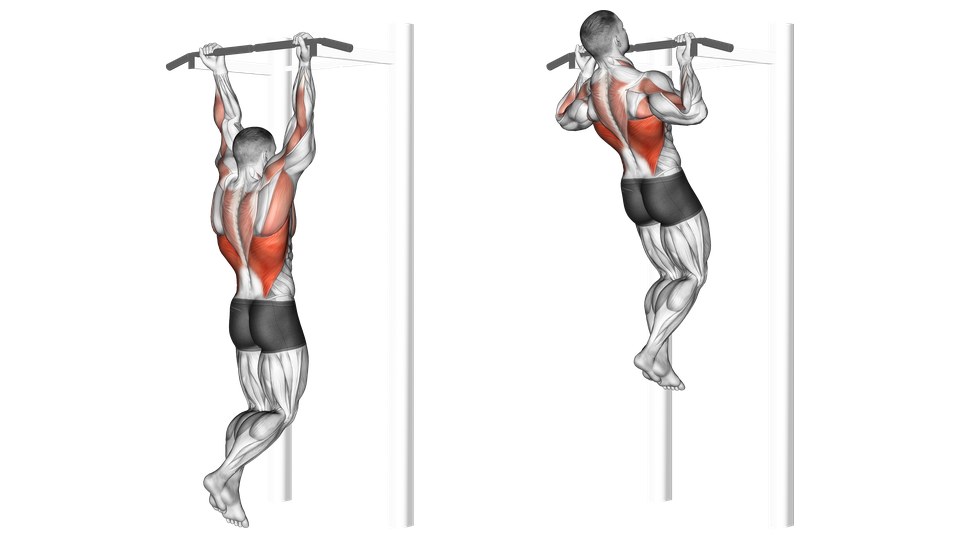
- Neutral-grip pull-up — Palms facing each other on parallel handles. Often the kindest option for a cranky shoulder or elbow.
- Wide-grip pull-up — The grip the illustration shows. Widely sold as the lat version, which is the claim the evidence on this page does not support.
- Weighted pull-upBelt, vest or a dumbbell between the feet. The usual answer once bodyweight sets run long.
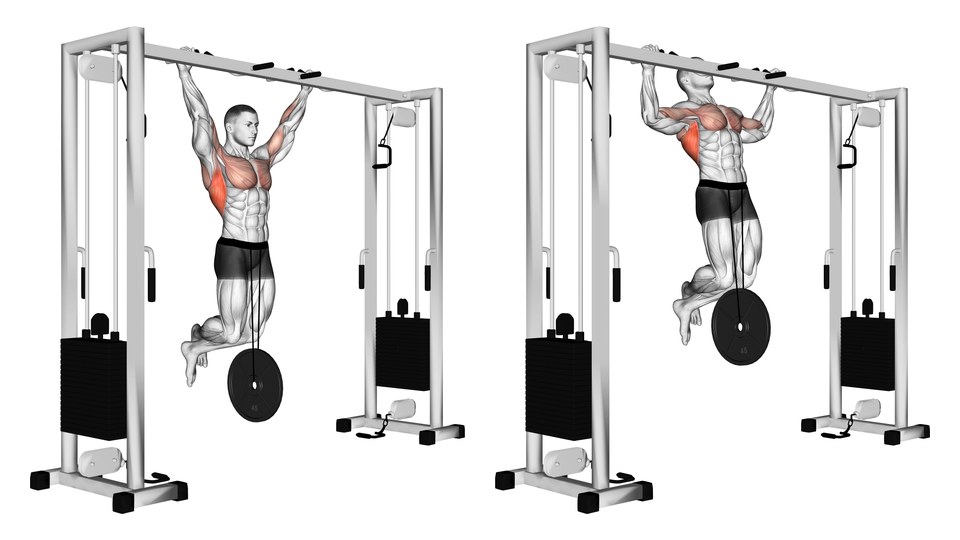
- Assisted pull-upBand or machine taking part of the load, so the movement can be trained before a full rep exists.

- Negative pull-up — Jump or step to the top and lower slowly. A way to train the movement without being able to pull one yet.
- Ring pull-up — Gymnastic rings let the hands rotate through the rep instead of being fixed by a bar.
- Towel pull-up — Towels over the bar. Tested against the standard version: it changed grip demand and middle trapezius activity, not what the lats did.
Articles
Related tools
Frequently asked questions
What muscles do pull-ups work?
The latissimus dorsi and teres major, which extend and adduct the upper arm and act so closely together that EMG studies describe them as a single unit; the elbow flexors, mainly biceps brachii; and the muscles that control the shoulder blade, particularly the middle and lower trapezius. In a study of twenty-five people that recorded seven muscles at once, across the pull-up, the chin-up and a rotating-handle device, latissimus dorsi averaged 117% to 130% of a maximum voluntary contraction and biceps brachii 78% to 96%, with infraspinatus, lower trapezius, erector spinae and external oblique all lower.
Do wide-grip pull-ups work the lats more?
Not on the available evidence. A 2026 review of four pull-up studies concluded that latissimus dorsi activation is broadly comparable across grip configurations, and a separate trial in fourteen trained men found that grip width changed neither one rep max nor reps to failure. The only pull-up study to vary grip width with electrodes attached had ten men perform a single repetition per grip, and its abstract and the review that read its full text describe its latissimus result in opposite directions. Wide grips are fine. They are not a lat setting.
Pull-ups or chin-ups for the back?
The study that compared them directly, in twenty-five people, found significantly more pectoralis major and biceps brachii in the chin-up and more lower trapezius in the pull-up. Latissimus dorsi was not among the significant differences. So the honest answer is that the choice changes what your arms and shoulder blades do rather than what your back does. If your elbows prefer one of them, that is a better reason than any activation claim.
What grip width should I use?
Whatever you can pull from comfortably and repeat. This is a preference, not a technique point: nothing in the pull-up evidence favours one width over another for the back, and the one study that tested performance found self-chosen grips 20% wider than a standard biacromial grip with no difference in strength or reps. The illustration on this page shows a wide grip because a picture has to show something. Read it as one option, not as the instruction.
Can lat pulldowns help me get my first pull-up?
Nobody has tested that exact question, but the nearest trial is encouraging. Thirty-four recreationally active male college students, every one of whom could already do at least one pull-up, trained lat pull-downs three times a week for eight weeks, four sets of twelve, with no pull-ups anywhere in either group's programme. Pull-up repetitions rose from about 2 to 5.8 in the group training on a stable machine and to 8.5 in the group training with added instability. So the pull-down transfers at the bottom of the range, in a small, young, all-male sample. Whether it takes you from none to one is untested.
Are pull-ups a good core exercise?
They involve the trunk, but the numbers do not support treating them as abdominal work. In a twenty-five-person study of the pull-up, the chin-up and a rotating-handle device, the two trunk muscles recorded were the lowest of the seven: external oblique at 31% to 35% of a maximum voluntary contraction and erector spinae at 39% to 41%, against 117% to 130% for the latissimus dorsi. Staying rigid is what keeps the rep honest, not what makes the exercise work.
How many pull-ups should I be able to do?
Nobody can tell you honestly. The rep targets that circulate are not traceable to any dataset of lifters, and ours would be no better: bodyweight is recorded on too few of the workouts we can see to build one from. The useful comparison is your own — whether the reps you can do with a full hang at the bottom and your chin over the bar have moved over the last few months, at the same bodyweight.
Are pull-ups worth doing?
Around 44% of regular RepCount users have logged a pull-up, and they turn up in roughly one workout in fourteen. When they appear it is usually about three sets inside a full session of around seven exercises, most often alongside cable rows, pulldowns, hammer curls and barbell rows. Lifters treat them as one part of a pulling session rather than as a test to be passed.
Does grip strength limit your pull-ups?
It can, and it is worth telling apart from a back that has run out. If your hands open before your pull slows down, the set ended for a reason that has nothing to do with your lats. One review notes that grip assistance devices reduce forearm muscle activity during pulling without meaningfully changing latissimus dorsi activation, which is a fair description of what straps do: they move the limit, they do not train past it. If your grip is what ends your sets, it is worth training as its own limiter rather than cutting the sets short.
Sources
- Di Fonza D, Di Claudio G, Colantuono G, Persichini L, Cerulo N, Sangregorio B, Buonsenso A, Fiorilli G, Calcagno G, di Cagno A. Electromyographic Analysis of Latissimus Dorsi Activation During Common Resistance Training Exercises: A Narrative Review. J Funct Morphol Kinesiol. 2026;11(3):315. https://doi.org/10.3390/jfmk11030315
- Dickie JA, Faulkner JA, Barnes MJ, Lark SD. Electromyographic analysis of muscle activation during pull-up variations. J Electromyogr Kinesiol. 2017;32:30-36. https://pubmed.ncbi.nlm.nih.gov/28011412/
- Youdas JW, Amundson CL, Cicero KS, Hahn JJ, Harezlak DT, Hollman JH. Surface electromyographic activation patterns and elbow joint motion during a pull-up, chin-up, or Perfect-Pullup rotational exercise. J Strength Cond Res. 2010;24(12):3404-3414. https://pubmed.ncbi.nlm.nih.gov/21068680/
- Snarr RL, Hallmark AV, Casey JC, Esco MR. Electromyographical Comparison of a Traditional, Suspension Device, and Towel Pull-Up. J Hum Kinet. 2017;58:5-13. https://pmc.ncbi.nlm.nih.gov/articles/PMC5548150/
- Ortega-Rodríguez R, Feriche B, Almeida F, Bonitch-Góngora J, Padial P. Effect of the Pronated Pull-Up Grip Width on Performance and Power-Force-Velocity Profile. Res Q Exerc Sport. 2021;92(4):651-658. https://pubmed.ncbi.nlm.nih.gov/32669057/
- Raizada S, Bagchi A. A Comparative Electromyographical Investigation of Latissimus Dorsi and Biceps Brachii Using Various Hand Positions in Pull Ups. Indian J Public Health Res Dev. 2019;10(7):1624-1629. https://indianjournals.com/article/ijphrd-10-7-309
- Andersen V, Fimland MS, Wiik E, Skoglund A, Saeterbakken AH. Effects of grip width on muscle strength and activation in the lat pull-down. J Strength Cond Res. 2014;28(4):1135-1142. https://pubmed.ncbi.nlm.nih.gov/24662157/
- Lusk SJ, Hale BD, Russell DM. Grip width and forearm orientation effects on muscle activity during the lat pull-down. J Strength Cond Res. 2010;24(7):1895-1900. https://pubmed.ncbi.nlm.nih.gov/20543740/
- Li Q, Yan J, Qiao M, Quan J, Chen Y, Gong M, Niu W, Wang L. Eight-week lat pull-down resistance training with joint instability leads to superior pull-up endurance performance and reduced antagonist coactivation in recreationally active male college students. Eur J Sport Sci. 2025;25:e12243. https://pmc.ncbi.nlm.nih.gov/articles/PMC11667758/
- Jeno SH, Varacallo MA. Anatomy, Back, Latissimus Dorsi. StatPearls. https://www.ncbi.nlm.nih.gov/books/NBK448120/
- Syros A, Rizzo MG. Anatomy, Shoulder and Upper Limb, Teres Major Muscle. StatPearls. https://www.ncbi.nlm.nih.gov/books/NBK580487/
- Ourieff J, Scheckel B, Agarwal A. Anatomy, Back, Trapezius. StatPearls. https://www.ncbi.nlm.nih.gov/books/NBK518994/
- Tiwana MS, Charlick M, Varacallo MA. Anatomy, Shoulder and Upper Limb, Biceps Muscle. StatPearls. https://www.ncbi.nlm.nih.gov/books/NBK519538/
- Urbanczyk CA, Prinold JAI, Reilly P, Bull AMJ. Avoiding high-risk rotator cuff loading: Muscle force during three pull-up techniques. Scand J Med Sci Sports. 2020. https://doi.org/10.1111/sms.13780
- Prinold JAI, Bull AMJ. Scapula kinematics of pull-up techniques: Avoiding impingement risk with training changes. J Sci Med Sport. 2016. https://pmc.ncbi.nlm.nih.gov/articles/PMC4916995/