
Two-arm dumbbell row
Also called bent-over two-dumbbell row.
What is a two-arm dumbbell row?
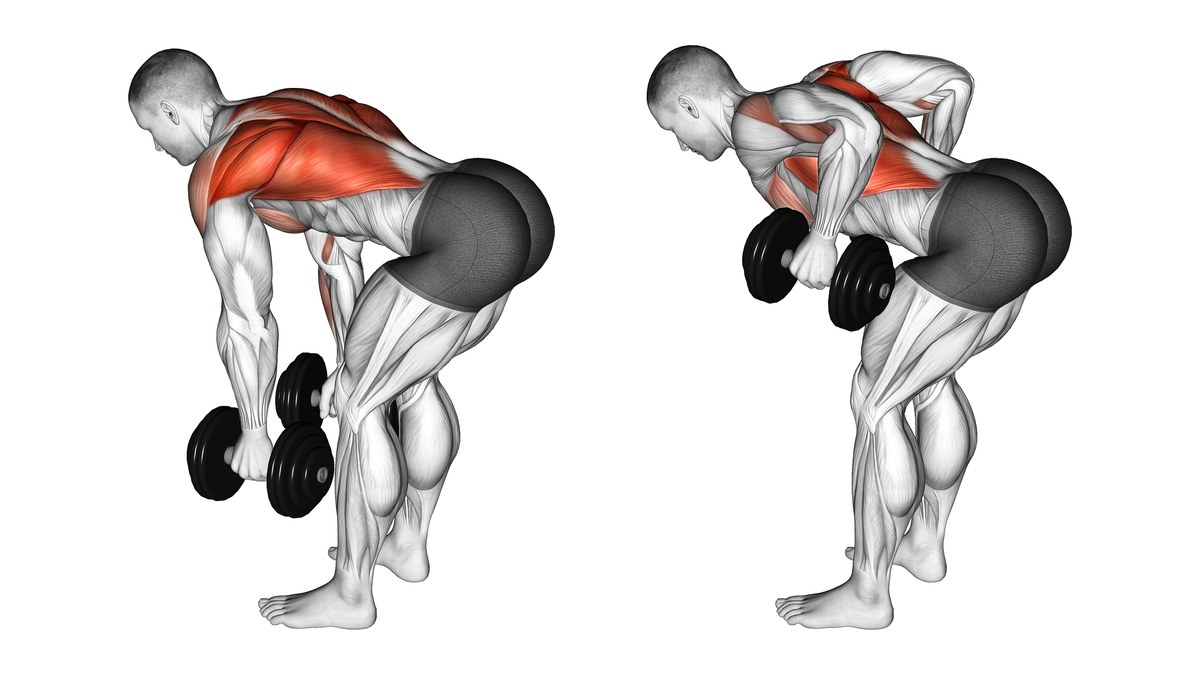
A two-arm dumbbell row lifts a dumbbell in each hand at the same time while you hold a standing hip hinge. Your palms face one another and your elbows travel back near your sides. The back and elbow flexors pull the weights; your trunk stays unsupported throughout the set.
How do you perform a two-arm dumbbell row?
Set up
- Stand upright holding a matched pair of dumbbells beside your thighs, with your palms facing each other and your feet around hip-width apart.
- Soften your knees and move your hips backward as you tip your torso forward, keeping your back in a steady, natural shape.
- Settle into a hinge with your torso close to horizontal, your arms hanging below your shoulders and your abdomen braced. Look at the floor a little ahead of your feet.
Execution
- Row both dumbbells toward your lower ribs, drawing your elbows backward near your sides and your shoulder blades toward each other. Keep your chest at the same height.
- Lower the weights smoothly until your elbows straighten and your shoulder blades reach forward. Keep your trunk angle steady as you repeat.
- After the last rep, let your arms hang and stand tall with the dumbbells at your sides. Bend your hips and knees to set them down under control.
Common mistakes
Standing up a little with every pull
The hip drive starts lifting the weights before the arms have rowed them. Try a lighter pair and keep the same torso position through the rep.
Sending the elbows wide toward shoulder height
That changes the close-elbow row taught here into a wider-elbow row. Bring the weights toward the lower ribs with room between the dumbbells and your knees.
Leaving the elbows bent at the bottom
Each new rep then begins with the arms already partway through the pull. Let them lengthen without changing the shape of your back before you row again.
Where it fits in a session
Put the row where you can still hold the hinge steadily. If earlier work leaves you unable to maintain that position, use a supported row or move this exercise earlier in the session.
Start with a pair you can lower smoothly while keeping both sides moving together. Increase the weight when your planned reps stay consistent from the first to the last, rather than adding load by standing up farther.
Muscles worked
Primary
Secondary
Schematic surface view. Some muscles are partly visible or not shown.
The back and rear shoulders move the upper arms and shoulder blades, while the biceps help bend the elbows. The spinal extensors help hold the bent-over position.
Variations
- One-arm dumbbell row with bench supportThe working arm rows while the other hand and the same-side knee brace on a bench. This changes the support and lets you do one side at a time.
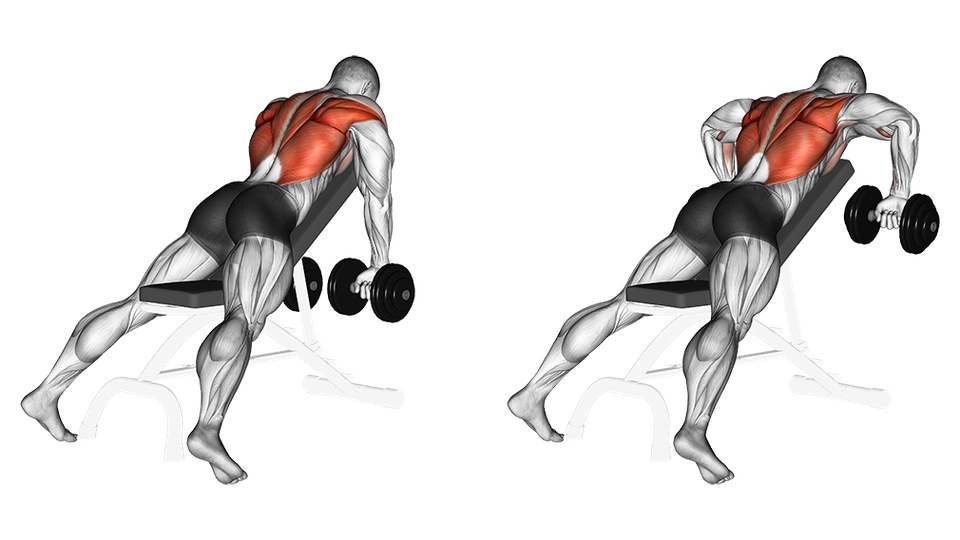
- Chest-supported dumbbell rowYour chest rests on an incline bench while both dumbbells row, instead of holding the torso in a standing hinge.
Frequently asked questions
Do I need a bench for a two-arm dumbbell row?
No. This version uses two dumbbells and a standing hip hinge, with neither hand resting on a support. A one-arm bench-supported row and a chest-supported row use different setups.
How far forward should I bend?
Aim for a torso position close to horizontal that you can hold with a steady back. Keep a small bend in the knees and move the hips back. If you cannot hold that position while rowing a light pair, practise the hinge without weights or choose a supported row.
Should I lift both dumbbells together or alternate?
Move them together for the version taught here. Alternating rows are another option, but keep that choice consistent within the set rather than switching when one arm starts to lag.
Is this the same as the one-arm dumbbell row?
Both are dumbbell rows. Here, each hand holds a weight and both arms pull together without bench support. In the bench-supported one-arm setup, the free hand and the same-side knee rest on the bench while the other arm rows.
How heavy should the dumbbells be?
Choose the weight by the position you can hold. You should be able to finish your planned reps without repeatedly standing up, losing your back position or letting one arm race ahead. Reduce the load if those changes appear.
Sources
- Javed O, Maldonado KA, Ashmyan R. Anatomy, shoulder and upper limb, muscles. StatPearls. Updated July 24, 2023. https://www.ncbi.nlm.nih.gov/sites/books/NBK482410/
- Betts JG et al. Anatomy and physiology 2e. Section 11.3, axial muscles of the head, neck, and back. OpenStax, 2022. https://openstax.org/books/anatomy-and-physiology-2e/pages/11-3-axial-muscles-of-the-head-neck-and-back
- Ourieff J, Scheckel B, Agarwal A. Anatomy, back, trapezius. StatPearls. Updated March 11, 2023. https://www.ncbi.nlm.nih.gov/sites/books/NBK518994/