
Lat pulldown
Also called lat pull-down, front lat pulldown, cable pulldown.
What is a lat pulldown?
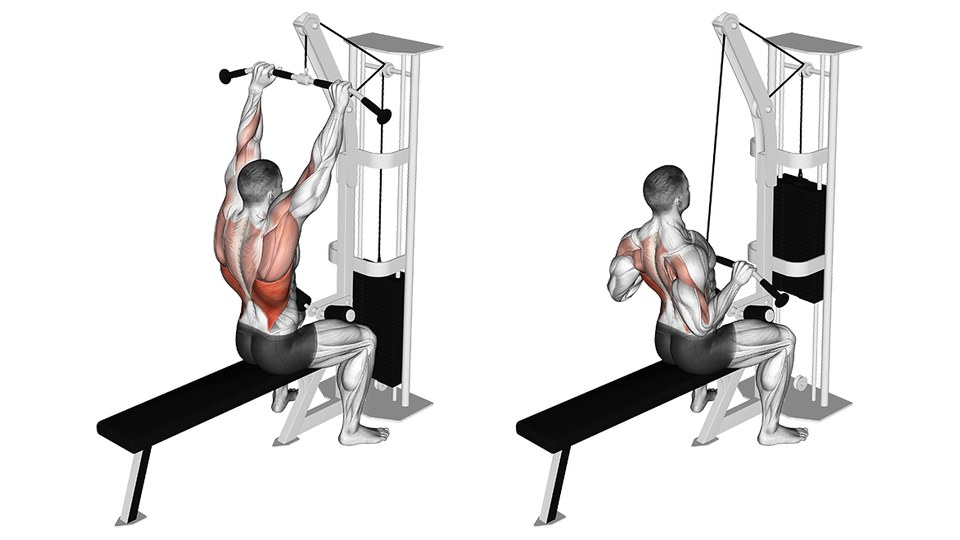
The lat pulldown is a seated cable or machine exercise: you pull a bar down from overhead to your upper chest. It trains the latissimus dorsi and teres major, which pull the upper arm down and in toward the body, with the biceps and rear deltoid helping at the elbow and shoulder and the trapezius and rhomboids controlling the shoulder blade. Grip width is a preference: use a grip you can hold and control, and put your effort into the load and the reps.
How do you perform a lat pulldown?
Set up
- Choose a weight you can control, then set the thigh pad snugly over your thighs so it holds you in the seat.
- Take an overhand grip slightly wider than shoulder width.
- Sit with your hips under the bar, feet flat, chest up, and arms straight overhead.
Execution
- Keep a small, steady backward lean and pull the bar down in front of your face toward your upper chest.
- Drive your elbows down toward your ribs, letting your shoulder blades move down with your arms.
- Stop at your upper chest, or sooner if your shoulders start to roll forward.
- Return the bar under control until your arms are straight overhead and your shoulder blades rise naturally.
Common mistakes
Rowing the torso back and forth to move the bar
A swinging torso does part of the work and makes each rep a slightly different exercise, which is a problem for progressing the load over time. Holding one trunk angle throughout is what makes this week's set comparable to last week's.
Choosing a grip width to target a region of the lat
The grip comparisons here do not establish that a wide grip builds the upper lats or a close grip builds the lower lats. They measured electrical activity rather than regional muscle growth. Choose for comfort and control.
Pulling behind the neck for more lat
Behind-the-neck pulldowns have not shown a consistent lat-activity advantage in the comparisons here. The front version remains our default. One study found higher lat activity in front during the pull, but higher activity behind during the return, with different loads in the two versions. These are not measurements of growth or injury risk.
Stopping the return short of straight arms
Judgment rather than evidence on this exercise: cutting the top short shrinks the range you are training and makes the set easier in a way that is easy to miss when you compare it with last week's.
Where it fits in a session
Early in a pull or upper-body session, while you can still control the trunk, or straight after a heavy row.
A compound movement for a large muscle, so it takes real load and benefits from being progressed rather than chased with variations. If you are changing grip week to week, change it because your shoulders or elbows prefer it, not because you expect a different muscle to grow.
Muscles worked
Primary
Secondary
Schematic surface view. Some muscles are partly visible or not shown.
The two primaries are listed together rather than ranked. The latissimus dorsi and teres major share a line of pull almost exactly — both run from the back to the intertubercular groove of the humerus, the latissimus to its floor and the teres major to its medial lip, with the two tendons often joining before they get there — and electromyographic work described in the teres major anatomy reference has them behaving as a single unit, so no source here supports putting one above the other. The secondaries do different jobs and are not interchangeable: biceps brachii bends the elbow, posterior deltoid and infraspinatus work at the shoulder, and the trapezius and rhomboids move the shoulder blade rather than the arm. The muscle-activity studies below do not establish a grip that selectively trains one region of the back.
What lifters actually do
About two thirds of regular RepCount users have logged a lat pulldown, and it turns up in roughly one workout in nine. Those are sessions of about seven exercises, with around three and a half sets of pulldowns in each. The movement it sits beside most often is a cable row, in about a third of its sessions, then hammer curls, dumbbell curls and barbell rows — the ordinary shape of a pull day. That is worth noting against the idea that pulldowns and rows do two different jobs: in a third of the sessions containing a pulldown the lifter did a cable row as well, rather than picking one of the two.
Most often trained alongside
Share of lat pulldown sessions that also include each exercise.
- Cable row34.1%
- Hammer curl21.2%
- Dumbbell bicep curl18.9%
- Barbell row15.4%
Figures come from workouts tracked in RepCount.
Scientific studies on the lat pulldown
Does a wider grip build a wider back? Does pulling behind the neck train the lats more? The studies below compare grip, bar path and trunk angle, with a distinction between muscle activity during a set and muscle growth over time.
The grip studies do not establish a best width for lat growth or a way to target the lower lats. Pulling in front is a practical default, but the front-versus-behind comparisons do not establish which version builds more muscle or causes fewer injuries.
What can these studies tell us?
These experiments used electromyography, or EMG, to record electrical activity in muscles during a set. That helps describe a movement, but a higher reading does not by itself show that it will build more muscle.
The seven primary studies discussed here tested 10 to 40 men each. None tracked lat growth over a training programme. Finding no statistically clear difference also leaves uncertainty; it does not prove that two grips are equivalent.
Does a wide grip build a wider back?
There is no established growth advantage in these grip comparisons. In 15 men, Andersen found similar lat activity across narrow, medium and wide overhand grips when the whole repetition was analysed. The wide grip did produce a higher reading during the return alone, so saying width never changes activity would go too far.
Buonsenso later found no clear lat activity difference across seven grip and trunk-angle variations in 40 trained men. Neither experiment measured growth in different regions of the lats. They cannot tell us that a close grip builds the lower lats or a wide grip builds the upper lats.
For training, choose a width you can control comfortably. That is a practical choice under uncertainty, rather than a promise that every width produces the same results.
Study details: width and load
Andersen tested overhand grips at one, one and a half, and twice shoulder breadth. Average six-rep maximum loads were 80.3 kg, 80.0 kg and 77.3 kg respectively. The wide grip allowed slightly less weight, while its higher lat reading occurred specifically during the return. We read the complete abstract; the full paper was not available to this review.
Buonsenso used five repetitions at 70% of one-rep maximum, with grip widths up to one and a half times shoulder breadth. These were brief comparisons, not months of training.
Do overhand grips use more lat and less biceps?
The findings are mixed. Lusk found greater lat activity with an overhand grip than an underhand grip in 12 men, while Buonsenso found no clear lat difference across its seven variations.
The claim that widening your grip takes the biceps out of the exercise is not supported by these comparisons. Lusk and Buonsenso found no clear biceps difference, while Andersen found higher biceps activity with the medium grip than the narrow grip during the pull. The biceps remains involved; these results do not establish a grip that removes its contribution.
Study details: separate grip width from hand orientation
Lusk compared wide and narrow grips in both overhand and underhand positions. An earlier experiment by Signorile found the highest lat activity with a wide grip pulled in front, but its other conditions also differed in hand orientation or bar path. That comparison does not isolate width across all conditions. Both papers were read as complete abstracts.
Lehman also found no clear biceps difference between wide overhand and narrower underhand pulldowns. Its 12 participants held each position still for ten seconds, so it cannot settle how the grips compare during a normal moving set.
Is pulling in front better than behind the neck?
Pulling in front remains our default, but the results do not give it a simple win on every measure. In Padovan’s study of 14 trained men, lat activity was higher in front during the pull and higher behind the neck during the return. The men also handled more weight in front.
Sperandei’s earlier study of 24 men found no clear lat activity difference between front, behind-the-neck and V-bar pulldowns. Neither study measured muscle growth or injury rates. These results support keeping a front pulldown as a practical option; they do not establish that behind-the-neck pulldowns are ineffective or necessarily harmful.
Study details: heavier loads and different phases
Padovan used an electrode grid to measure activity across part of the muscle. Both versions used an overhand grip at one and a half times shoulder breadth. The average eight-rep maximum was 70.0 kg in front and 59.3 kg behind. Activity was recorded during four repetitions with those loads.
The authors note that the different absolute loads and movement distances may have affected the activity comparison. They discuss a greater shoulder-mobility requirement behind the neck and suggest a place for both versions, rather than testing whether one prevents injuries. Sperandei’s findings were checked against its complete abstract.
Does leaning back change which muscles work?
In Buonsenso’s experiment, a fixed 30-degree backward lean with a wide overhand grip produced higher rear-deltoid activity than the upright version, without a clear lat activity difference. That does not establish that leaning back is harmless: the experiment did not measure injuries.
Holding a lean is also different from swinging your torso to move the bar. Keeping your trunk angle steady remains our coaching cue because it makes repetitions easier to compare, rather than because this study tested swinging.
Sources
Variations
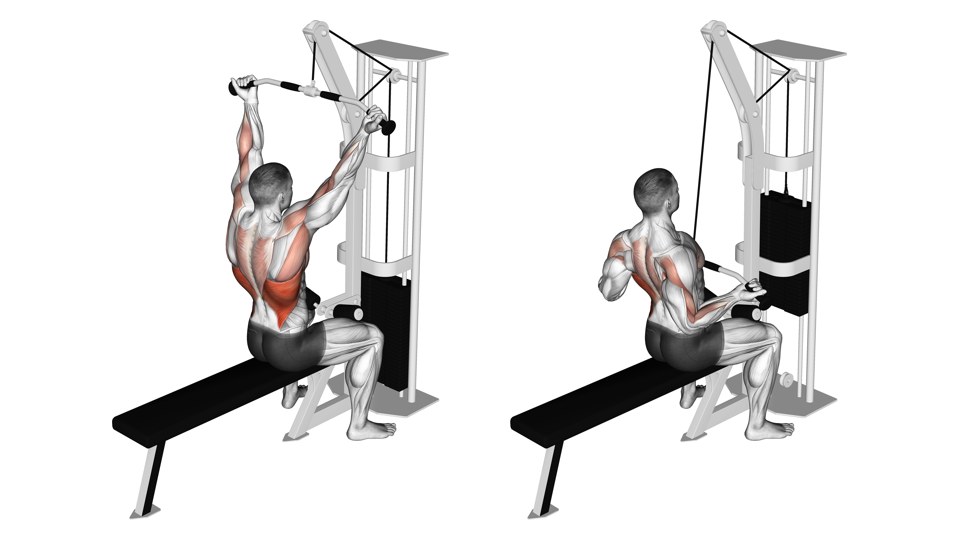
- Close grip pulldownHands about shoulder width. The studies here do not establish that this targets the lower lats.
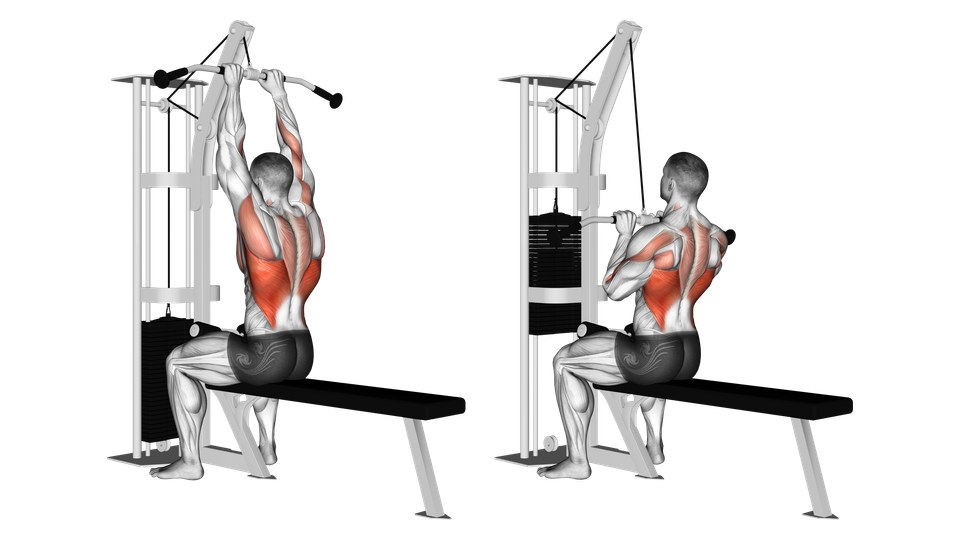
- Wide grip lat pulldown — Hands farther apart. The widest grip allowed slightly less weight in one six-rep comparison.
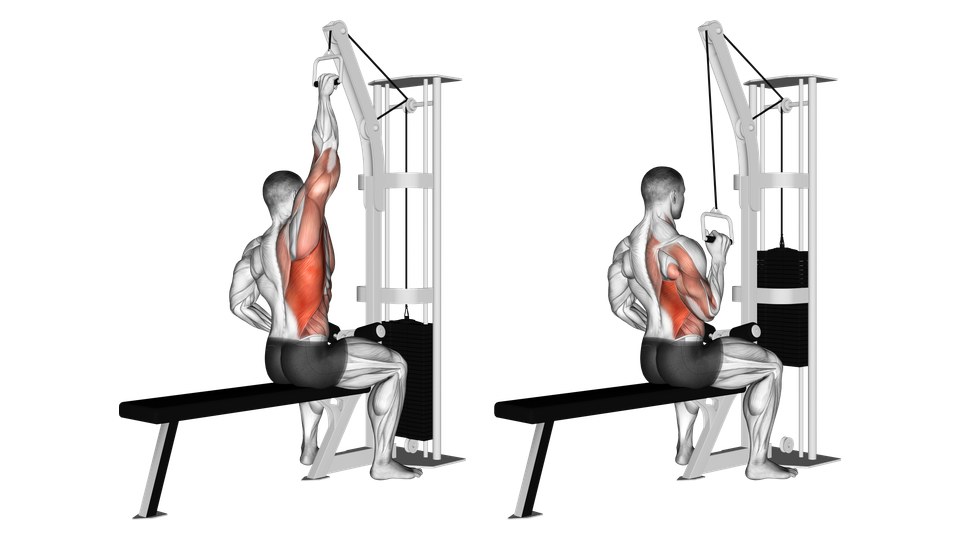
- Reverse-grip lat pulldownUses a palms-up grip on a straight bar; the grip changes, but the same cable-pulldown pattern remains.

Articles
Related tools
Frequently asked questions
What muscles does the lat pulldown work?
Mainly the latissimus dorsi and teres major, which help pull the upper arm down and toward the body. The biceps bends the elbow, the posterior deltoid and infraspinatus work at the shoulder, and the middle and lower trapezius and the rhomboids control the shoulder blade.
Is a wide grip better for building back width?
The studies here do not establish that. They compared muscle activity during repetitions rather than changes in back size. One found higher lat activity with a wide grip during the return alone, but similar activity across widths over the whole repetition. Another found no clear lat difference across seven variations. That leaves the growth question open.
Does a close grip work the lower lats?
The grip studies discussed here do not establish selective lower-lat growth. Their measurements do not map growth across the whole muscle. Padovan measured the location of electrical activity across part of the lat, but compared front and behind-the-neck pulldowns at the same grip width.
Does a wide grip reduce biceps involvement?
There is no consistent reduction in the comparisons here. Lusk and Buonsenso found no clear biceps difference, while Andersen found higher biceps activity with a medium grip than a narrow grip during the pull. These studies do not establish a grip that takes the biceps out of the movement.
Should you lean back during a lat pulldown?
Use the small, steady lean described in the instructions. A study comparing an upright position with a fixed 30-degree lean found no clear lat activity difference, although rear-deltoid activity was higher in the wide overhand lean condition. It did not test injuries or a swinging torso. Keeping the angle steady is our coaching cue for making repetitions comparable.
Are behind-the-neck pulldowns bad?
The studies here do not establish that they cause more injuries or build less muscle. One found greater lat activity in front during the pull and behind during the return, while another found no clear lat difference. We use the front pulldown as the default; the activity comparisons do not settle which version is safer.
Is the lat pulldown for width and the row for thickness?
That slogan is more specific than the measurements support. In Lehman’s small study, a seated row held with the shoulder blades forward produced higher lat activity than either pulldown. Middle-trapezius/rhomboid activity was also higher than in the underhand pulldown. These were static holds, not a comparison of back growth. The study cannot tell us which exercise builds width or thickness.
Which grip should I use on the lat pulldown?
Start with the overhand grip slightly wider than shoulder width described in the instructions, and adjust within a comfortable range you can control. The studies here do not identify a best grip for lat growth. Wider than about twice shoulder width shortens the available pulling range; that is a coaching consideration, not a growth finding from these comparisons.
How many sets of lat pulldowns should I do?
There is no evidence-backed number, and anyone giving you one is generalising. For context rather than as advice, RepCount users who log this exercise average around three and a half sets of it in a session of roughly seven exercises. What matters more is whether the load has moved over the past few months and whether the trunk is holding still.
How much should I be able to lat pulldown?
There is no reliable public dataset of pulldown loads by bodyweight and training age, and machines differ enough in leverage and pulley ratio that the number on the stack is not comparable between gyms. A more useful test is whether you can complete your target reps without the torso swinging, and whether that weight has gone up since last season.
Sources
- Buonsenso A, Di Fonza D, Di Claudio G, Carangelo M, Centorbi M, di Cagno A, Calcagno G, Fiorilli G. Electromyographic Analysis of Back Muscle Activation During Lat Pulldown Exercise: Effects of Grip Variations and Forearm Orientation. J Funct Morphol Kinesiol. 2025. https://pmc.ncbi.nlm.nih.gov/articles/PMC12452428/
- Andersen V, Fimland MS, Wiik E, Skoglund A, Saeterbakken AH. Effects of grip width on muscle strength and activation in the lat pull-down. J Strength Cond Res. 2014. https://pubmed.ncbi.nlm.nih.gov/24662157/
- Lusk SJ, Hale BD, Russell DM. Grip width and forearm orientation effects on muscle activity during the lat pull-down. J Strength Cond Res. 2010. https://pubmed.ncbi.nlm.nih.gov/20543740/
- Signorile JF, Zink AJ, Szwed SP. A comparative electromyographical investigation of muscle utilization patterns using various hand positions during the lat pull-down. J Strength Cond Res. 2002. https://pubmed.ncbi.nlm.nih.gov/12423182/
- Sperandei S, Barros MA, Silveira-Júnior PC, Oliveira CG. Electromyographic analysis of three different types of lat pull-down. J Strength Cond Res. 2009. https://pubmed.ncbi.nlm.nih.gov/19855327/
- Padovan R, Toninelli N, Longo S, Tornatore G, Esposito F, Cè E, Coratella G. High-Density Electromyography Excitation in Front vs. Back Lat Pull-Down Prime Movers. J Hum Kinet. 2024. https://pmc.ncbi.nlm.nih.gov/articles/PMC11057623/
- Lehman GJ, Buchan DD, Lundy A, Myers N, Nalborczyk A. Variations in muscle activation levels during traditional latissimus dorsi weight training exercises: An experimental study. Dyn Med. 2004. https://pmc.ncbi.nlm.nih.gov/articles/PMC449729/
- Jeno SH, Varacallo MA. Anatomy, Back, Latissimus Dorsi. StatPearls. https://www.ncbi.nlm.nih.gov/books/NBK448120/
- Syros A, Rizzo MG. Anatomy, Shoulder and Upper Limb, Teres Major Muscle. StatPearls. https://www.ncbi.nlm.nih.gov/books/NBK580487/
- Ourieff J, Scheckel B, Agarwal A. Anatomy, Back, Trapezius. StatPearls. https://www.ncbi.nlm.nih.gov/books/NBK518994/
- Farrell C, Kiel J. Anatomy, Back, Rhomboid Muscles. StatPearls. https://www.ncbi.nlm.nih.gov/books/NBK534856/