
Band hip abduction
Also called banded hip abduction, standing band hip abduction, standing banded hip abduction.
What is band hip abduction?
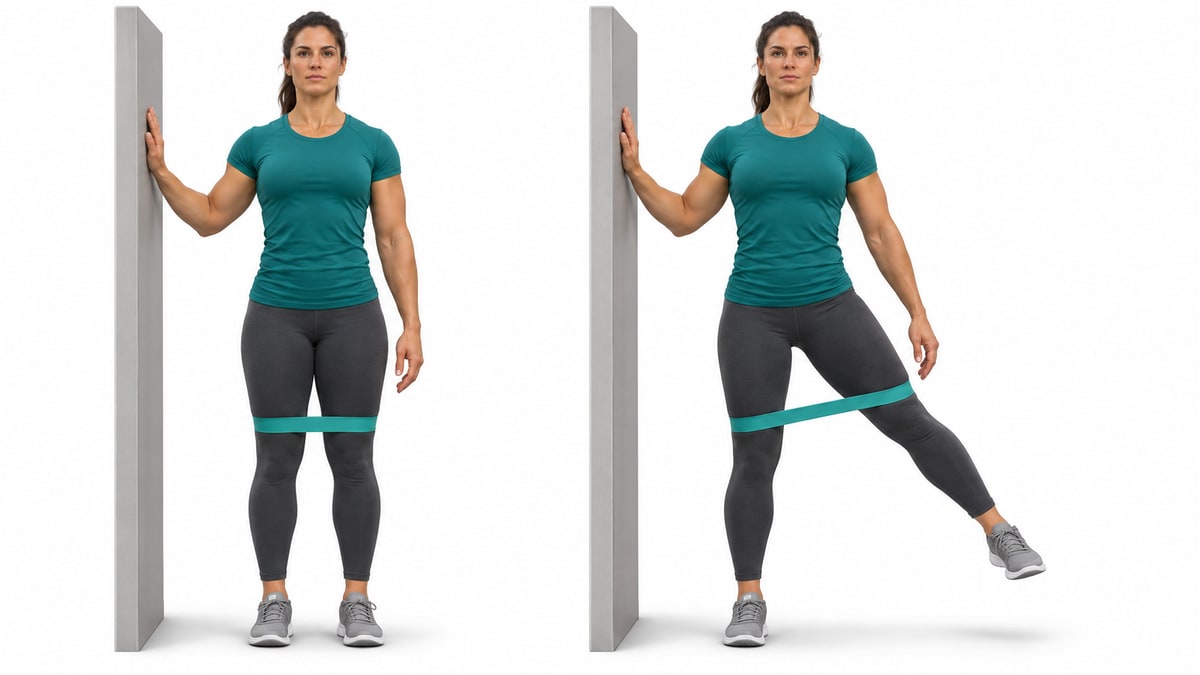
Band hip abduction is a standing exercise in which you lift one leg sideways against a loop band around your thighs. This version uses a wall for balance and keeps the band just above the knees. It trains the hip abductors, including the gluteus medius and gluteus minimus.
How do you do standing band hip abduction?
Set up
- Check a light loop band for cuts or worn patches, then sit on a sturdy chair and place it flat around your thighs just above your knees.
- Stand beside a wall with your feet about hip-width apart and your nearer hand against the wall.
- Shift onto the foot nearer the wall, lift the other foot clear of the floor and keep your chest and hips facing forward.
Execution
- Move the raised leg sideways with the knee nearly straight. Stop before your hip rises or your upper body leans.
- Bring the leg back slowly and repeat. After your reps, put the foot down, turn around and use the other hand on the wall to work the other leg.
- After both sides, set both feet down and bring them closer to ease the band's pull. Sit on the chair and slide the loop off one leg at a time.
Common mistakes
Lifting the side of the pelvis to reach higher
That adds movement from the pelvis instead of more outward movement at the hip. End the rep where you can keep your belt line level.
Swinging the leg forward or backward
A forward lift or backward kick changes the direction of the exercise. Use a shorter sideways lift if you cannot keep the path consistent.
Letting the band pull the leg back abruptly
The return is part of the repetition. Use a lighter band if you cannot bring the leg back at a steady pace.
Where it fits in a session
Use it as hip accessory work alongside your other lower-body exercises.
Keep the same band, its position on your thighs and the wall support consistent when comparing reps between sessions.
Muscles worked
Primary
Secondary
- None listed in this guide
Schematic surface view. Some muscles are partly visible or not shown.
Gluteus minimus and tensor fasciae latae also help move the thigh outward. The hip abductors on the supporting side help keep the pelvis steady.
Variations
Frequently asked questions
What muscles does band hip abduction work?
It works the hip abductors, including gluteus medius and gluteus minimus, with tensor fasciae latae also contributing. The supporting leg's hip abductors help hold the pelvis steady while the other leg moves.
Where should the band go?
For this version, place a loop band flat around both thighs just above the knees. It does not attach to the wall. The wall is there for your hand to rest on while the other leg lifts.
How high should I lift my leg?
Lift only as far as you can keep your pelvis level and your upper body upright. There is no fixed height to reach; shorten the lift if your hip starts to rise or you lean.
Is this the same as a lateral band walk?
No. Here one foot stays planted while the other leg lifts sideways and returns to the same spot. In a lateral band walk, you take sideways steps across the floor.
Sources
- Shah A, Bordoni B. Anatomy, Bony Pelvis and Lower Limb, Gluteus Medius Muscle. StatPearls. Updated 2023 Feb 17. https://www.ncbi.nlm.nih.gov/books/NBK557509/