
Battle ropes
Also called battling ropes, battle rope alternating waves, alternating rope waves.
What are battle ropes?
Battle ropes are heavy ropes used for conditioning by sending waves toward a fixed anchor. For alternating waves, hold one end in each hand and move the arms in opposite directions: one rises while the other drops. Keep your feet planted and your torso controlled as the waves travel along the ropes.
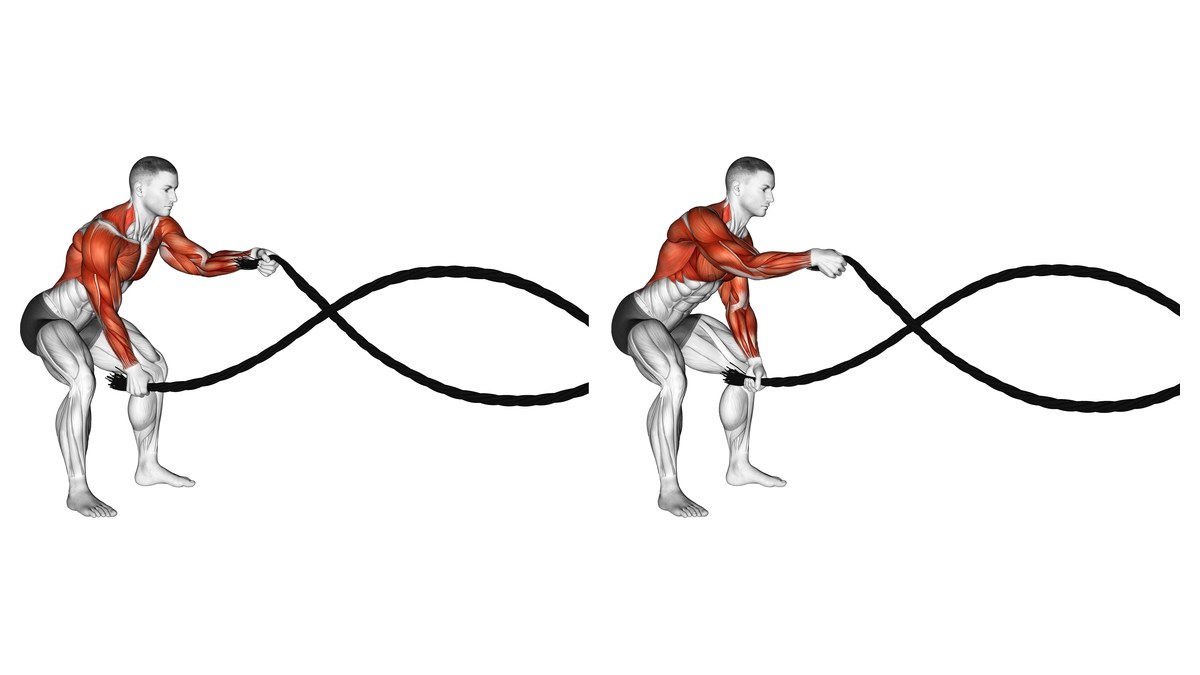
How do you do alternating battle-rope waves?
Set up
- Use a rope secured at its midpoint to a stable anchor intended for battle-rope training. Check the attachment and clear both rope paths of people and objects.
- Face the anchor with one end in each hand. Move back until the rope sections are nearly straight, then step toward the anchor enough to leave a little slack.
- Plant your feet about shoulder-width apart, soften your knees and sit your hips back slightly. Hold the ends in front of your thighs with a firm grip, comfortable wrist alignment and your midsection braced.
Execution
- Lift one hand in front of you, then drive it down as the other hand rises. Keep the hands on their own sides and let your elbows bend naturally.
- Continue exchanging the high and low hands to send alternating waves toward the anchor. Keep your stance steady and choose a hand range you can repeat without rocking your whole body.
- To finish, reduce the hand movements, let the ropes settle, then lower both ends to the floor before stepping away.
Common mistakes
Pulling the ropes completely taut
A stretched-straight rope leaves little room for the wave. Stop, move a little closer to the anchor and restart with usable slack in both sections.
Turning every wave into a body bounce
Standing alternating waves keep the stance relatively steady. If your torso starts heaving to keep the rope moving, reduce the hand range or pause and reset your stance. Squat-assisted waves are a deliberate variation rather than a requirement.
Crossing the hands during the exchange
Keep each hand in its own lane so the rope ends do not collide. From an oblique view the rope sections can appear to cross even when the hands stay apart; follow the hand paths rather than copying that visual overlap.
Where it fits in a session
Use alternating waves where your existing session plan calls for rope conditioning.
Match your effort to that session while keeping the waves and body position repeatable.
Muscles worked
Primary
Secondary
Schematic surface view. Some muscles are partly visible or not shown.
The shoulders move the upper arms while the elbow flexors and extensors contribute to the changing elbow bend. The abdominal muscles help steady the trunk. These are functional roles in the standing wave pattern, not a measured activation ranking or a list of every muscle involved.
Variations
- Double-arm waves — Move both hands up and down together instead of alternating them.
- Rope slams — Raise both ends overhead and drive them down together, adding a larger leg and trunk action.
- Rope circles — Make circular hand paths instead of a vertical alternating pattern.
Frequently asked questions
What muscles do battle ropes work?
In alternating waves, the front and rear deltoids contribute to moving the upper arms. The biceps and triceps help control elbow bending and straightening, while the abdominal muscles help hold the trunk steady. The legs support your stance. This is a coordinated conditioning movement, not an isolation exercise or a measured ranking of those muscles.
Should the ropes be tight or slack?
Leave enough slack for waves to form rather than leaning back against taut ropes. If the ropes pull you out of position, stop and move a little toward the anchor. If excess rope piles up by your feet, move back slightly before restarting. Keep the two rope sections clear and roughly even.
Do I need to squat with every wave?
No. The default here keeps a small hip and knee bend while the hands alternate. A deeper squat or a repeated leg drive changes the pattern and can be added deliberately as a variation. The illustration's partial squat does not set a required depth for everyone.
Which way should my palms face?
A palms-down or more palms-in grip can be used. The illustration shows the latter. Hold the ends securely and choose an angle that lets your hands move without repeatedly bending the wrists. There is no need to twist the grips back and forth during each wave.
Are alternating waves the same as rope slams?
They use the same ropes but different movement patterns. Alternating waves exchange one high hand for one low hand. A slam raises both ends overhead and sends them down together, usually with more leg and trunk movement.
Sources
- Elzanie A, Varacallo MA. Anatomy, Shoulder and Upper Limb, Deltoid Muscle. StatPearls. Updated 2024. https://www.ncbi.nlm.nih.gov/books/NBK537056/
- Betts JG, et al. Anatomy and Physiology 2e, 11.5: Muscles of the Pectoral Girdle and Upper Limbs. OpenStax. https://openstax.org/books/anatomy-and-physiology-2e/pages/11-5-muscles-of-the-pectoral-girdle-and-upper-limbs
- Betts JG, et al. Anatomy and Physiology 2e, 11.4: Axial Muscles of the Abdominal Wall and Thorax. OpenStax. https://openstax.org/books/anatomy-and-physiology-2e/pages/11-4-axial-muscles-of-the-abdominal-wall-and-thorax