
Bear plank
Also called bear hold, quadruped hover.
What is a bear plank?
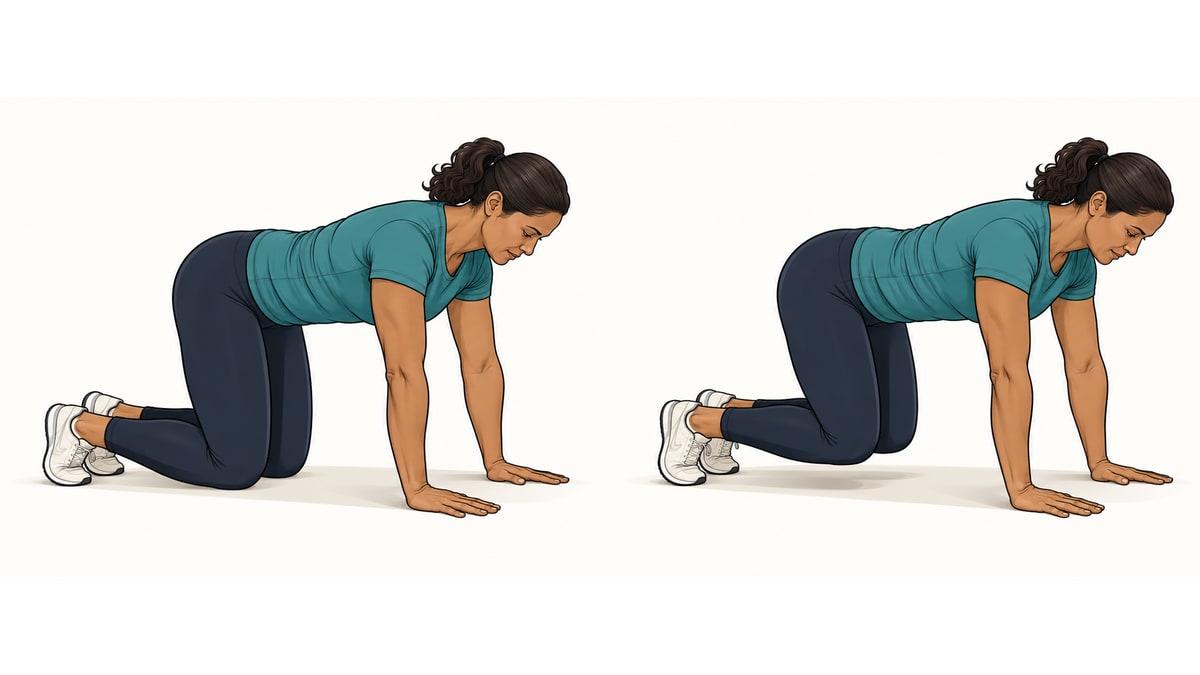
A bear plank is a stationary bodyweight hold on your hands and toes, with your knees bent beneath your hips and lifted just clear of the floor. Your abdomen stays firm while you breathe and keep your back still. A bear crawl adds steps; the bear plank keeps all four support points in place.
How do you perform a bear plank?
Set up
- Start on all fours on a firm, non-slip surface. Place your hands beneath your shoulders and your knees beneath your hips, about hip-width apart.
- Tuck your toes under and spread your fingers. Keep your arms straight, look at the floor between your hands, and gently firm your abdomen.
Execution
- Press through your hands and toes until both knees leave the floor. Lift only enough to make a small gap, keeping your knees bent beneath your hips.
- Stay in that position without stepping or rocking. Keep your back's shape steady and take controlled breaths without letting your abdomen relax completely.
- Finish before your hips rise, your back sags or you need to hold your breath. Lower both knees gently, then rest before another hold.
Common mistakes
Raising the hips to keep going
Once the hips climb and the knees move away from their starting position, you are no longer practising the same hold. Put your knees down, rest and make the next attempt shorter.
Holding a breath for the whole set
Choose a hold you can manage while breathing. If a breath makes the position fall apart, end the attempt and reset instead of extending it.
Barely touching down between tired attempts
A quick knee tap may leave you starting the next hover before you are ready. Let both knees settle, relax and recover before lifting again.
Where it fits in a session
Use it as a stationary trunk exercise in a bodyweight or core session. Set up where you have enough room to place both hands and feet securely.
Start with a hold that stays steady while you breathe, even if it lasts only a few seconds. Rest with your knees down between attempts. Add a little time only when you can repeat the same position; keep your rest and knee height consistent when comparing sessions. If even a brief hover is too much, rehearse the setup with your knees supported first.
Muscles worked
Primary
Secondary
- None listed in this guide
Schematic surface view. Some muscles are partly visible or not shown.
Your abdominal muscles work together to keep your trunk steady. The list describes their role in the hold, rather than ranking them by how hard they work. Your hands and toes provide the support.
Variations
- Short bear-plank holds with rests — Keep the same setup, but practise brief hovers separated by a full knees-down rest. Build the continuous hold gradually.
- Front plankA related static hold with straight legs and forearm support. Treat its hold times separately from your bent-knee bear plank.

Frequently asked questions
How is a bear plank different from a front plank?
In a bear plank, your knees stay bent beneath your hips and your hands support your upper body. In the forearm front plank, your legs extend behind you and your forearms rest on the floor. They are different positions, so compare progress within each exercise.
Is a bear plank the same as a bear crawl?
A bear plank stays in one place with both hands and both feet planted. A bear crawl adds alternating hand and foot steps to travel across the floor. Keep the stationary hold and the moving crawl separate in your training log.
What muscles does a bear plank work?
The abdominal wall includes the rectus abdominis at the front, the internal and external obliques at the sides, and the deeper transversus abdominis. These muscles contribute to holding your trunk steady. The exercise does not isolate one abdominal layer.
How high should my knees be?
Lift just enough that neither knee rests on the floor. Keep the knees underneath the hips instead of lifting your hips and opening the knee angle to chase more height. The small gap is a coaching guide, not an exact measurement you need to reproduce.
What if I cannot keep my knees hovering?
Try a shorter hover, then lower both knees and take a proper rest. If that is still too much, keep your knees on the floor and practise setting your hands, firming your abdomen and breathing. This is a supported setup drill, not the same unsupported hold.
How do I make the hold harder?
First make your holds more repeatable, then gradually extend the time without lifting your hips or holding your breath. There is no required hold time before you progress. Moving a limb or adding a crawl changes the exercise; you do not need either to practise this stationary hold.
Sources
- Betts JG et al. Anatomy and Physiology 2e. Section 11.4: Axial muscles of the abdominal wall, and thorax. OpenStax, 2022. https://openstax.org/books/anatomy-and-physiology-2e/pages/11-4-axial-muscles-of-the-abdominal-wall-and-thorax
- Stokes IAF, Gardner-Morse MG, Henry SM. Abdominal muscle activation increases lumbar spinal stability: analysis of contributions of different muscle groups. Clinical Biomechanics. 2011;26:797–803. https://doi.org/10.1016/j.clinbiomech.2011.04.006