
Copenhagen plank
Also called Copenhagen side plank.
What is a copenhagen plank?
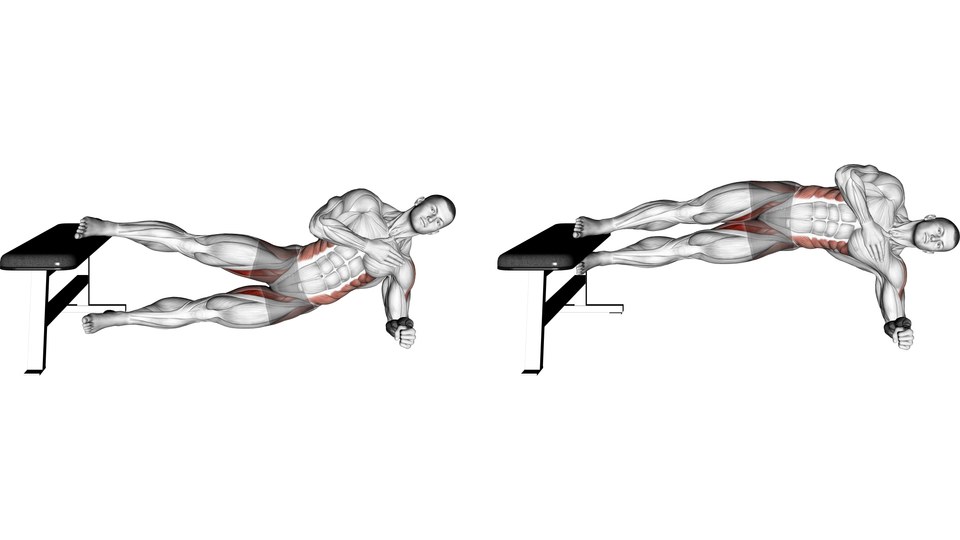
A Copenhagen plank is a side-plank hold with the upper leg supported on a bench and the lower leg held clear of the floor. This guide covers the long-lever version, with the upper ankle on the bench. It trains the hip adductors while the trunk holds the body sideways.
How do you perform a copenhagen plank?
Set up
- Place a stable bench beside you. Lie on your side with the upper ankle resting on its padded top and your lower forearm on the floor, elbow under shoulder.
- Keep the upper leg straight and place the free hand on your hip. Arrange the bench so the ankle rests securely without balancing on a sharp edge.
Execution
- Press the supported leg into the bench and lift your hips off the floor.
- Bring the lower leg up beneath the supported leg and hold your body in a line from shoulders through hips to the upper foot.
- Breathe while keeping your pelvis facing forward. End the hold before your hips sag or roll.
- Lower your hips and lower foot to the floor under control, then change sides.
Common mistakes
Letting the hips sink
Finish the hold when you can no longer keep your body aligned. Build up the duration while holding the same position.
Rolling the chest toward the floor
Keep the shoulders and hips stacked instead of turning into a front plank.
Where it fits in a session
Use short controlled holds for direct inner-thigh and side-trunk work.
Log hold duration for each side. End a set when you cannot keep the hips stacked and raised.
Muscles worked
Primary
Secondary
Schematic surface view. Some muscles are partly visible or not shown.
The upper leg supports the hold through the hip adductors; the obliques help hold the trunk sideways.
Frequently asked questions
Why does the illustration show the lower leg moving?
It shows the lower leg below the bench and then raised beneath the supported leg. For this plank guide, bring it up and hold the final position rather than performing repeated lower-leg lifts.
Where should the bench support my leg?
This guide uses the ankle of the straight upper leg. Supporting closer to the knee changes the lever and is a different setup; do not move between the two within a timed hold.
Sources
- OpenStax. Anatomy and Physiology 2e. Appendicular Muscles of the Pelvic Girdle and Lower Limbs. https://openstax.org/books/anatomy-and-physiology-2e/pages/11-6-appendicular-muscles-of-the-pelvic-girdle-and-lower-limbs
- OpenStax. Anatomy and Physiology 2e. Axial Muscles of the Abdominal Wall and Thorax. https://openstax.org/books/anatomy-and-physiology-2e/pages/11-4-axial-muscles-of-the-abdominal-wall-and-thorax