
Cossack squat
What is a cossack squat?
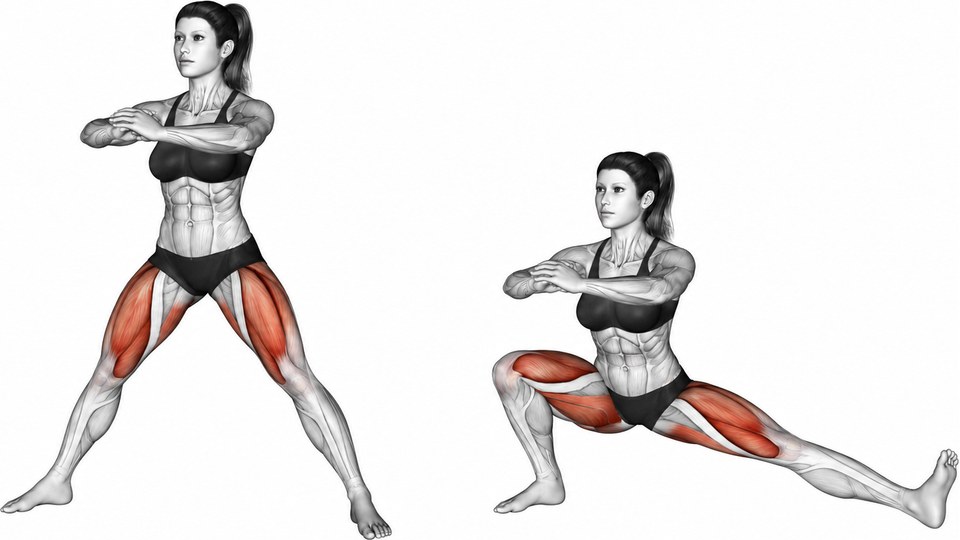
A Cossack squat is a wide-stance squat toward one leg while the other leg stays straight. This bodyweight version keeps the feet in place: sit toward one heel, let the toes of the straight leg turn upward, then rise before moving to the other side.
How do you perform a cossack squat?
Set up
- Stand with your feet wider than shoulder width on a clear, nonslip surface. Hold your hands in front of you for balance.
- Shift a little weight toward one side and check that you can bend that knee while keeping its heel on the floor. Begin with a shallow range.
Execution
- Sit your hips down toward the bent leg, keeping that knee aligned with its toes.
- Keep the opposite leg straight and its heel grounded, allowing its toes to turn upward. Descend only as far as you can stay balanced without forcing the position.
- Press through the bent leg to return to the wide standing position. Repeat toward the other side, keeping both feet in their original spots.
Common mistakes
Chasing depth by lifting the bent-leg heel
Use a shallower squat so the heel stays grounded. Increase depth only while keeping control.
Dropping abruptly into the bottom
Lower gradually and reverse the movement without bouncing or forcing the straight leg farther away.
Where it fits in a session
Place this where your plan calls for lower-body assistance work.
Log repetitions per side, and use the same depth and counting method when comparing sessions.
Muscles worked
Primary
Secondary
- None listed in this guide
Schematic surface view. Some muscles are partly visible or not shown.
Variations
Frequently asked questions
How is this different from a lateral lunge?
This Cossack squat starts and finishes in a wide stance, with the straight leg's toes allowed to lift. Our lateral lunge starts with the feet about hip width apart, steps sideways and returns, keeping the toes directed ahead.
Do I have to squat all the way down?
No. Start with a depth you can control, with the bent-leg heel down. A shallower repetition is the version to practise if going deeper makes you lose balance.
Sources
- Marjorie V. Launico; Margaret A. Sinkler; Shivajee V. Nallamothu. Anatomy, Bony Pelvis and Lower Limb: Femoral Muscles. StatPearls. https://www.ncbi.nlm.nih.gov/sites/books/NBK500008/?report=printable
- Roland Glenister; Sandeep Sharma. Anatomy, Bony Pelvis and Lower Limb, Hip. StatPearls. https://www.ncbi.nlm.nih.gov/sites/books/NBK526019/?report=printable