Dead hang
Also called bar hang, passive hang, two-arm dead hang.
What is a dead hang?
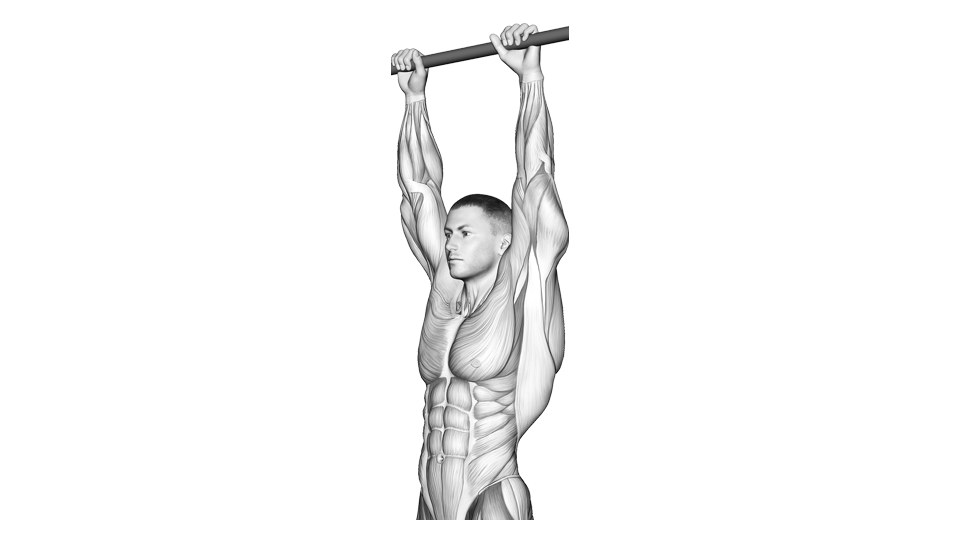
A dead hang is a timed hold from a pull-up bar with both arms straight and the feet clear of the floor. The main training demand is maintaining your grip while your body hangs below your hands.
How do you perform a dead hang?
Set up
- Use a stable pull-up bar you can reach without a risky jump, using a step if needed.
- Take a comfortable overhand grip slightly wider than shoulder width and wrap your thumbs around the bar.
Execution
- Step from the support and let your body hang with both arms straight.
- Keep a secure grip, a quiet trunk and your feet clear of the floor without swinging.
- Finish the hold before your hands begin to open, then return to the step or floor under control.
Common mistakes
Jumping to a bar that is difficult to reach
A step gives you a controlled start and a safe way to end the hold instead of dropping when the grip fails.
Swinging through the hold
Movement makes the position less repeatable and adds a balance problem to a grip hold.
Holding until the fingers suddenly open
Ending with a small grip reserve lets you step down deliberately rather than relying on the floor to stop a fall.
Where it fits in a session
After pulling work or near the end of a session, so tired hands do not limit earlier lifts.
Track clean hold time with the same bar and grip. Use a step and shorter sets if the finish becomes an uncontrolled drop.
Muscles worked
Primary
Secondary
- None listed in this guide
Schematic surface view. Some muscles are partly visible or not shown.
The hands and forearm flexors maintain the grip while the body hangs below the bar; the shoulders and trunk support the position but are not listed as primary training targets.
Variations
- Active hang — Keeps the shoulder blades gently pulled down instead of allowing a fully relaxed shoulder position.
- Towel hang — Hangs from towels looped over the bar to increase the grip demand.
- One-arm hang — Uses one hand and greatly increases the grip and shoulder-support demand.
- Flexed-arm hang — Holds the body with the elbows bent rather than hanging from straight arms.
Frequently asked questions
What muscles does a dead hang work?
Its clearest training demand is grip: the finger and forearm flexors keep the hands closed around the bar. Many upper-body muscles support the hanging position, but that does not make the dead hang a replacement for pulling exercises.
Should my shoulders be relaxed in a dead hang?
This page covers a passive hang with straight arms, but relaxed does not mean losing control. If a fully passive shoulder position is uncomfortable, use a lightly active hang or stop the set.
How long should I dead hang?
Use a duration you can finish with a secure grip and a controlled step down. Compare time only when the bar, grip and setup stay the same.
Should I use an overhand or underhand grip?
The standard version here uses an overhand grip. Other grips change the arm and shoulder position, so treat them as variations and use one that is comfortable and secure.
Do dead hangs decompress the spine?
Hanging changes the load on the body for the duration of the hold, but strong claims that dead hangs treat back pain or permanently decompress the spine are not established here. Use it as a grip hold, not as medical treatment.