
Devil press
Also called devil's press, double dumbbell devil press.
What is a devil press?
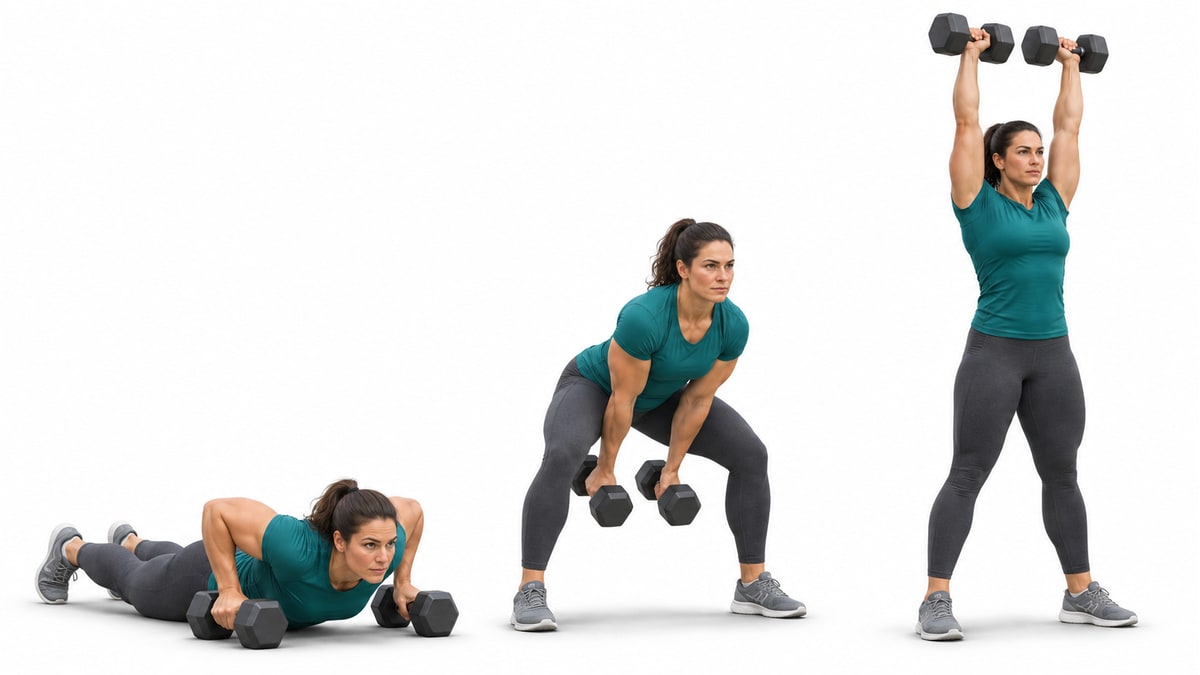
A Devil press combines a burpee with a two-dumbbell lift overhead. Keeping hold of the handles, you lower your chest and thighs to the floor, bring your feet forward, then use a hip-driven swing to take both weights overhead together. The lift continues past the shoulders without a separate clean and press.
How do you perform a devil press?
Set up
- Use two equally weighted dumbbells with flat heads that stay put on a firm, level floor. Start light, and clear space behind you and above your head.
- Place the dumbbells parallel, handles pointing front to back, about shoulder-width apart and just ahead of your toes. Leave room for your chest between them, then bend your hips and knees and grip the handles with your palms facing each other.
Execution
- Keep the dumbbells planted, step or jump your feet back, and bend your elbows to lower your chest and thighs to the floor between the weights. Keep hold of both handles.
- Push your torso away from the floor and step or hop your feet forward outside the dumbbells. Settle onto your whole feet with your knees bent and your back long.
- Brace your midsection, lift the dumbbells just clear of the floor, and send your hips back so the weights swing between your thighs.
- Drive through your feet and straighten your hips and knees. Let your elbows bend as you guide the weights close to your body and overhead in one flowing lift. Finish standing tall with straight arms and the weights above your shoulders.
- Lower the weights close to your body until your arms hang, then bend your hips and knees to place them on the floor. Let them settle before the next rep. To finish, release the handles and stand up.
Common mistakes
Rushing onto unstable dumbbells
Your hands support you during the floor portion. If a head rolls or the weights slide as you move your feet, stop and reset the equipment before continuing.
Swinging before your feet are planted
Bring your feet forward far enough to settle your heels and make room between your legs. Starting the swing while still on your toes leaves you chasing the weights rather than driving from a steady stance.
Finishing with a separate shoulder press
Stopping at the shoulders changes the continuous overhead lift into a clean followed by a press. Reduce the load if you cannot guide both dumbbells overhead from the hip drive without that pause.
Leaning back to get the weights overhead
Finish with your ribs over your pelvis rather than pushing your chest up and arching your lower back. Use a lighter pair if you cannot stand upright under the weights.
Where it fits in a session
Use within the conditioning work you have planned, with enough space to set the weights down between efforts.
Practise the burpee and light dumbbell swing-to-overhead movement before linking them. Choose a pair you can control through the floor transition, overhead finish and return; pause or end the set when those positions become rushed.
Muscles worked
Primary
Secondary
Schematic surface view. Some muscles are partly visible or not shown.
The glutes and thighs drive the lower-body portion, while the front of the shoulders helps bring the arms overhead. The chest and triceps help you push away from the floor, and the abdominal muscles steady the trunk. These roles describe different parts of the repetition, not an activation ranking.
Variations
- Step-back Devil press — Move one foot at a time into and out of the floor portion, keeping the chest-to-floor burpee and two-dumbbell overhead lift.
Frequently asked questions
What muscles does a Devil press work?
The glutes and quadriceps help you rise and drive the weights, with the hip-extending hamstrings assisting at the hips. The anterior deltoids help lift the arms. The chest and triceps help with the push away from the floor, and the abdominal muscles support trunk control. It combines several actions rather than isolating one muscle group.
Does your chest have to touch the floor?
Yes, for the chest-to-floor Devil press: lower both your chest and thighs between the dumbbells. Moving your feet out to a plank and straight back in leaves out that part of the burpee. You can step your feet in and out instead of jumping.
Does a Devil press require a strict push-up?
No. You need to reach the floor and push your torso up so you can bring your feet forward, but the burpee does not have to be a rigid-body push-up. Keep the descent controlled and your hands secure on the dumbbells. Check the stated rules if you are doing a competition workout.
Is a Devil press a clean and press?
The continuous version goes from the burpee into a hip-driven lift overhead, without resting the dumbbells on the shoulders for a separate press. Some competition workouts also accept a clean and jerk. Follow that workout's rules rather than assuming every Devil press uses the same standard.
How heavy should the dumbbells be?
Begin with a light pair while learning the sequence. You should be able to keep the dumbbells still on the floor, bring your feet forward, lift both weights overhead together and lower them without losing your stance. A weight you can clean and press separately may still be too heavy for a continuous Devil press.
Can I do Devil presses with one dumbbell?
A single-dumbbell Devil press is a separate variation with one loaded arm. It is not the same repetition as the two-dumbbell movement. If a workout calls for the single-dumbbell version, follow its hand position and arm-switching instructions.
Sources
- Hu Y, Raja A. Anatomy, Bony Pelvis and Lower Limb, Hamstring Muscle. StatPearls, updated 2026. https://www.ncbi.nlm.nih.gov/sites/books/NBK546688/
- Betts JG, et al. Anatomy and Physiology 2e. 11.6: Appendicular muscles of the pelvic girdle and lower limbs. OpenStax, 2022. https://openstax.org/books/anatomy-and-physiology-2e/pages/11-6-appendicular-muscles-of-the-pelvic-girdle-and-lower-limbs
- Elzanie A, Varacallo MA. Anatomy, Shoulder and Upper Limb, Deltoid Muscle. StatPearls, updated 2024. https://www.ncbi.nlm.nih.gov/sites/books/NBK537056/
- Betts JG, et al. Anatomy and Physiology 2e. 11.5: Muscles of the pectoral girdle and upper limbs. OpenStax, 2022. https://openstax.org/books/anatomy-and-physiology-2e/pages/11-5-muscles-of-the-pectoral-girdle-and-upper-limbs
- Betts JG, et al. Anatomy and Physiology 2e. 11.4: Axial muscles of the abdominal wall, and thorax. OpenStax, 2022. https://openstax.org/books/anatomy-and-physiology-2e/pages/11-4-axial-muscles-of-the-abdominal-wall-and-thorax