
Dragon flag
Also called dragon flags.
What is a dragon flag?
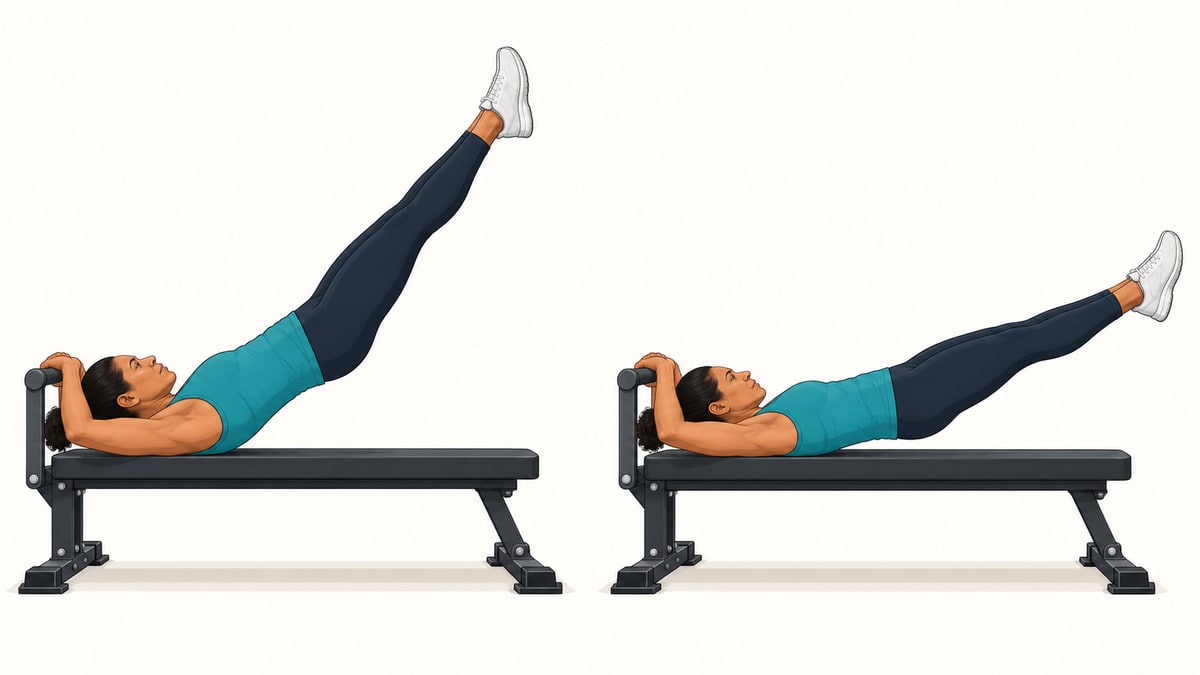
A dragon flag is an advanced bodyweight abdominal exercise in which your upper back stays supported while your torso and straight legs lower and rise together. You hold a secure bench behind your head and keep a firm line through your shoulders, hips and ankles. The aim is to control that body line, not simply lift your feet.
How do you perform a dragon flag?
Set up
- Choose a solid flat bench with a secure handhold behind your head. Check that the bench and handhold stay still when you pull on them.
- Lie face up with your head and upper back on the pad. Grip the bench behind your head with both hands and bend your elbows.
- Brace your abdomen and squeeze your glutes. Bring your knees toward your chest, then curl your hips up so your weight rests across your upper back and shoulders, away from your neck.
Execution
- Extend both legs upward until your shoulders, hips and ankles form one firm line. Keep your upper back supported without rolling onto your neck.
- Lower your torso and legs together, keeping your hips straight. Turn around while you can still hold that shape, even if you are well above the pad.
- Raise the same body line back toward the starting position without kicking your feet or folding at the hips.
- To finish, bend your knees and lower your hips and back gently onto the pad before releasing your grip.
Common mistakes
Rolling onto the neck at the top
Keep the base across your upper back and shoulders. If the support shifts toward your neck, lower to the pad and reset with your knees tucked.
Folding at the hips during a full repetition
A visible fold changes the shape you are trying to hold. Use a shorter range or a planned tuck instead of changing shape halfway through a straight-leg rep.
Dropping through the bottom of the lowering
Turn around before speed takes over. If you can lower under control but cannot lift back up, practise a lowering-only rep and tuck to finish.
Where it fits in a session
Practise dragon flags while you are fresh enough to control the bench setup and each lowering. Choose a tuck or a short range if a straight-leg rep turns into a kick or a hip bend.
Start with repeatable reps at one knee position and one turnaround point. Progress by reaching a little farther with the same shape, then gradually opening the tuck. When practising negatives, lower only as far as you can control, bend your knees and settle onto the pad before setting up again. Keep those lowering-only attempts separate from full up-and-down reps in your training notes.
Muscles worked
Primary
Secondary
- None listed in this guide
Schematic surface view. Some muscles are partly visible or not shown.
The rectus abdominis is the abdominal muscle running down the front of your trunk. Here the task is to keep the torso braced while the body moves, rather than repeatedly curling the chest toward the hips.
Frequently asked questions
How do I work toward my first dragon flag?
Begin with a reverse crunch if you need practice lifting and lowering your pelvis under control. For a tuck dragon flag, use the same secure bench grip and upper-back support and keep your knees bent toward your chest. Keep that bend at the hips and knees as you lower and lift through a short arc. Gradually open the tuck and increase the range while keeping control. Move on when you can repeat the same shape and range without dropping.
What is a dragon flag negative?
It is a lowering-only repetition. Enter the raised position with bent knees, extend your legs as far as you can control and lower your torso and legs together. Before your body line breaks, tuck your knees and lower gently onto the bench. Reset for the next attempt instead of kicking back up. A straight-leg negative is still demanding; keep a tuck if you cannot control the descent.
Why do straight legs and a lower position make it harder?
Straightening your legs moves more of their mass farther from the upper-back support. As your body approaches horizontal, gravity also has a longer horizontal lever arm. That means more turning force to resist. Tucking your knees or turning around higher reduces that leverage.
Is a dragon flag the same as a lying leg raise?
No. In a lying leg raise, your back stays on the floor while your legs move at the hips. In a dragon flag, most of your back is lifted and the torso and legs travel together from the upper-back support. They can be practised separately; raising your feet high does not by itself make a leg raise a dragon flag.
How low should I go?
Use the lowest position from which you can keep the same body line and reverse the movement under control. Reaching horizontal is not a reason to arch your back, fold at the hips or drop onto the bench. If you are practising a negative, finish with the tucked reset instead of trying to force the return.
Can I use a floor setup instead of a bench?
A floor setup needs a fixed handhold behind your head and padding beneath your upper back. The support must stay secure as you pull against it; loose furniture is not a suitable anchor. If you cannot arrange that, choose a supported abdominal exercise such as a reverse crunch. The instructions above use a flat bench.
Sources
- Betts JG, et al. Anatomy and Physiology 2e. Section 11.4: Axial muscles of the abdominal wall, and thorax. OpenStax; 2022. https://openstax.org/books/anatomy-and-physiology-2e/pages/11-4-axial-muscles-of-the-abdominal-wall-and-thorax
- Urone PP, Hinrichs R. College Physics 2e. Section 9.2: The second condition for equilibrium. OpenStax; 2022. https://openstax.org/books/college-physics-2e/pages/9-2-the-second-condition-for-equilibrium