
Fire hydrant
Also called quadruped hip abduction, fire hydrants.
What is a fire hydrant?
A fire hydrant is a hands-and-knees exercise in which you lift one bent knee out to the side while keeping your trunk steady. This guide covers the bodyweight version without a band or ankle weight.
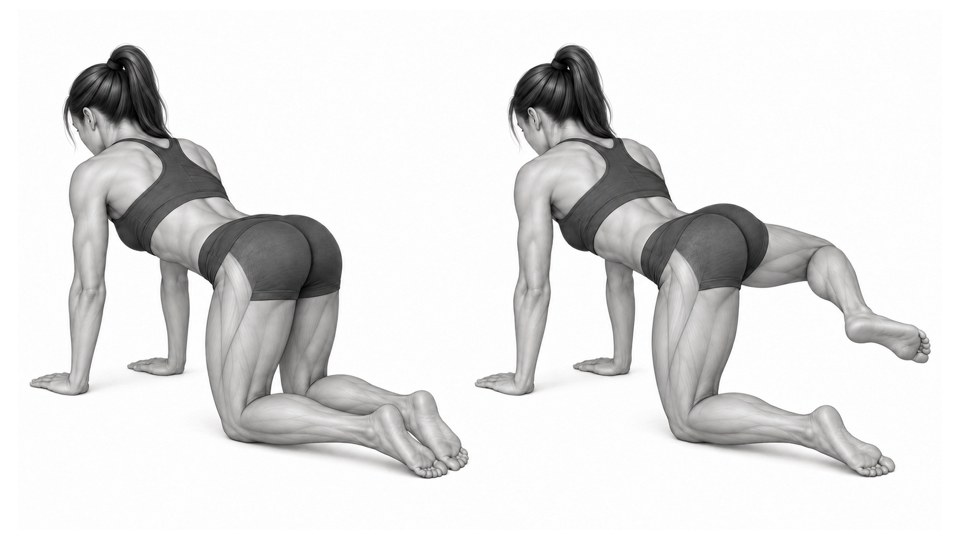
How do you perform a fire hydrant?
Set up
- Start on your hands and knees, with your hands below your shoulders and your knees below your hips.
- Keep your elbows straight and look down between your hands. Set your back in a comfortable, steady position.
Execution
- Keeping one knee bent, lift that knee out to the side without turning your chest or hips.
- Stop before your pelvis starts to roll or your lower back changes position.
- Bring the knee back underneath your hip with control. Finish your reps, then change sides.
Common mistakes
Rolling onto the supporting side
Use a smaller lift so your torso stays centred over your hands and supporting knee.
Chasing a high knee
Stop where you can hold your pelvis steady; the top does not need to match someone else’s.
Where it fits in a session
Include this exercise where it fits your planned lower-body or home session.
Log repetitions for each side and use a repeatable range.
Muscles worked
Primary
Secondary
- None listed in this guide
Schematic surface view. Some muscles are partly visible or not shown.
The listed muscles contribute to the movement; no isolation or activation ranking is implied.
Frequently asked questions
Should I straighten my leg?
Keep the knee bent for this version. A straight-leg raise is a different variation.
How high should I lift my knee?
Use the height you can reach without rolling your hips. Start small, then explore a little more range while keeping your trunk still.
Sources
- Shah A, Bordoni B. Anatomy, Bony Pelvis and Lower Limb, Gluteus Medius Muscle. StatPearls, updated 2023. https://www.ncbi.nlm.nih.gov/sites/books/NBK557509/?report=classic