Frog pumps
Also called frog pump, frog bridge.
What are frog pumps?
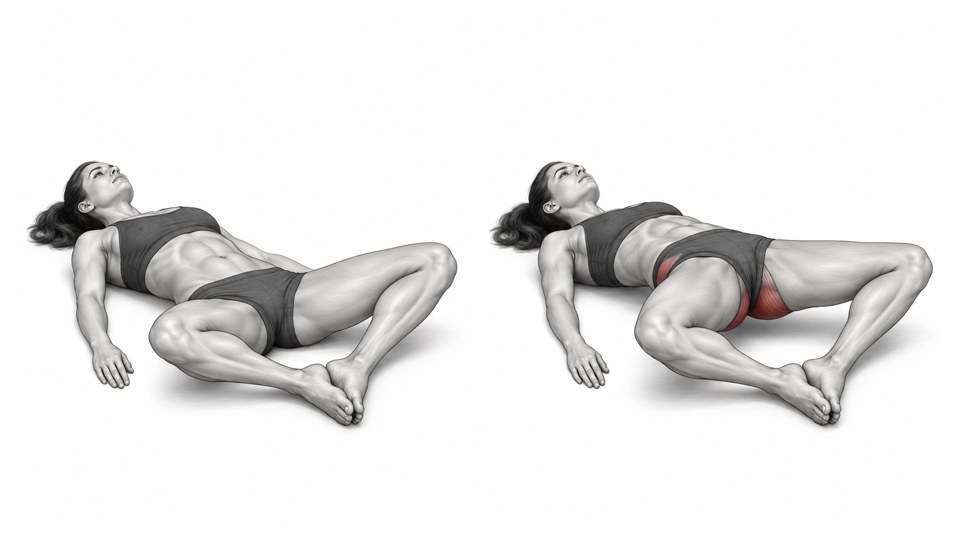
Frog pumps are floor hip lifts performed with the soles of your feet together and your knees opened outward. Your upper back stays on the floor as your hips rise and lower. This guide uses bodyweight.
How do you perform frog pumps?
Set up
- Lie on your back with your knees bent. Press your feet sole-to-sole and let your knees open outward comfortably.
- Rest your arms on the floor and bring your joined feet close enough that you can lift your hips without sliding.
Execution
- Press the outer edges of your feet into the floor and lift your hips, keeping your knees open.
- Finish the lift when your hips are extended without pushing your ribs upward or arching your lower back.
- Lower your hips to the floor with control and repeat.
Common mistakes
Forcing the knees toward the floor
Let the knees rest at a comfortable angle instead of pressing them down.
Finishing with a back arch
End the lift a little earlier and keep the front of your ribcage quiet.
Where it fits in a session
Include this exercise where it fits your planned lower-body or home session.
Log repetitions and keep the same foot position and controlled range between sessions.
Muscles worked
Primary
Secondary
- None listed in this guide
Schematic surface view. Some muscles are partly visible or not shown.
The listed muscles contribute to the movement; no isolation or activation ranking is implied.
Frequently asked questions
Do my knees need to touch the floor?
No. Let them open only as far as feels comfortable while keeping the soles of your feet together.
Should I add a weight?
Learn the bodyweight movement first. If you later use external weight, treat that as a loaded variation and log it separately.
Sources
- Elzanie A, Borger J. Anatomy, Bony Pelvis and Lower Limb, Gluteus Maximus Muscle. StatPearls, updated 2023. https://www.ncbi.nlm.nih.gov/sites/books/NBK538193/