
Handstand push-up
What is a handstand push-up?
A handstand push-up lowers the head toward the floor from an inverted position and presses back to straight arms. This guide covers strict repetitions with the back facing a wall, using the wall for balance and no leg drive.
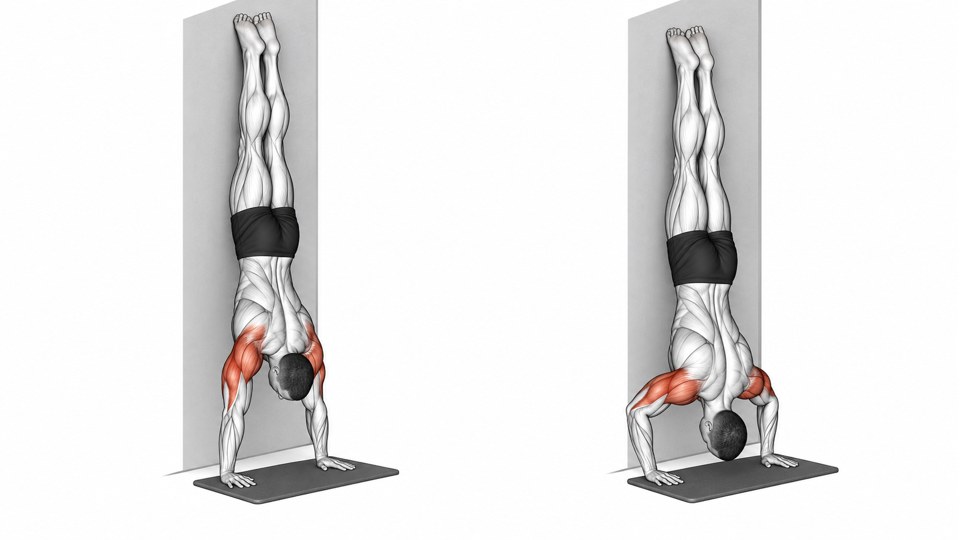
How do you perform a handstand push-up?
Set up
- Clear the wall and floor, place a firm thin mat for the head and practise a controlled exit before pressing. Begin with pike push-ups if you cannot yet support yourself inverted.
- Set your hands a little outside shoulder width and kick up with control so your heels lightly meet the wall. Brace your torso with elbows straight.
Execution
- Bend the elbows and lower slowly, letting your head move slightly ahead of your hands to form a three-point base.
- Touch the mat gently without settling your weight onto your head or neck. Only descend as far as you can control and press back from.
- Press through both palms until the elbows are straight, keeping the legs quiet and using the wall only for balance.
- After the final repetition, bring one leg down and follow with the other to leave the position deliberately.
Common mistakes
Dropping onto the head
Reduce the range or use a pike push-up until the descent is controlled.
Arching to reach the top
Keep the ribs and pelvis aligned and end the set if you need to bend through your back.
Where it fits in a session
Practice this movement while you can control the required positions and finish each repetition deliberately.
Use a range you can lower through and press out of without resting on your head. Get hands-on coaching for an unfamiliar inversion and exit; avoid testing repeated failures upside down.
Muscles worked
Primary
Secondary
- None listed in this guide
Schematic surface view. Some muscles are partly visible or not shown.
Variations
- Kipping handstand push-up — Adds a deliberate leg drive from an inverted tuck; it is a separate skill.
- Pike push-up — Keeps the feet on the floor or a stable platform while pressing in a hips-high position.
Frequently asked questions
How should I start learning handstand push-ups?
Use pike push-ups and short controlled wall-supported holds. Add partial-range wall-supported repetitions only when you can enter, lower and exit deliberately.
Is the kipping version a mistake?
No. A kipping handstand push-up intentionally uses leg drive, but it needs its own coaching and should be tracked separately from the strict version taught here.
Sources
- Betts et al. Anatomy and Physiology 2e. OpenStax, 2022. https://openstax.org/books/anatomy-and-physiology-2e/pages/11-5-muscles-of-the-pectoral-girdle-and-upper-limbs