
High knees
Also called high-knee run, high-knee running.
What are high knees?
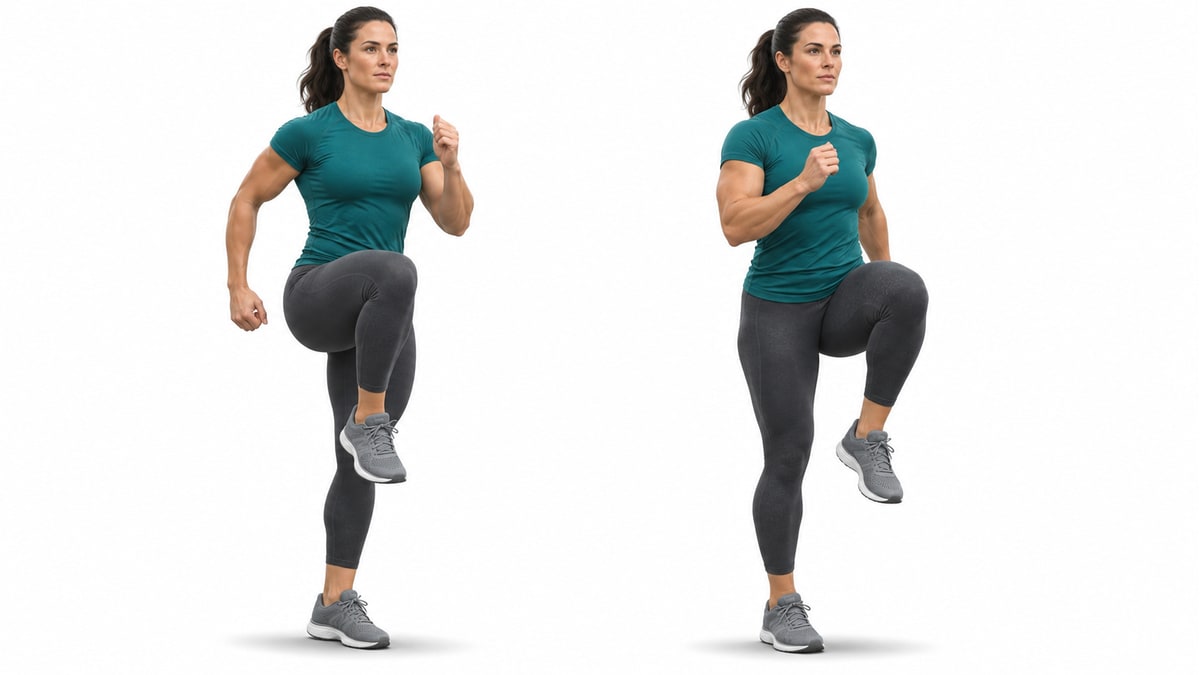
High knees are running in place while lifting alternate knees in front of you and swinging the opposite arms. Each foot returns beneath your body as the other knee rises, with a small airborne change between contacts. The movement stays in one spot; it is different from a slow march or a traveling skipping drill.
How do you do high knees?
Set up
- Use a level, non-slip area with clear space around your feet and arms. Begin with your feet spaced beneath your hips.
- Face ahead with your torso upright and your elbows bent. Keep your shoulders relaxed and your hands free to swing.
Execution
- Lift your right knee in front of you toward hip height while bringing your left arm forward. Keep your torso over the supporting leg.
- Push off the left foot into a small airborne switch. Land on the right foot beneath you as the left knee rises and the right arm comes forward.
- Continue alternating in place, meeting the floor lightly and letting the ankle and knee bend on each contact. Use a knee height you can maintain without leaning back.
- To finish, lower the knee lift and ease into walking on the spot, then settle with both feet down.
Common mistakes
Leaning backward to lift the knee higher
Reduce the knee height until you can keep your torso upright. A higher knee is not the goal if it changes the whole body position.
Drifting across the floor
Return each foot near the spot it left. Reaching forward with every contact turns an in-place drill into traveling steps.
Adding a second hop on the same foot
Switch the raised knee on the next running step. Holding it up for another hop changes the rhythm into a skip.
Where it fits in a session
Where high knees fit the session you have planned.
Set the amount of work for that session. If counting repetitions, count each knee lift once and state whether the target is total lifts or lifts per side; a timed bout needs no repetition count.
Muscles worked
Primary
Secondary
Schematic surface view. Some muscles are partly visible or not shown.
The iliopsoas helps lift each thigh, the calf muscles contribute to the repeated push-offs, and the quadriceps help control the knees. These are roles within a cardio movement, not a ranking of muscle activation or a claim that high knees replace loaded strength exercises.
Variations
- Lower knee lift — Keep the alternating running rhythm while using less hip flexion. Choose the range that lets you stay upright and control each contact.
Frequently asked questions
How do you count high knees?
Use one count for each knee lift: right is one, left is two. Ten total lifts means five on each side. A plan asking for ten per side means twenty total. This is a clear counting convention, so confirm any different convention a class or test uses.
Do your knees have to reach hip height?
Hip height is a useful reference, not a reason to lean back or fold your chest down. Lift only as far as you can while keeping your torso upright and changing feet under control. A smaller knee lift is an available adjustment.
Can you do high knees without the hop?
Yes, use a high-knee march by placing one foot down before lifting the other. Keep the opposite arm moving with the raised knee. This removes the airborne switch and changes the movement from running to marching.
Which muscles are involved?
The iliopsoas, a hip-flexor group, helps bring the thigh forward. The calf muscles contribute at the ankle during push-off, while the quadriceps contribute to knee control. That explains parts of the movement; it does not establish a muscle-growth or activation ranking.
Should high knees be counted or timed?
Either can describe the amount of work. Use the time or number of lifts set by your session, and keep the knee height and footwork consistent. There is no single duration or speed that suits every purpose.
Sources
- Bordoni B, Varacallo MA. Anatomy, Bony Pelvis and Lower Limb: Iliopsoas Muscle. StatPearls, 2026. https://www.ncbi.nlm.nih.gov/sites/books/NBK531508/
- Bordoni B, Varacallo MA. Anatomy, Bony Pelvis and Lower Limb: Gastrocnemius Muscle. StatPearls, 2026. https://www.ncbi.nlm.nih.gov/sites/books/NBK532946/
- Bordoni B, Varacallo MA. Anatomy, Bony Pelvis and Lower Limb: Thigh Quadriceps Muscle. StatPearls, 2023. https://www.ncbi.nlm.nih.gov/sites/books/NBK513334/