Hip adduction
Also called hip adductor, adductor machine, hip adduction machine, seated hip adduction.
What is a hip adduction?
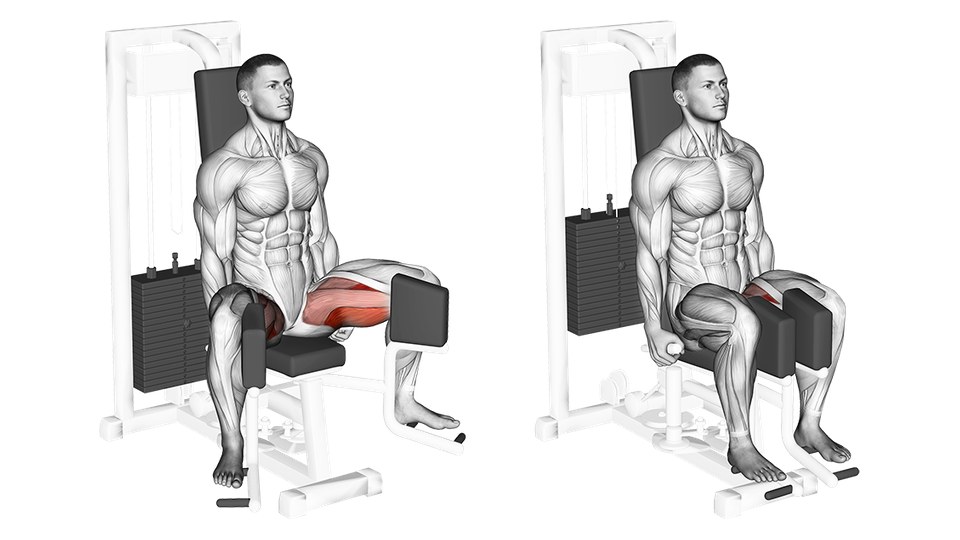
Hip adduction on a machine trains the inner-thigh muscles by bringing the thighs together against resistance. Sit with each leg outside its pad, close the legs under control and return only to a comfortable stretch.
How do you perform a hip adduction?
Set up
- Sit fully back in the machine with your feet on the supports and the inside of each thigh or knee against its pad.
- Set a comfortable open starting angle, hold the handles and keep your pelvis and back supported by the seat.
Execution
- Press both pads inward by bringing your thighs together.
- Finish without lifting your hips or forcing the pads past the machine's natural meeting point.
- Let the pads open slowly until you feel a comfortable inner-thigh stretch, then repeat without bouncing.
Common mistakes
Starting too wide
A wider setting is not automatically better. Choose an angle you can leave and return to without the pelvis twisting or the stretch becoming sharp.
Letting the stack slam
The outward phase is still part of the repetition. Slow it before the plates meet so the next rep begins from control.
Sliding or twisting on the seat
Moving the pelvis changes the hip position and makes the two sides inconsistent. Stay against the pad and reduce the load or range if needed.
Where it fits in a session
Use it as direct inner-thigh work after compound lower-body exercises or in a machine-focused leg session.
Record the same starting-angle setting where possible; changing it changes the range even when the stack weight stays the same.
Muscles worked
Primary
Secondary
- None listed in this guide
Schematic surface view. Some muscles are partly visible or not shown.
The inner-thigh muscles bring the thighs toward the body's midline against the machine pads.
Variations
- Standing cable hip adduction — Moves one leg inward from a low ankle cable while the other leg provides balance.
- Band hip adduction — Uses a resistance band around one ankle instead of a machine.
- Copenhagen adduction — A side-plank variation in which the upper leg supports the body.
Frequently asked questions
What muscles does the hip adduction machine work?
It trains the inner-thigh adductors: adductor magnus, adductor longus, adductor brevis, gracilis and pectineus.
How wide should you set the hip adduction machine?
Use an opening that gives a comfortable stretch while your pelvis and back stay supported. There is no need to force the widest setting.
Should you lean forward during hip adduction?
You do not need to. Follow the machine's back pad at a supported angle and keep that torso position consistent through the set.
Is hip adduction the inner-thigh machine?
Yes. Hip adduction brings the thighs inward. The neighboring hip abduction machine moves them outward and is a different exercise.
Sources
- Anatomy, Bony Pelvis and Lower Limb: Thigh Adductor Magnus Muscle. StatPearls. https://www.ncbi.nlm.nih.gov/books/NBK534842/