Inchworm
Also called in-place inchworm, inchworm walkout.
What is an inchworm?
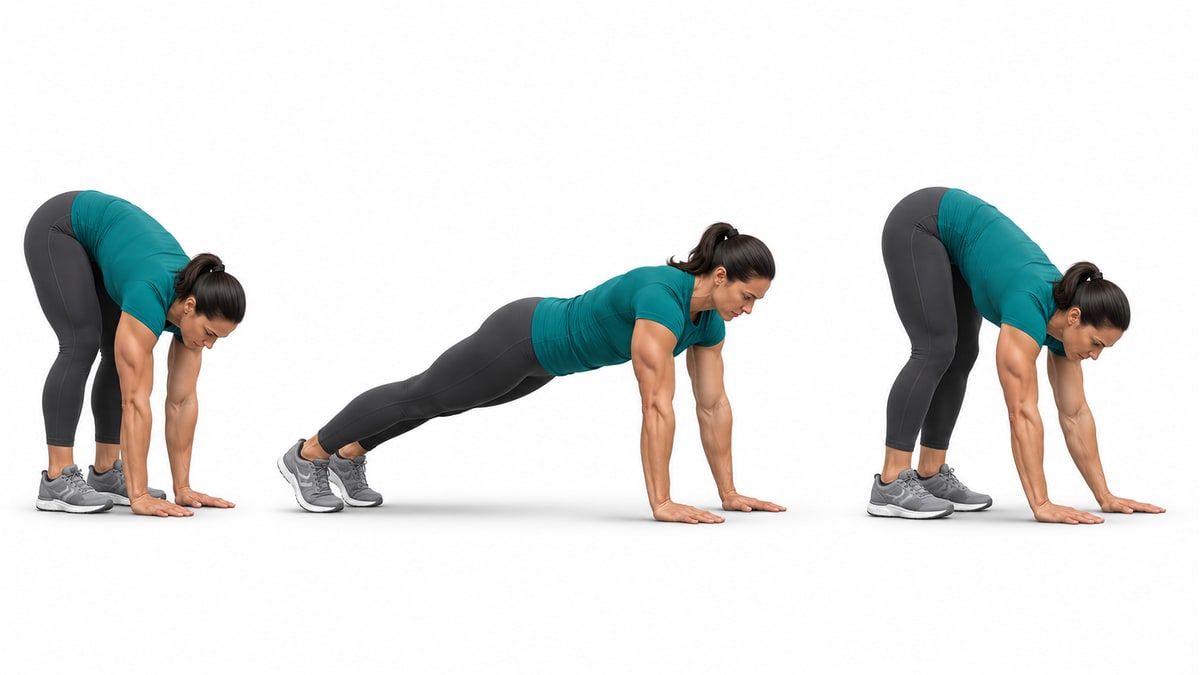
An inchworm is a bodyweight movement from standing to a high plank and back. Fold forward, place your hands on the floor, and move them away from your feet in small steps. In this in-place version, your feet stay near their starting spot as your hands return, then you stand again. There is no push-up or jump.
How do you do an inchworm?
Set up
- Stand on a firm, non-slip surface with enough clear floor ahead to reach a high plank. Space your feet about hip width.
- Soften your knees and fold forward at the hips until both palms can rest on the floor ahead of your toes. Bend the knees further if you need to reach.
Execution
- Keep your feet near their starting spot and take small forward steps with alternate hands. Let your heels rise as your body lengthens.
- Stop with your shoulders over your hands, arms straight, and legs reaching behind you. Firm your abdomen and keep your hips in line with your trunk while breathing.
- Raise your hips and step each hand back toward your feet. Allow your knees to bend as needed so the return stays controlled.
- With your hands close to your feet, bring your weight onto both feet and lift your torso to stand. You have completed one out-and-back repetition.
Common mistakes
Letting the middle sag at the walkout
Finish the outward steps when the hands are beneath the shoulders. Reset your abdominal brace if your pelvis drops or your lower back arches.
Forcing straight knees to reach the floor
Bend your knees enough to put your palms down and return with control. Reaching the floor with locked legs is not a requirement.
Changing the return into traveling steps
For this version, bring the hands back rather than walking the feet toward them. The feet-in version moves you along the floor and is a separate variation.
Where it fits in a session
As a controlled bodyweight movement in the warm-up or session you have planned.
Count the return to standing as one repetition. Use the amount of work set for that session, and stop before the walkout or return becomes a rushed drop.
Muscles worked
Primary
Secondary
Schematic surface view. Some muscles are partly visible or not shown.
The abdominal wall helps keep the trunk steady during the walkout and plank. The front of the shoulders and the triceps contribute to arm support. These are functional roles, not measured activation rankings. A stretch sensation behind the thighs does not show how hard the hamstrings are working.
Variations
- More knee bend — Use extra knee bend while placing the hands and bringing them back. Keep the same hand walkout, high-plank finish and standing return.
Frequently asked questions
Does an inchworm include a push-up?
Not in this guide. Reach a high plank with straight arms, then walk the hands back and stand. An inchworm with a push-up adds a press before the return and should be named separately when describing the exercise.
Do you walk your hands back or your feet forward?
Both patterns exist under the inchworm name. For the in-place pattern, move the hands out and back while the feet stay near their original spot. Walking the feet toward the hands makes it a traveling version.
Can you bend your knees?
Yes. Use enough bend to reach the floor and bring your hands back without forcing the position. You can keep the legs longer where comfortable, but locked knees and a toe-touch are not prerequisites.
Which muscles does an inchworm use?
Your abdominal wall helps control the trunk as the arms move away and while you hold the plank. The anterior deltoids at the front of the shoulders and the triceps support the arms. You may also feel tension behind the thighs as you fold forward; that sensation alone does not tell you how hard the hamstrings are working.
How far should you walk your hands out?
Finish in a high plank with the shoulders above the hands. Reaching farther forward creates a longer-lever variation. It is not needed for the standard repetition here; keep the shorter endpoint if reaching farther makes your hips sag.
Sources
- Betts JG, et al. Anatomy and Physiology 2e, section 11.4: Axial Muscles of the Abdominal Wall, and Thorax. OpenStax, 2022. https://openstax.org/books/anatomy-and-physiology-2e/pages/11-4-axial-muscles-of-the-abdominal-wall-and-thorax
- Betts JG, et al. Anatomy and Physiology 2e, section 11.5: Muscles of the Pectoral Girdle and Upper Limbs. OpenStax, 2022. https://openstax.org/books/anatomy-and-physiology-2e/pages/11-5-muscles-of-the-pectoral-girdle-and-upper-limbs