
Jumping jacks
Also called jumping jack.
What are jumping jacks?
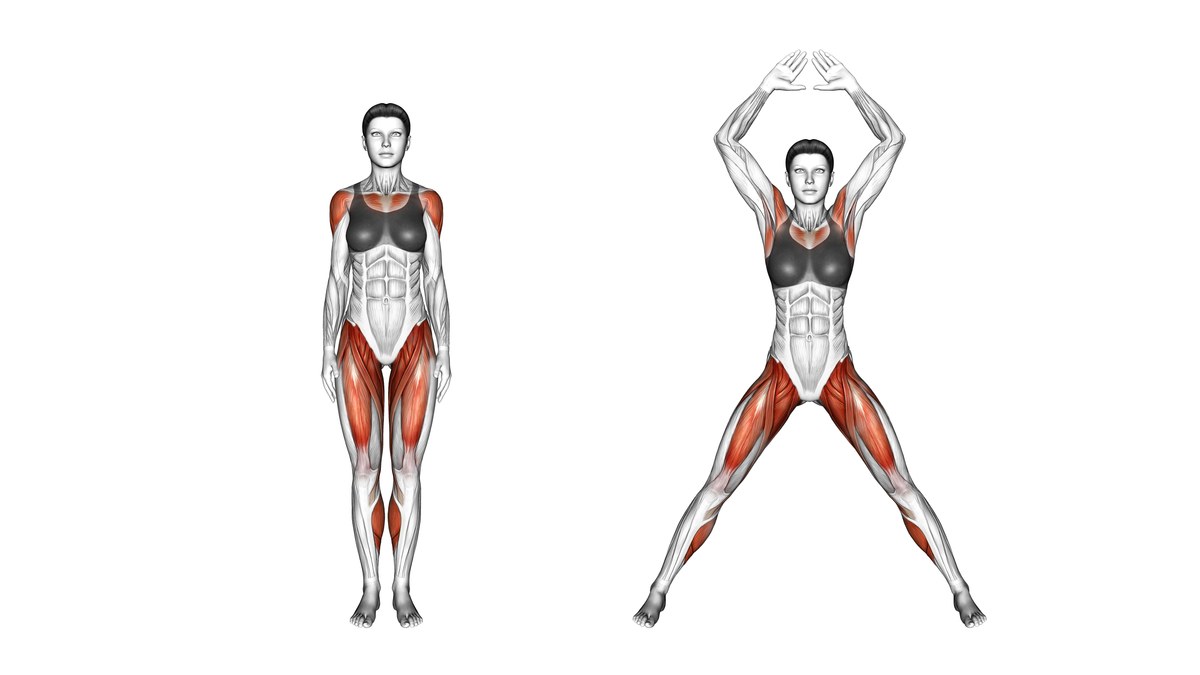
Jumping jacks are a bodyweight cardio movement: a small hop sends both feet apart as the arms sweep overhead, then another hop brings the feet together as the arms come down. You stay upright and repeat that open-and-close pattern in place. One trip out and back is one full repetition in this guide.
How do you do jumping jacks?
Set up
- Find a level, non-slip area with room to spread your feet and lift your hands overhead without hitting anything.
- Begin upright, feet close together and hands beside your thighs. Keep a little bend in your knees and look ahead.
Execution
- Make a small hop, moving both feet sideways while sweeping both arms out and up.
- Meet the floor with your feet comfortably wider than your hips and your hands overhead. Let your ankles and knees bend as you land, with your knees following your toes.
- Hop back to the narrow stance as your arms sweep down beside you. That return completes one repetition.
- Continue the same out-and-back pattern. To finish, settle into the narrow stance with your arms down and both feet still.
Common mistakes
Feet and hands losing the same rhythm
Pause in the narrow stance and practise one opening and one closing before stringing repetitions together.
Reaching for an exaggerated wide landing
A very wide stance can leave you struggling to bring the feet back beneath you. Use a width you can land in and leave again without stumbling.
Keeping the legs rigid on contact
Allow a small bend through the ankles and knees on both landings instead of trying to hold a locked standing position.
Where it fits in a session
Where jumping jacks fit the session you have planned.
Choose the amount of work for that session. The movement instructions define a repetition without setting a universal duration, speed or work-to-rest ratio.
Muscles worked
Primary
Secondary
Schematic surface view. Some muscles are partly visible or not shown.
The calves and quadriceps contribute to the hops, while the deltoids help lift the arms. This short list describes parts of a whole-body cardio movement; it does not rank muscle activation or promise muscle growth.
Variations
- Reduced arm range — Use a comfortable arm arc rather than forcing the hands to meet overhead. Keep the chosen range consistent.
Frequently asked questions
How do you count jumping jacks?
Count once after the feet have opened and returned together with the arms back down. This guide uses that complete out-and-back cycle as one rep. Follow a different count if a class or test explicitly defines one, and keep that convention consistent.
Can you do jumping jacks without jumping?
A step jack is a separate stepping alternative: step one foot out while lifting the arms, bring it back while lowering them, then change sides. One foot stays on the floor throughout. Keep it distinct from the two-foot jumping version when counting or recording your work.
Do your hands have to clap above your head?
No. A clap is not part of the definition. Let the hands approach each other overhead without forcing them together; if that arc is uncomfortable, use a smaller arm movement.
What muscles are involved in jumping jacks?
The calf muscles help push through the ankles, and the quadriceps straighten the knees during the hops. The deltoids help move the arms upward, with other shoulder muscles coordinating the overhead reach. These roles describe the movement, rather than showing which muscle gets the largest training effect.
Are jumping jacks the same as burpees?
No. Jumping jacks stay upright while the feet and arms open and close. A burpee includes bringing the hands to the floor and moving into and out of a plank. Jumping jacks also need no rope or rope-turning action.
Sources
- Bordoni B, Varacallo MA. Anatomy, Bony Pelvis and Lower Limb: Gastrocnemius Muscle. StatPearls, 2026. https://www.ncbi.nlm.nih.gov/sites/books/NBK532946/
- Bordoni B, Varacallo MA. Anatomy, Bony Pelvis and Lower Limb: Thigh Quadriceps Muscle. StatPearls, 2023. https://www.ncbi.nlm.nih.gov/sites/books/NBK513334/
- Lam JH, Bordoni B. Anatomy, Shoulder and Upper Limb, Arm Abductor Muscles. StatPearls, 2023. https://www.ncbi.nlm.nih.gov/sites/books/NBK537148/