
Kettlebell halo
Also called kettlebell around-head rotation.
What is a kettlebell halo?
A kettlebell halo moves one kettlebell around your head with both hands while you stand still. It involves the shoulders and upper back as your arms guide the bell through a controlled circle.
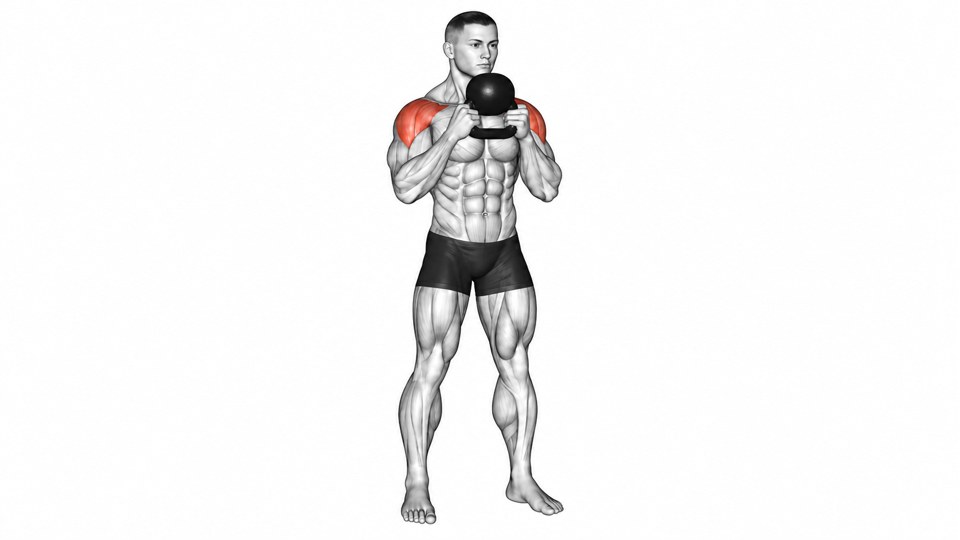
How do you perform a kettlebell halo?
Set up
- Stand with your feet comfortably apart and both feet planted. Grip the sides of a light kettlebell handle with both hands, with the rounded bell above the handle in front of your upper chest.
- Hold your head upright and settle your ribcage over your hips before moving the bell.
Execution
- Guide the kettlebell past one side of your head, lifting your elbows as it travels behind you. Keep both hands on the handle and leave room between the bell and your head.
- Continue around the other side to return to the front, keeping your feet planted and your trunk steady.
- Complete the planned circles, then reverse direction. Bring the bell back to your chest before lowering it.
Common mistakes
Arching the lower back to make room
Use a lighter bell or a smaller comfortable circle if you cannot pass it behind your head with your trunk steady.
Swinging the bell quickly past the face
Keep the pace slow enough to guide the weight and maintain clearance throughout the circle.
Turning the whole body with the bell
Keep your feet and hips facing ahead; the arms carry the bell around your head.
Where it fits in a session
Use controlled, light circles during a warm-up or as a separate shoulder movement.
Choose a load that lets you guide the entire circle. Count one complete circuit as one repetition and note whether the count is per direction or combined.
Muscles worked
Primary
Secondary
Schematic surface view. Some muscles are partly visible or not shown.
The deltoids and trapezius participate as the arms guide the kettlebell around the head.
Frequently asked questions
Should the kettlebell be upside down?
This guide begins with the round bell above the handle and a hand on each side of the handle. The bell changes orientation as you take it behind your head; keep your grip instead of trying to hold the bell upright throughout.
Is a halo an overhead press?
No. In a halo, you carry the bell around your head with bent elbows. In an overhead press, you push the weight upward and straighten your arms.
How heavy should the kettlebell be?
Start light enough to make the complete circle slowly while your head and trunk remain steady. If you have to duck, lean or rush, reduce the weight.
Do I circle in both directions?
Practice both directions. You can alternate directions each repetition or complete the planned repetitions one way before reversing.
Sources
- Elzanie A, Varacallo MA. Anatomy, Shoulder and Upper Limb, Deltoid Muscle. StatPearls. https://www.ncbi.nlm.nih.gov/sites/books/NBK537056/