
Kettlebell snatch
Also called single-arm kettlebell snatch, one-arm kettlebell snatch.
What is a kettlebell snatch?
A kettlebell snatch brings one kettlebell from a backswing between your legs to a straight-arm hold overhead. This guide covers one arm at a time, with each repetition flowing back into the next backswing.
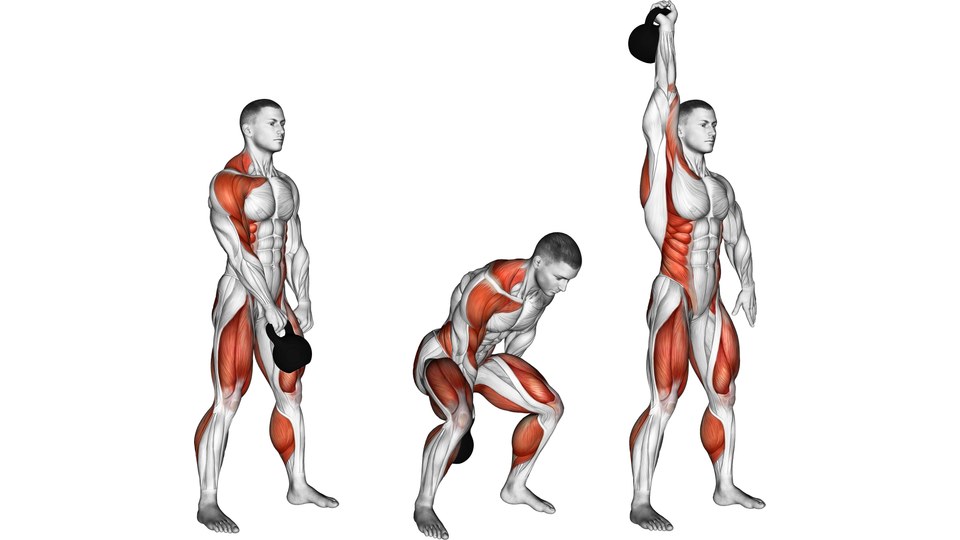
How do you perform a kettlebell snatch?
Set up
- Clear the space around and above you. Put one kettlebell just ahead of your feet and take a stance wide enough for it to pass between your legs.
- Bend at your hips and knees to take the handle in one hand. Brace your torso and draw the bell back between your thighs, keeping your free hand out of its path.
Execution
- Drive through your feet and stand up sharply, using your hips to send the bell upward. Guide it near your torso with a bent elbow.
- As the bell approaches overhead, slide your hand through the handle and straighten your arm so it settles behind your forearm. Finish upright with your wrist straight and the weight above your shoulder.
- Tip the bell forward from the overhead hold and guide it down. Let your hips move back as your arm approaches your body, returning the bell between your legs.
- Repeat on that side. To finish, follow the last backswing forward and place the bell on the floor; change hands only after it is settled.
Common mistakes
Letting the bell arc far away from you
Reduce the load and guide the handle closer as it rises, leaving room to turn your hand through it.
Leaning backward to finish
Choose a lighter bell and pause upright before starting the descent.
Where it fits in a session
Practise the turnover while fresh, before longer sets.
Choose a bell you can catch softly and lower deliberately on either side. Record repetitions per arm consistently.
Muscles worked
Primary
Secondary
Schematic surface view. Some muscles are partly visible or not shown.
These are the lower-body muscles involved in driving the bell upward; the list is not an exhaustive account of the overhead hold.
Frequently asked questions
Should I start with swings?
For learning this movement, practise a comfortable one-arm swing and a stable overhead hold first. Add the snatch turnover with a light bell before increasing the load.
Do I change hands in the air?
This guide uses one side at a time and puts the bell down before switching. Keep that convention consistent when recording sets.
Sources
- J. Gordon Betts et al.. Anatomy and Physiology 2e: Appendicular muscles of the pelvic girdle and lower limbs. 2022. https://openstax.org/books/anatomy-and-physiology-2e/pages/11-6-appendicular-muscles-of-the-pelvic-girdle-and-lower-limbs