
L-sit
Also called L sit.
What is an L-sit?
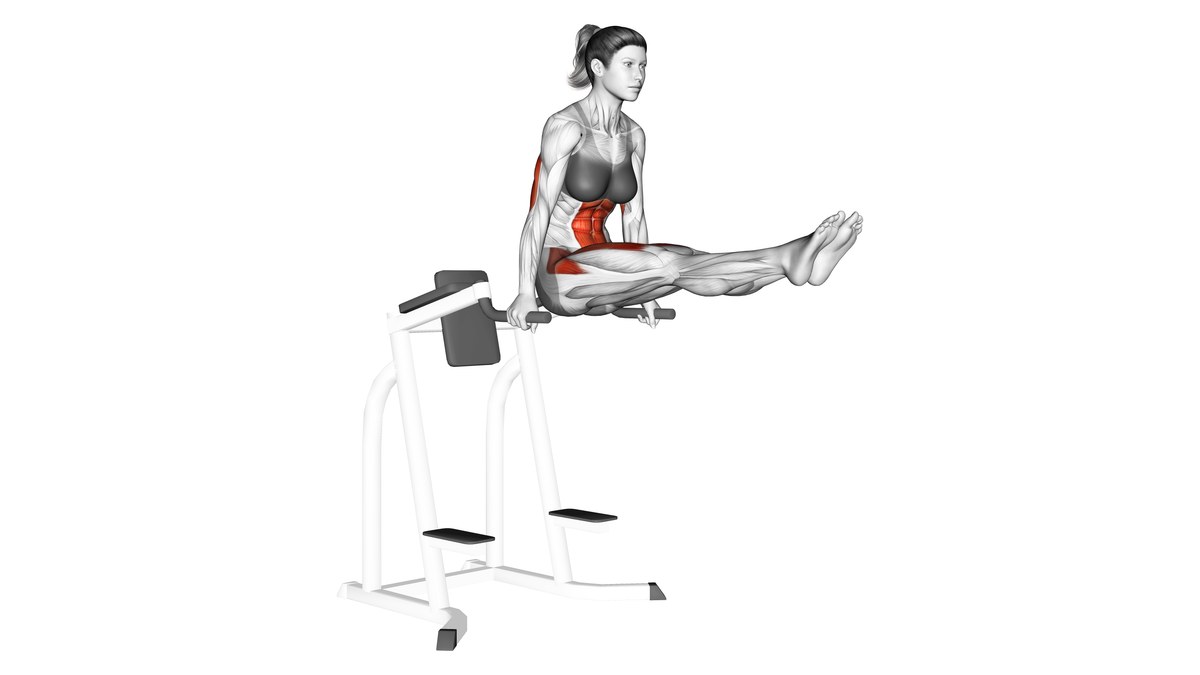
An L-sit is a bodyweight hold with your weight supported through straight arms and both straight legs held together in front of you, roughly parallel to the floor. Your torso and legs make an L shape. This guide uses parallel dip handles, matching the illustration. You hold the position rather than repeatedly raising and lowering your legs.
How do you perform an L-sit?
Set up
- Use a stable dip station with parallel handles, built-in steps and clear space for your legs in front. Step onto the footrests.
- Grip the handles beside your hips with your palms facing each other and your thumbs wrapped around them. Keep your back away from the pad.
Execution
- Press down through the handles until your arms are straight and your feet lift clear of the steps. Keep your shoulders away from your ears.
- Bring your knees toward your chest, then straighten both legs together in front of you until they are roughly parallel to the floor.
- Hold your torso upright and your legs still while breathing. Finish the hold before your heels drop, your knees bend or your shoulders sink.
- Bend your knees, bring your feet back onto the steps and take your weight through your feet before releasing the handles.
Common mistakes
Counting time after the legs drop
Once your heels fall, your legs are below the position you are trying to hold. End that attempt and choose a tuck or one-leg version for the next set.
Kicking up into position
A kick makes it harder to settle into a still hold. Lift with bent knees first, then extend only as far as you can keep the station and your body steady.
Resting on the forearm or back pads
This version supports your weight through your hands with straight arms. If you need the pads to stay up, return to the steps and practice the supported progression described below.
Where it fits in a session
If the L-sit is a skill you want to learn, practice it while your arms and trunk are fresh.
Choose a progression you can enter and leave under control. Start with a few short holds, rest until you can repeat the same position, and record both the version and the time held. Extend the hold or straighten more of the legs as separate changes. Use your own repeatable position as the progress check rather than chasing a universal time target.
Muscles worked
Primary
Secondary
Schematic surface view. Some muscles are partly visible or not shown.
The hip flexors hold the thighs forward while the abdominal muscles help keep the trunk steady. The quadriceps maintain straight knees and the triceps help maintain straight elbows.
Frequently asked questions
What muscles does an L-sit work?
The hip flexors, including the iliopsoas, keep the thighs lifted, while the abdominal muscles help stabilize the trunk. Your quadriceps keep your knees straight, and your triceps help keep your elbows straight. An L-sit combines leg and trunk control with support through the arms; it is not just an abdominal exercise.
How can a beginner build toward an L-sit?
On the station's steps, practice pressing down with straight arms while leaving some weight through your feet. Next, lift both feet with your knees tucked. When that is steady, extend one leg and keep the other tucked, practicing both sides before trying both legs straight. Return to the previous version whenever you cannot hold your position or lower to the steps under control.
Why is a tuck L-sit easier than a full L-sit?
Bending the knees brings the lower legs closer to the hips, reducing the leverage of their weight. You still have to support your body through your hands, so a tuck reduces the leg-holding demand without removing the need for arm support.
How long should you hold an L-sit?
Choose a time you can repeat with straight knees, raised legs and steady arm support. Stop before that shape changes, even if the hold lasts only a few seconds. Build repeatable short holds before adding time, and keep tuck and full L-sit times separate when comparing sessions.
Can you do an L-sit on the floor or parallettes?
Yes. They are other setups for the same L-shaped hold, but this page's instructions and media use a fixed dip station. Low parallettes or the floor leave less space underneath your legs than high dip handles. Use stable equipment designed to support your bodyweight; do not balance on loose dumbbells or chairs to imitate the picture.
Is an L-sit the same as a hanging leg raise?
No. In this L-sit your hands press down on handles beside your hips and you hold your legs forward. In a hanging leg raise your hands grip a bar overhead while you raise and lower the legs. They use different support positions and should be recorded as different exercises.
Sources
- Betts JG et al. Anatomy and Physiology 2e, section 11.4: Axial muscles of the abdominal wall, and thorax. OpenStax, 2022. https://openstax.org/books/anatomy-and-physiology-2e/pages/11-4-axial-muscles-of-the-abdominal-wall-and-thorax
- Betts JG et al. Anatomy and Physiology 2e, section 11.5: Muscles of the pectoral girdle and upper limbs. OpenStax, 2022. https://openstax.org/books/anatomy-and-physiology-2e/pages/11-5-muscles-of-the-pectoral-girdle-and-upper-limbs
- Betts JG et al. Anatomy and Physiology 2e, section 11.6: Appendicular muscles of the pelvic girdle and lower limbs. OpenStax, 2022. https://openstax.org/books/anatomy-and-physiology-2e/pages/11-6-appendicular-muscles-of-the-pelvic-girdle-and-lower-limbs
- Urone PP, Hinrichs R. College Physics 2e, section 9.6: Forces and torques in muscles and joints. OpenStax, 2022. https://openstax.org/books/college-physics-2e/pages/9-6-forces-and-torques-in-muscles-and-joints