
Landmine hack squat
What is a landmine hack squat?
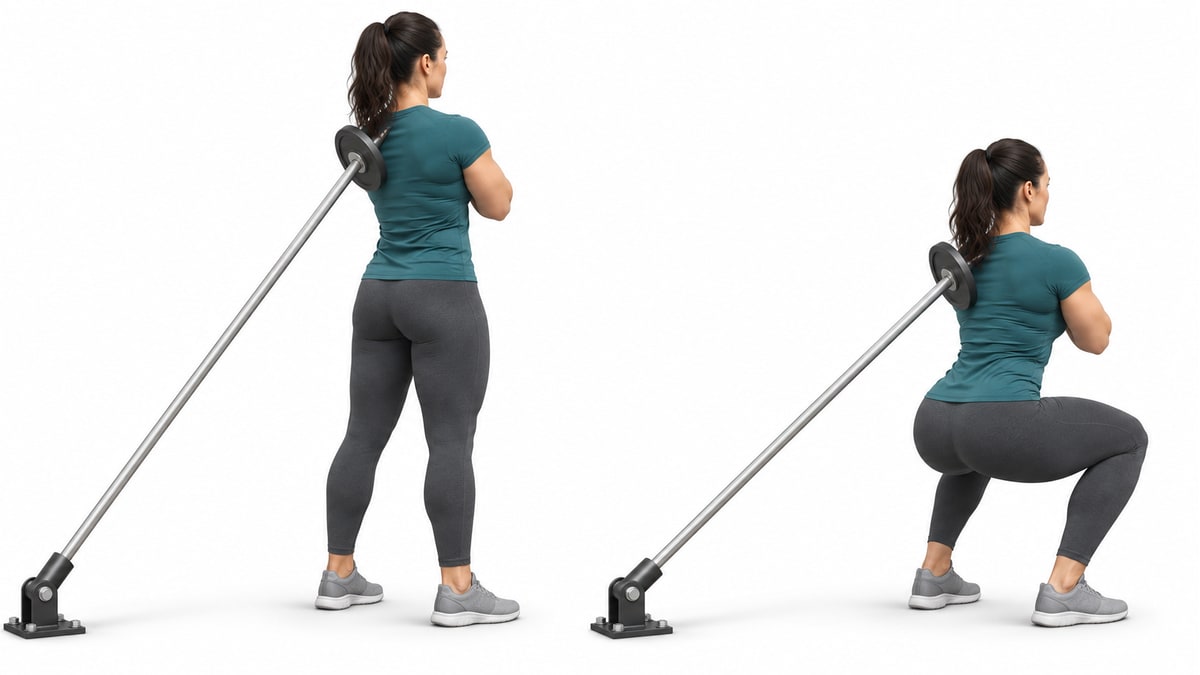
A landmine hack squat is a squat with the free end of an anchored barbell resting on one shoulder and your back toward the anchor. Both legs work together while your hands steady the bar. The shoulder support distinguishes it from a landmine squat held in front of the chest.
How do you perform a landmine hack squat?
Set up
- Secure an empty bar in a landmine attachment, leaving room for the bar to travel. Practise lifting and lowering it before adding plates; fasten loaded plates with a collar.
- Use both hands to bring the free end onto one shoulder, with your back toward the anchor. Set the sleeve on the muscular top of the shoulder, away from your neck.
- Place your feet about shoulder-width apart, slightly ahead of your hips. Keep both hands around the sleeve in front of your shoulder and brace your trunk.
Execution
- Bend your knees and hips to lower into the squat, keeping your whole feet on the floor as your shoulder follows the bar's arc.
- End the descent at a depth you can reverse without your heels lifting, your torso twisting or the bar moving on your shoulder.
- Push through both feet to stand tall, keeping the bar on your shoulder rather than pressing it upward with your arms.
- After your last rep, use both hands to guide the free end off your shoulder and back to the floor. Keep hold of the bar until it is down.
Common mistakes
Using more weight than you can get into position
The set includes lifting the bar to your shoulder and putting it down again. Reduce the load if either transition becomes a struggle.
Letting the sleeve slide toward the neck
Stop the set and reposition the bar on the shoulder before continuing. Do not try to adjust it during a squat.
Forcing extra depth after the heels leave the floor
Shorten the descent and reset your stance with the empty bar so you can keep your feet planted throughout the rep.
Where it fits in a session
Use it as a squat in a lower-body workout. Practise the shoulder setup before working sets.
Choose a load you can position and put down without help. Change shoulders between sets if you use both sides; keep both feet working on every rep.
Muscles worked
Primary
Secondary
- None listed in this guide
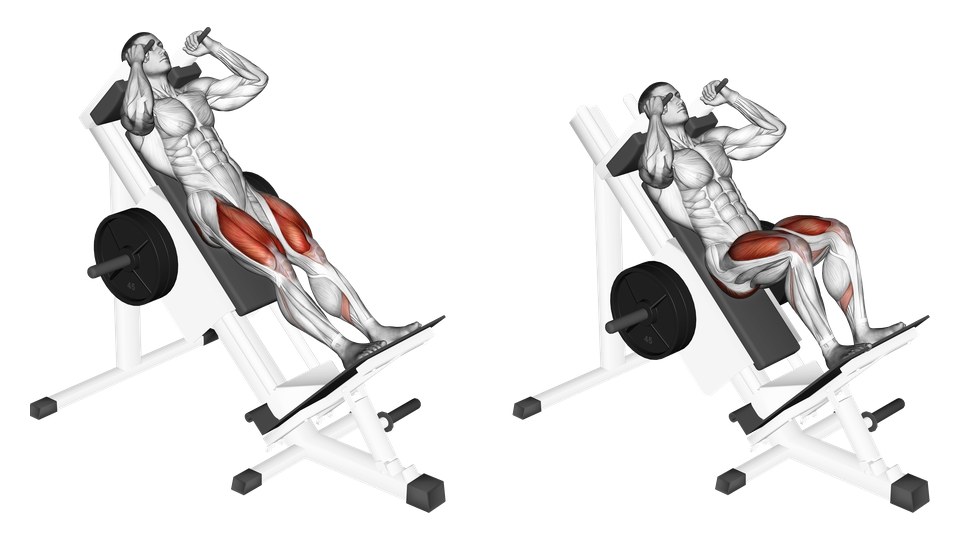
Schematic surface view. Some muscles are partly visible or not shown.
The quadriceps straighten the knees; the gluteus maximus and adductor magnus help straighten the hips as you rise. These are involved muscle groups, not a ranking of how much each works.
Variations
- Landmine squatFace the anchor and hold the free end at the chest with both hands.
Frequently asked questions
Is this the same as a front-held landmine squat?
No. In a front-held landmine squat you face the anchor and support the free end at your chest. Here the anchor is behind you and the sleeve rests on one shoulder. Keep the two setups separate when recording your workouts.
Which shoulder should I use?
Either shoulder is an option. Practise each side with the empty bar and change sides between sets, after lowering the bar. Do not pass a loaded bar across your neck.
How far forward should my feet go?
Start with your feet slightly ahead of your hips and test a few shallow reps with the empty bar. Adjust before adding weight until the sleeve stays on your shoulder and both feet stay planted through your chosen depth.
Is it a single-leg exercise because the bar is on one shoulder?
No. This guide uses a two-foot stance, and both legs squat together. One-sided shoulder support does not turn the movement into a single-leg squat.
Sources
- Betts JG et al. Anatomy and Physiology 2e, section 11.6: Appendicular muscles of the pelvic girdle and lower limbs. OpenStax. https://openstax.org/books/anatomy-and-physiology-2e/pages/11-6-appendicular-muscles-of-the-pelvic-girdle-and-lower-limbs
- Elzanie A, Borger J. Anatomy, Bony Pelvis and Lower Limb, Gluteus Maximus Muscle. Updated April 1, 2023. StatPearls. https://www.ncbi.nlm.nih.gov/books/NBK538193/