
Lateral bound
Also called lateral bounds, skater jumps, skater hops, side-to-side bounds.
What is a lateral bound?
A lateral bound is a sideways jump from one leg to the other. Push away from the supporting foot, receive your weight on the opposite foot, then reverse direction. Often called skater jumps or skater hops, the version taught here includes a balance reset between jumps rather than an immediate rebound.
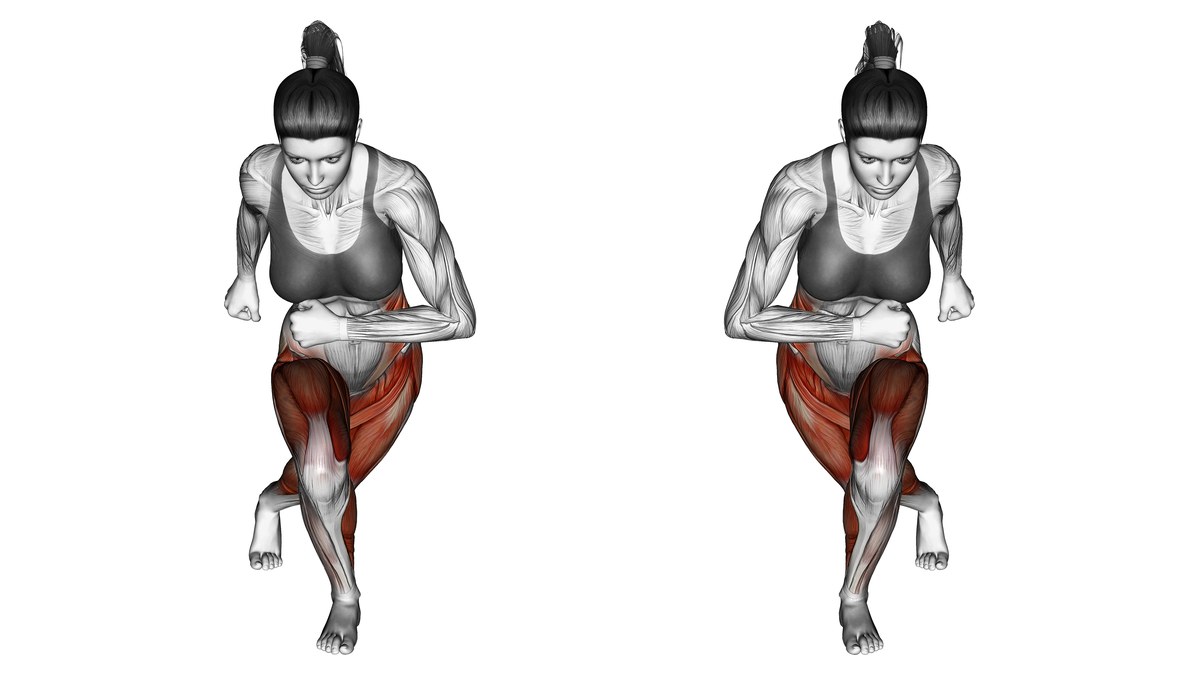
How do you perform a lateral bound?
Set up
- Choose a level, nonslip surface with clear space to both sides. Face forward, set your feet roughly hip-width apart and leave your arms free to swing.
- Shift your weight onto your left foot, bend that hip and knee slightly, and lift your right foot just clear of the floor. Keep your chest facing forward as you prepare to move right.
Execution
- Push through your left foot to jump a short distance to the right. Extend the left hip, knee and ankle as your arms swing naturally to help the jump.
- Meet the floor with your right foot and bend that hip and knee to receive your weight. Keep the knee pointing along the foot and the left foot clear while you settle over the right leg.
- Regain your balance before pushing from the right foot to travel left. Land on the left foot in the same controlled way, then continue alternating without turning your body away from the front.
- After the last landing, hold your balance, place the free foot down beside the supporting foot and stand with both feet settled before walking away.
Common mistakes
Jumping farther than you can control
If the landing needs several recovery hops or the free foot keeps catching you, shorten the next bound. Establish a stable landing before asking for more distance.
Bouncing away before finding your balance
An immediate return is a continuous variation. For this version, finish one landing before starting the next push-off so each side has a clear reset.
Turning the jump into a sideways step
A bound has a push-off and a brief airborne transfer to the opposite foot. A step can help you rehearse the positions, but it is a different movement from the jump described here.
Where it fits in a session
Include bounds where your session plan calls for lateral jumps.
Start with a short transfer you can land and balance on either side. End the set when you can no longer control the landing rather than turning it into hurried recovery hops.
Muscles worked
Primary
Secondary
Schematic surface view. Some muscles are partly visible or not shown.
The gluteus maximus and quadriceps contribute to the hip and knee extension of the push-off and control the bend on landing. The calf muscles contribute at the ankle, while gluteus medius helps steady the pelvis over the supporting leg. These are functional roles, not an activation ranking or an exhaustive list of every muscle involved.
Variations
- Continuous lateral bound — Reverse direction soon after each landing instead of pausing to balance; keep the same opposite-foot takeoff and landing pattern.
Frequently asked questions
What muscles do lateral bounds work?
The gluteus maximus and quadriceps help extend the hip and knee during takeoff and control their bend on landing. Gastrocnemius and soleus contribute to the ankle push-off. Gluteus medius helps support the pelvis while your weight is on one leg. This describes their movement roles; it does not mean that the jump isolates one muscle or provides a measured ranking of activation.
Are lateral bounds the same as skater jumps?
Those names commonly describe the same side-to-side jump: take off from one foot and land on the other. This guide uses them for that pattern. A two-foot sideways hop or a stationary skater squat has different mechanics and is not the default taught here.
Does the free leg have to cross behind me?
No particular amount of crossing is required here. The illustration shows the free leg trailing behind the supporting leg, but your priority is to clear the floor and settle over the landing foot. Let the free leg follow naturally without forcing a large cross-behind step or twisting the landing knee.
How far should I jump, and should I pause?
Use a distance that lets you land on the opposite foot and regain balance without extra hops. There is no fixed distance or hold time in this guide. A short balance reset is the default; continuous bounds reverse sooner and change the rhythm.
How is a lateral bound different from a broad jump?
A lateral bound travels sideways and transfers you from one foot to the opposite foot. A standing broad jump travels forward, usually with a two-foot takeoff and landing. The direction and foot pattern differ; neither is an alias for the other.
Sources
- Betts JG, et al. Anatomy and Physiology 2e, 11.6: Appendicular Muscles of the Pelvic Girdle and Lower Limbs. OpenStax. https://openstax.org/books/anatomy-and-physiology-2e/pages/11-6-appendicular-muscles-of-the-pelvic-girdle-and-lower-limbs
- Shah A, Bordoni B. Anatomy, Bony Pelvis and Lower Limb, Gluteus Medius Muscle. StatPearls. Updated 2023. https://www.ncbi.nlm.nih.gov/books/NBK557509/