
Medicine-ball slam
Also called medicine ball slams, ball slam, overhead medicine-ball slam, med ball slam.
What is a medicine-ball slam?
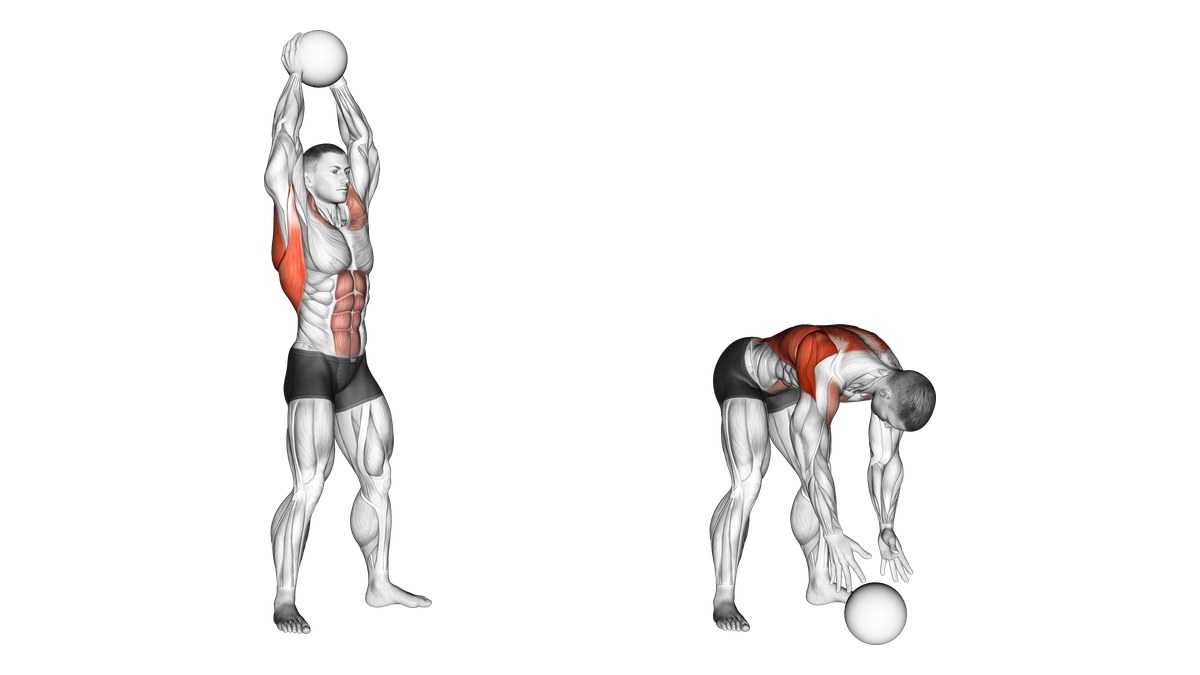
A medicine-ball slam is a two-hand throw from overhead into the floor. Raise a ball intended for floor slams, then bring your arms and body down together as you release it. This guide uses a nonbouncing slam ball and a separate pickup between repetitions, rather than catching a rebound.
How do you perform a medicine-ball slam?
Set up
- Choose an undamaged, nonbouncing ball that its maker permits for overhead slams. Use a floor approved for that impact and clear the space above you and around the landing area.
- Place the ball just in front of your feet. Bend your hips and knees, grip its sides with both hands, then stand with it close to your chest. Set your feet about shoulder-width apart with your weight balanced.
Execution
- Brace your middle and lift the ball above your head with both hands. Reach tall without leaning your lower back into a large arch.
- Drive the ball downward in front of you as your hips move back and your knees bend. Release it toward the cleared floor just ahead of your toes, keeping your hands and feet out of its path.
- Follow through with your arms, then let the ball settle before reaching down. If it moves away, wait until it stops and reposition yourself rather than diving after it.
- Bend your hips and knees to collect the ball with both hands, then stand and reset before another throw. After the last slam, leave the settled ball on the floor and step clear.
Common mistakes
Treating every medicine ball as a slam ball
A ball intended for wall throws or strong rebounds may be unsuitable for overhead slams. Check the maker's permitted use and the floor rules; the ball's name or appearance alone does not settle it.
Losing the overhead position to a back arch
Reach only as high as you can control while keeping your midsection steady. Use a lighter ball if you have to lean far backward to get it up.
Reaching for the ball while it is still moving
A bounce or roll can carry the ball outside your pickup position. Let it settle, then move your feet and collect it securely for the next rep.
Where it fits in a session
Put slams where your session plan calls for repeated ball throws.
Choose a load that lets you lift, aim and retrieve the ball consistently; pause when the throw or pickup becomes uncontrolled.
Muscles worked
Primary
Secondary
Schematic surface view. Some muscles are partly visible or not shown.
The lats help bring the raised arms down, while the abdominal muscles help control the trunk during the throw. The front deltoids lift the ball overhead; the glutes and quadriceps help you rise from the pickup. These are movement roles, not measured activation levels or a ranking of every muscle involved.
Variations
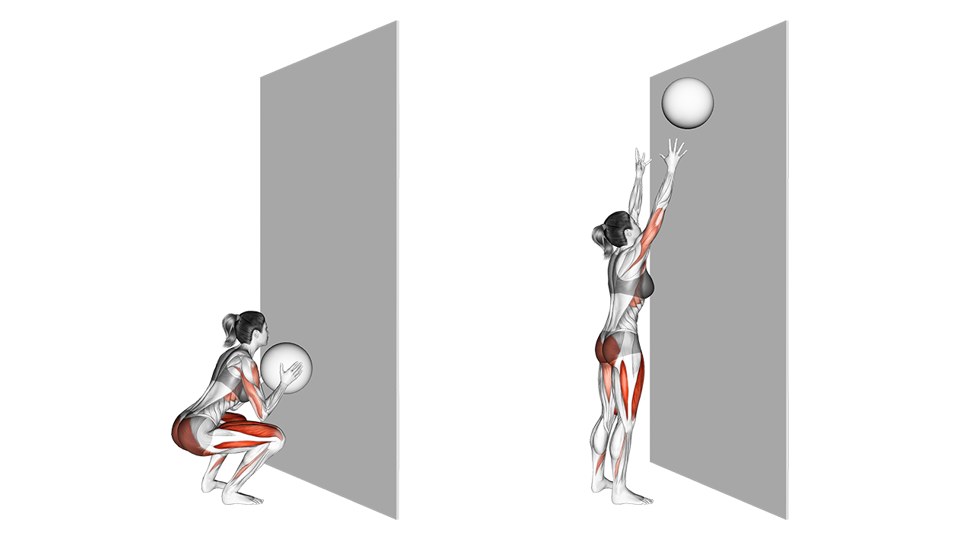
- Wall-ball shotSquat and throw a suitable ball upward at a wall target, then receive its return; this is a different throw from a floor slam.
Frequently asked questions
What muscles do medicine-ball slams work?
The lats contribute to bringing the arms down from overhead, and the abdominal muscles help control the trunk during the throw. The front deltoids raise the ball, while the glutes and quadriceps help with the repeated floor pickup and rise. It is a coordinated movement, so the muscle list does not mean that slams isolate the abs or lats.
Can I slam any medicine ball?
No. Use a ball specifically permitted for overhead floor slams and a surface that can take that use. Some medicine balls are built to rebound strongly, and some wall balls are intended for wall targets instead. This guide chooses a nonbouncing slam ball; check its condition and the maker's instructions before using it.
Should I catch the ball as it bounces?
Not in the version taught here. Let the ball settle, then bend down for a fresh pickup. A rebound-and-catch version requires equipment intended for that use and changes the rhythm. Do not put your face or hands over an unfamiliar rebound or chase a ball that leaves your stance.
How heavy should a slam ball be?
Start with one you can lift overhead without losing your position and release toward the same clear landing area each time. You should also be able to pick it up securely after every throw. If the lift turns into a backward lean or the ball slips from your grip, reduce the load and reset.
Is a medicine-ball slam the same as a wall-ball shot?
No. A slam sends the ball down into the floor from overhead. A wall-ball shot combines a squat with an upward throw at a wall target and a catch. They need different ball and space checks; permission for wall throws does not automatically mean a ball is suitable for floor slams.
Sources
- Elzanie A, Varacallo MA. Anatomy, Shoulder and Upper Limb, Deltoid Muscle. StatPearls. Updated 2024. https://www.ncbi.nlm.nih.gov/books/NBK537056/
- Betts JG, et al. Anatomy and Physiology 2e, 11.4: Axial Muscles of the Abdominal Wall and Thorax. OpenStax. https://openstax.org/books/anatomy-and-physiology-2e/pages/11-4-axial-muscles-of-the-abdominal-wall-and-thorax
- Betts JG, et al. Anatomy and Physiology 2e, 11.5: Muscles of the Pectoral Girdle and Upper Limbs. OpenStax. https://openstax.org/books/anatomy-and-physiology-2e/pages/11-5-muscles-of-the-pectoral-girdle-and-upper-limbs
- Betts JG, et al. Anatomy and Physiology 2e, 11.6: Appendicular Muscles of the Pelvic Girdle and Lower Limbs. OpenStax. https://openstax.org/books/anatomy-and-physiology-2e/pages/11-6-appendicular-muscles-of-the-pelvic-girdle-and-lower-limbs