Pallof press
Also called cable Pallof press, standing Pallof press.
What is a pallof press?
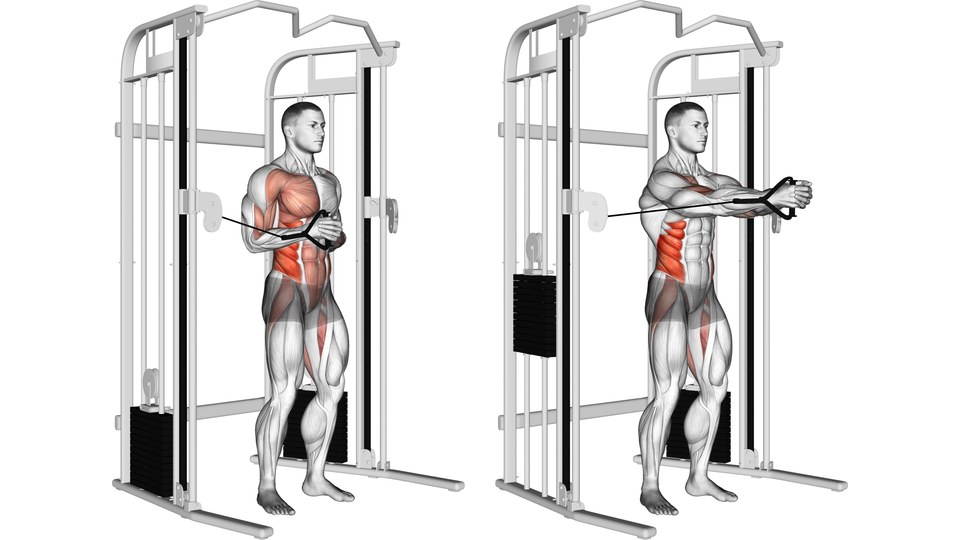
A Pallof press is a standing cable exercise in which you press a handle forward while resisting the cable's sideways pull. Your torso stays facing ahead as your hands move away from and back toward your chest. This guide covers the cable version, with the abdominal muscles holding your trunk steady.
How do you perform a pallof press?
Set up
- Set a cable handle around chest height. Stand side-on to the stack with your feet about shoulder-width apart.
- Hold the handle in both hands at your chest and step away until the cable is taut. Soften your knees and keep your shoulders above your hips.
Execution
- Press both hands straight forward from your chest without letting your shoulders or hips turn toward the machine.
- Pause with your arms extended, keeping the handle in front of your breastbone and breathing steadily.
- Bring the handle back to your chest under control and finish your repetitions. Step toward the stack to release cable tension before resetting to face the other way for the next side.
Common mistakes
Turning with the cable
Lower the weight if you cannot press and return while keeping your chest facing ahead.
Leaning away from the stack
Keep your shoulders over your hips instead of shifting your whole body to counter the pull.
Where it fits in a session
Place it with the core work in your session and keep the load light enough to pause without turning.
Log repetitions per side and keep the cable height and stance consistent.
Muscles worked
Primary
Secondary
Schematic surface view. Some muscles are partly visible or not shown.
The obliques and rectus abdominis hold the trunk steady against the sideways cable pull.
Frequently asked questions
Should I feel my arms working?
Your arms hold and move the handle, but the task is to keep your trunk from turning. Choose a load that lets you press smoothly without twisting or leaning.
Should I do both sides?
Yes. Face the opposite direction for the next set so the cable pulls from the other side. Keep the stance and handle height consistent.
Sources
- OpenStax. Anatomy and Physiology 2e. Axial Muscles of the Abdominal Wall and Thorax. https://openstax.org/books/anatomy-and-physiology-2e/pages/11-4-axial-muscles-of-the-abdominal-wall-and-thorax