Pendulum squat
Also called Pendulum machine squat.
What is a pendulum squat?
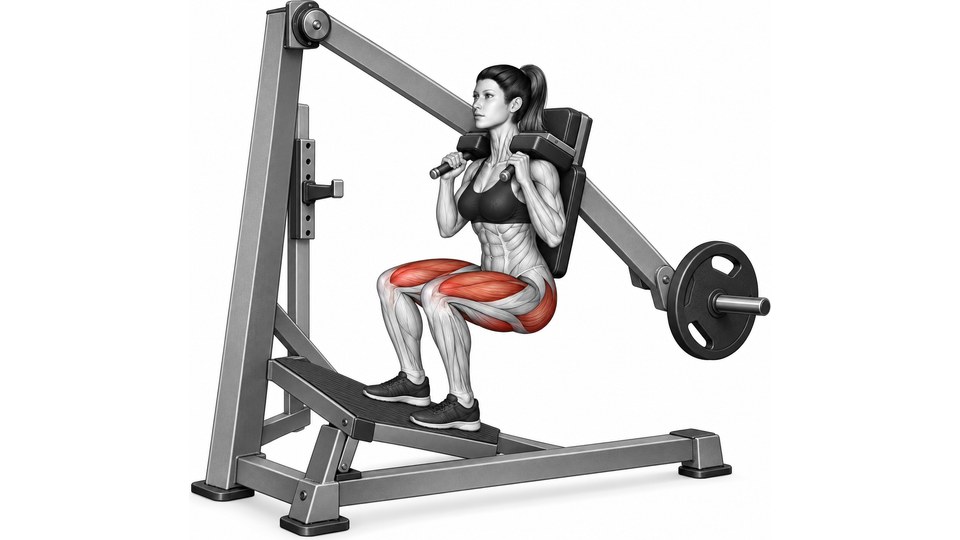
A pendulum squat uses a machine with shoulder pads and a moving arm that follows an arc. With your back against the pad and your feet on the platform, lower into a squat and stand back up. This guide covers the plate-loaded machine.
How do you perform a pendulum squat?
Set up
- Check the machine's instructions, choose a manageable load and set the safety stop before getting under the pads. Learn how to engage and release its catch while the machine is unloaded.
- Place your back against the pad, settle both shoulders under the pads and grip the handles. Set your feet on the platform where you can keep the whole foot supported through the rep.
Execution
- Stand tall enough to take the arm off its catch, then release the catch using the machine's control.
- Bend your knees and hips together, letting the machine carry you down its arc. Stop at a depth you can control while keeping your heels down and your back against the pad.
- Push through your feet to rise smoothly. Finish standing without snapping your knees backward, and repeat.
- After your last rep, engage the catch and lower the arm onto it. Confirm it is supported before stepping away.
Common mistakes
Starting before checking the catch
Know which control releases the arm and how to secure it again before beginning a loaded set.
Forcing more depth than your stance allows
Shorten the descent if your heels lift or your back separates from the pad. Adjust the machine or foot position between sets.
Where it fits in a session
Place this where your plan calls for a machine squat.
Keep the machine, stance and depth consistent when comparing sessions. Machine loads are not directly interchangeable.
Muscles worked
Primary
Secondary
- None listed in this guide
Schematic surface view. Some muscles are partly visible or not shown.
Variations
Frequently asked questions
Is a pendulum squat the same as a hack squat?
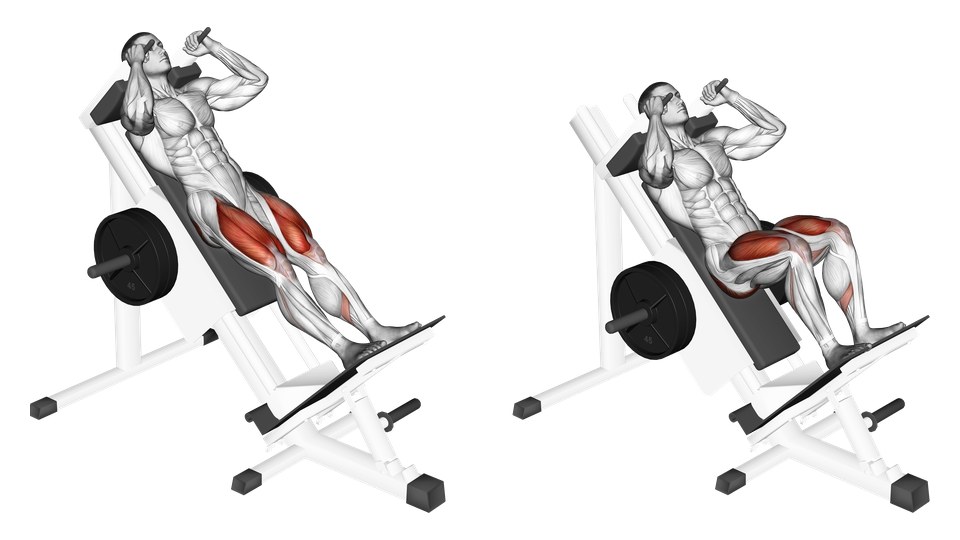
No. A pendulum machine rotates around a pivot, while a typical hack squat sled travels along rails. Keep separate training records for the two machines.
Where should I put my feet?
Use the machine's instructions as your starting point. Choose a stance that lets you keep your feet supported and your knees moving in line with your toes; there is no single platform position that fits every machine and lifter.
Sources
- Marjorie V. Launico; Margaret A. Sinkler; Shivajee V. Nallamothu. Anatomy, Bony Pelvis and Lower Limb: Femoral Muscles. StatPearls. https://www.ncbi.nlm.nih.gov/sites/books/NBK500008/?report=printable
- Roland Glenister; Sandeep Sharma. Anatomy, Bony Pelvis and Lower Limb, Hip. StatPearls. https://www.ncbi.nlm.nih.gov/sites/books/NBK526019/?report=printable