Plank jack
Also called plank jacks, high plank jack.
What is a plank jack?
A plank jack is a bodyweight exercise in which you hold a high plank and hop both feet apart, then back together. Your hands stay planted and your arms stay straight while your trunk remains steady. It combines a supported plank position with repeated sideways foot movement, rather than a push-up or a jump back to standing.
How do you do a plank jack?
Set up
- Choose a firm, non-slip patch of floor with room to move your feet sideways. Kneel on all fours and place your palms about shoulder width apart or a little wider, with your shoulders above your hands.
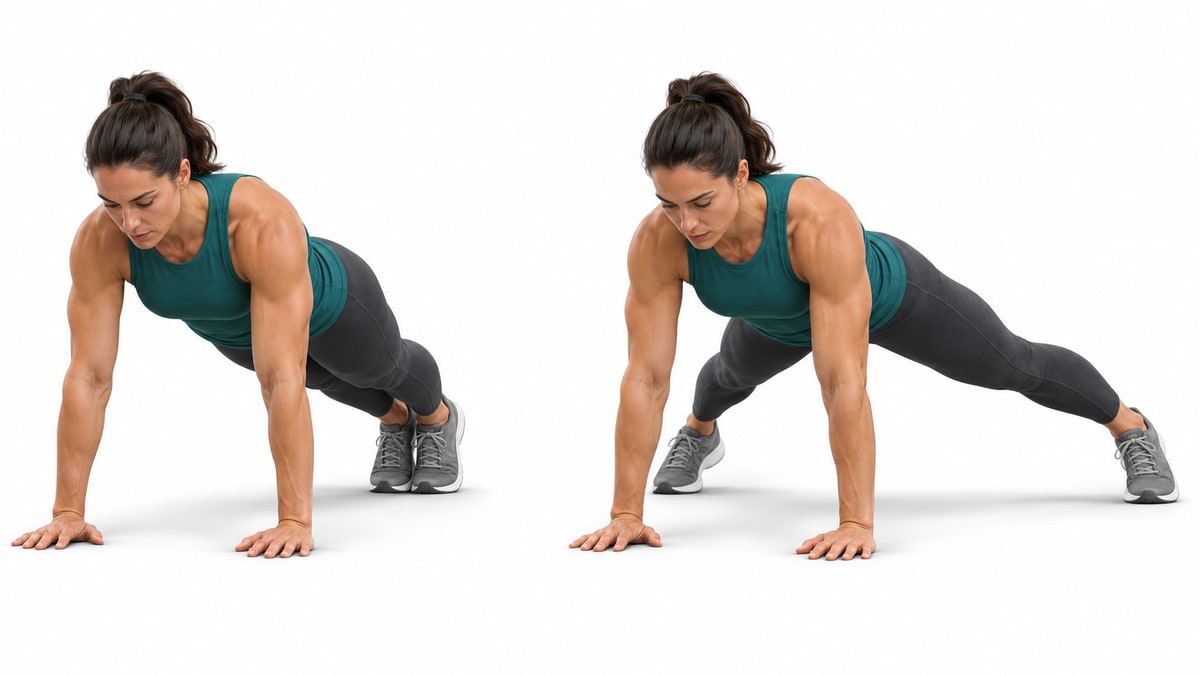
- Straighten your arms, firm your abdomen and step your feet back one at a time until they are close together. Support yourself on your hands and toes, with your head, hips and heels in a long line; look at the floor.
Execution
- Make a small hop with both feet, landing on your toes a comfortable distance apart. Keep your hands where they are and let your knees soften as you land.
- Hop both feet back to the narrow starting position without dropping your hips. One out-and-back cycle completes a repetition.
- Repeat the foot hops while keeping your arms straight and breathing regularly. Use a width and rhythm that let your trunk stay steady; stop if the hips start to sink or lift markedly.
- To finish, stop hopping and settle with both feet on the floor. Keep your hands planted as you lower your knees gently, then sit back into a comfortable kneeling position.
Common mistakes
Letting the hips bounce or sag
Reduce the hop width and slow down. If the straight-body position still changes, stop hopping, settle both feet and lower your knees to reset or use the step-out option.
Bending the arms into a push-up
This version keeps straight-arm support throughout the foot movement. A deliberate push-up adds another movement; it is not part of the repetition taught here.
Jumping the feet far beyond a controllable width
A very wide landing can make the return awkward and pull the trunk out of position. Use a modest sideways hop that you can reverse without swinging your hips.
Where it fits in a session
Use the movement where it fits your planned bodyweight or conditioning session, with enough free floor for both feet.
Choose a repetition count or a time period before starting. Keep the same counting convention and stop the set when you can no longer keep the upper-body support and trunk steady.
Muscles worked
Primary
Secondary
Schematic surface view. Some muscles are partly visible or not shown.
The abdominal wall helps keep your trunk steady while the feet move. The gluteus medius helps take the legs out to the sides. These roles describe the movement, rather than a measured activation ranking or a list of every muscle supporting you.
Variations
- Front plankHold still on the forearms and toes. It is a static plank option, rather than another name for the high-plank foot hops.

Frequently asked questions
Do you do plank jacks on your hands or forearms?
This guide uses a high plank with your palms on the floor and your arms straight. A forearm plank jack uses a different upper-body support position. Set up the version you intend to do before starting, and avoid changing arm support during a foot hop.
How do you count a plank jack?
Count one repetition when both feet hop out and then return to the narrow start. That is the convention used in this guide. You can instead work for the time chosen for your session; keep whichever measure you choose consistent.
Can you do plank jacks without jumping?
Use the step-out regression: step one foot to the side, bring it back, then change sides while your hands remain planted. It gives you time to control the plank position, but it is not the same simultaneous hopping pattern.
What muscles do plank jacks work?
The rectus abdominis, obliques and transversus abdominis help control your trunk while your feet move. The gluteus medius contributes to moving the legs sideways. Your upper body also supports your weight. These are functional roles, not proof that plank jacks isolate one muscle or train it more than another exercise.
Are plank jacks the same as jumping jacks or burpees?
Standing jumping jacks move the arms and feet while upright. Plank jacks keep the hands on the floor and move the feet sideways. A burpee includes a transition toward standing; this plank-jack version stays down and does not add a push-up.
Sources
- Flynn W, Vickerton P. Anatomy, Abdomen and Pelvis: Abdominal Wall. StatPearls, updated 2023. https://www.ncbi.nlm.nih.gov/books/NBK551649/
- Shah A, Bordoni B. Anatomy, Bony Pelvis and Lower Limb, Gluteus Medius Muscle. StatPearls, updated 2023. https://www.ncbi.nlm.nih.gov/books/NBK557509/