
Plank pull-through
Also called dumbbell plank pull-through, plank dumbbell drag, plank drag, kettlebell plank pull-through.
What is a plank pull-through?
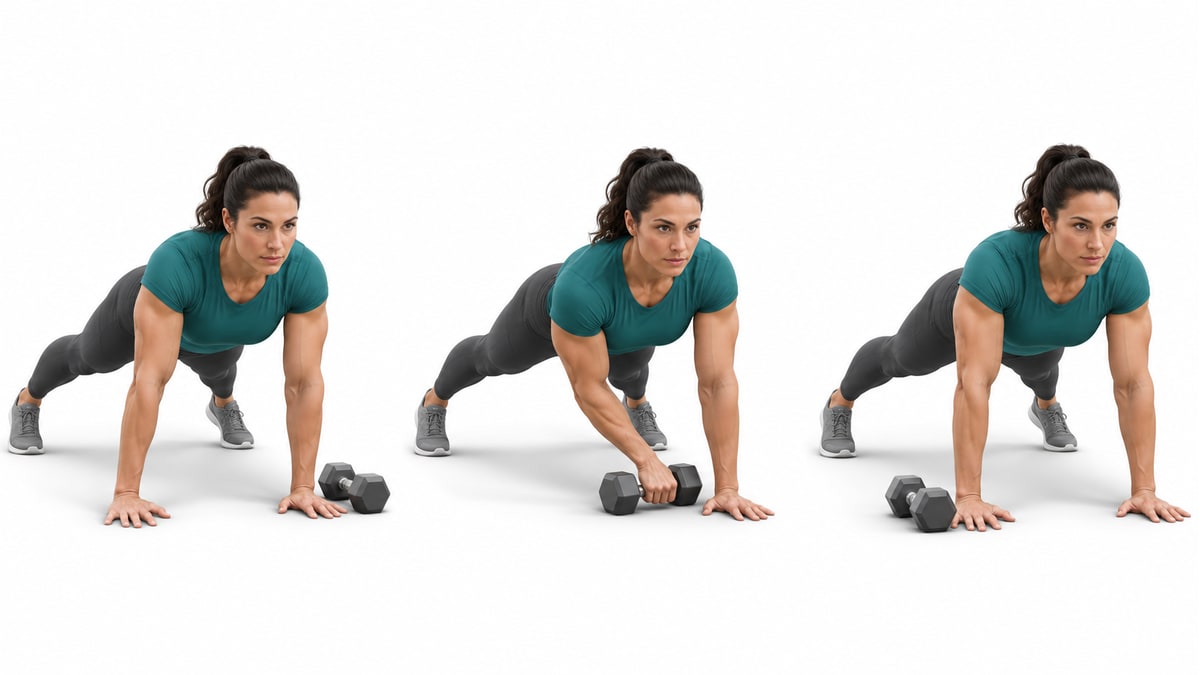
A plank pull-through is a high plank with a weight dragged from one side of your body to the other. You reach beneath your chest with one hand, pull the dumbbell across the floor, then replace that hand before changing sides. Keep your chest and hips facing the floor throughout the transfer.
How do you perform a plank pull-through?
Set up
- Set a light, flat-sided dumbbell on a clear patch of floor just behind where your left hand will rest. Check that it slides without catching or damaging the surface.
- Plant both palms beneath your shoulders and step your feet back, wider than your hips. The dumbbell should sit just outside your left hand.
- Lift your knees, straighten your legs, and brace your middle so your waist does not sag. Keep your neck aligned with your back and continue breathing.
Execution
- Press through your left palm and both feet, then lift your right hand and reach under your chest to grip the dumbbell.
- Drag the weight along the floor to just outside your right-hand position, keeping your chest and hips facing down.
- Release the weight and put your right palm back beneath your shoulder. Settle on both hands before reaching across with your left hand to drag it back. Continue alternating, then lower your knees to finish.
Common mistakes
Turning the whole body to move the weight
If your hips roll open on every drag, lighten the dumbbell or widen your feet. Keep the transfer within a distance you can reach without turning.
Lifting the dumbbell toward the ribs
A pull-through moves the weight across the floor. Pulling the elbow up beside your torso changes it into a plank row.
Letting the waist drop between transfers
Reset with both hands down before the next reach. Finish the set if you cannot recover your plank without sagging.
Where it fits in a session
Practise it while you can still control each reach and return.
Start with a weight you can slide without twisting. Count each transfer as one rep and use the same convention each session; 6 in each direction means 12 total transfers. Finish when the plank changes shape.
Muscles worked
Primary
Secondary
Schematic surface view. Some muscles are partly visible or not shown.
The abdominals and obliques help hold your trunk steady as the weight moves. Keep your torso facing the floor rather than turning with the dumbbell.
Variations
- Front plankA forearm hold without a moving weight. Use it to practise keeping a steady trunk, then establish a high plank before adding the drag.
- Kettlebell plank pull-through — Use a light kettlebell with a flat base in the same hand-supported position. It must pass beneath your body without catching; check your floor surface first.
Frequently asked questions
What muscles does the plank pull-through work?
This guide focuses on the rectus abdominis and obliques. The aim is to keep your trunk steady while an arm reaches across and moves the weight.
How can I make a plank pull-through easier?
Widen your feet or choose a lighter dumbbell first. If you cannot hold a high plank while lifting a hand, practise a high plank with both hands down. A knees-down drag is another way to rehearse the reach before returning to toe support.
Is this the same as a renegade row?
No. Here, one weight slides across the floor and your supporting hand rests on the floor. A renegade row lifts a dumbbell toward the ribs while the other hand supports you on a second dumbbell.
Is a plank pull-through the same as a cable pull-through?
No. A cable pull-through is a standing hip hinge with a cable running between the legs. This movement stays in a high plank and passes a weight across the floor beneath your chest.
Sources
- Flynn W, Vickerton P. Anatomy, Abdomen and Pelvis: Abdominal Wall. StatPearls. Updated July 24, 2023. https://www.ncbi.nlm.nih.gov/books/NBK551649/