
Plank shoulder taps
Also called high plank shoulder taps, shoulder tap plank.
What are plank shoulder taps?
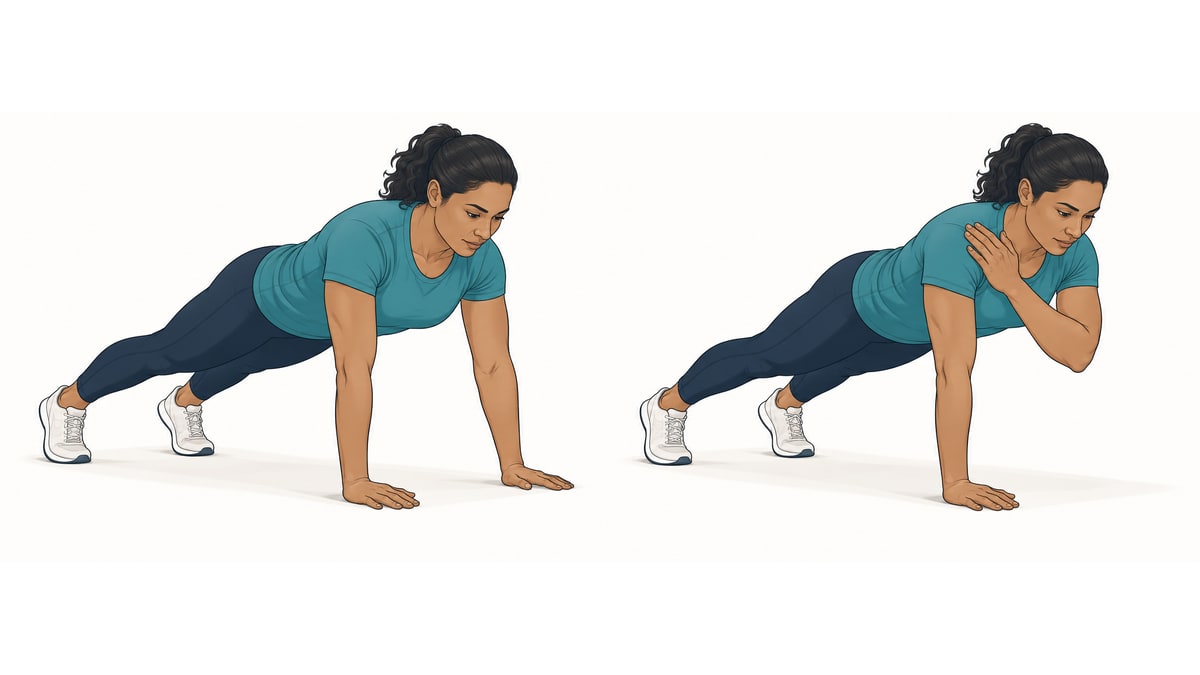
Plank shoulder taps are a bodyweight exercise in which you hold a high plank and lift one hand at a time to touch the opposite shoulder. Your trunk resists turning as support alternates between arms. The taps are performed without lowering into a push-up.
How do you do plank shoulder taps?
Set up
- Place your palms on the floor beneath your shoulders, then step your feet back with your arms and legs straight and your feet about shoulder-width apart.
- Brace your stomach and glutes to hold your head, hips and heels in one line. Keep both feet planted and look at the floor.
Execution
- Shift just enough weight into your right palm to lift your left hand and touch your right shoulder. Keep your hips facing the floor.
- Put your left hand back beneath its shoulder and settle onto both hands before the next tap.
- Shift onto your left palm and tap your left shoulder with your right hand. Keep alternating with light touches while you breathe.
- End the set when you cannot keep your hips level or your supporting arm steady. Return both hands to the floor, then lower your knees.
Common mistakes
Turning the hips with every tap
The goal is to move the hand while keeping the trunk steady. Slow down and reset with both hands down; use an easier setup if the twisting continues.
Lifting a foot to reach the shoulder
Keep both feet on the floor throughout the set. If you need to lift one to stay balanced, widen your stance or try the taps from your knees.
Sinking into the supporting shoulder
Keep pressing through the palm as the other hand lifts. Stop and reset if your chest drops or the supporting elbow keeps bending.
Where it fits in a session
Use during your planned core work, while you can still make each tap controlled.
Count each shoulder touch as one rep and give both sides the same number. Start with a number you can repeat without losing the plank position. Add taps gradually; if you change your foot spacing, record that change so you can compare like with like.
Muscles worked
Primary
Secondary
- None listed in this guide
Schematic surface view. Some muscles are partly visible or not shown.
The rectus abdominis and obliques help keep the trunk steady while a hand is lifted. The supporting shoulder and arm also bear weight.
Variations
- Front plankKeep both forearms on the floor for a held plank without alternating hand lifts.
Frequently asked questions
What muscles do plank shoulder taps work?
The abdominal muscles, including the rectus abdominis and internal and external obliques, work to steady your trunk. Your supporting shoulder and arm also work while the opposite hand is off the floor. The aim is to keep the torso from twisting, rather than twist it with each tap.
Are shoulder taps the same as holding a high plank?
No. In a high plank, both hands remain on the floor. In shoulder taps, you briefly support yourself on one hand and both feet as the other hand touches the opposite shoulder. There is no push-up between taps in this version.
What if I cannot keep my hips still?
Try a wider foot position and slower taps first. If that is still too difficult, keep your knees on the floor and hold a line from shoulders through hips to knees as you alternate. Another option is to place your hands on a sturdy raised surface that will not slide or tip. Return to floor taps when you can repeat the movement without losing that shape.
How can I progress plank shoulder taps?
Build up repeatable taps with the same stance first. Then try a slightly closer foot position or pause briefly at each shoulder before returning the hand. Change one thing at a time and stop the set when control goes. These are coaching options, not a required progression schedule.
Does one rep mean one tap or both sides?
This guide counts each tap as one rep. Ten total taps means five touches on each shoulder. Counting a left-and-right pair as one rep also works, provided you use the same convention each time and label it clearly.
Sources
- OpenStax. Anatomy and Physiology 2e. Axial Muscles of the Abdominal Wall, and Thorax. https://openstax.org/books/anatomy-and-physiology-2e/pages/11-4-axial-muscles-of-the-abdominal-wall-and-thorax
- Can EN, Harput G, Turgut E. Shoulder and Scapular Muscle Activity During Low and High Plank Variations With Different Body-Weight-Bearing Statuses. J Strength Cond Res. 2024;38(2):245-252. https://pubmed.ncbi.nlm.nih.gov/37815235/