
Plank to push-up
Also called up-down plank, plank up-down, plank to press-up.
What is a plank to push-up?
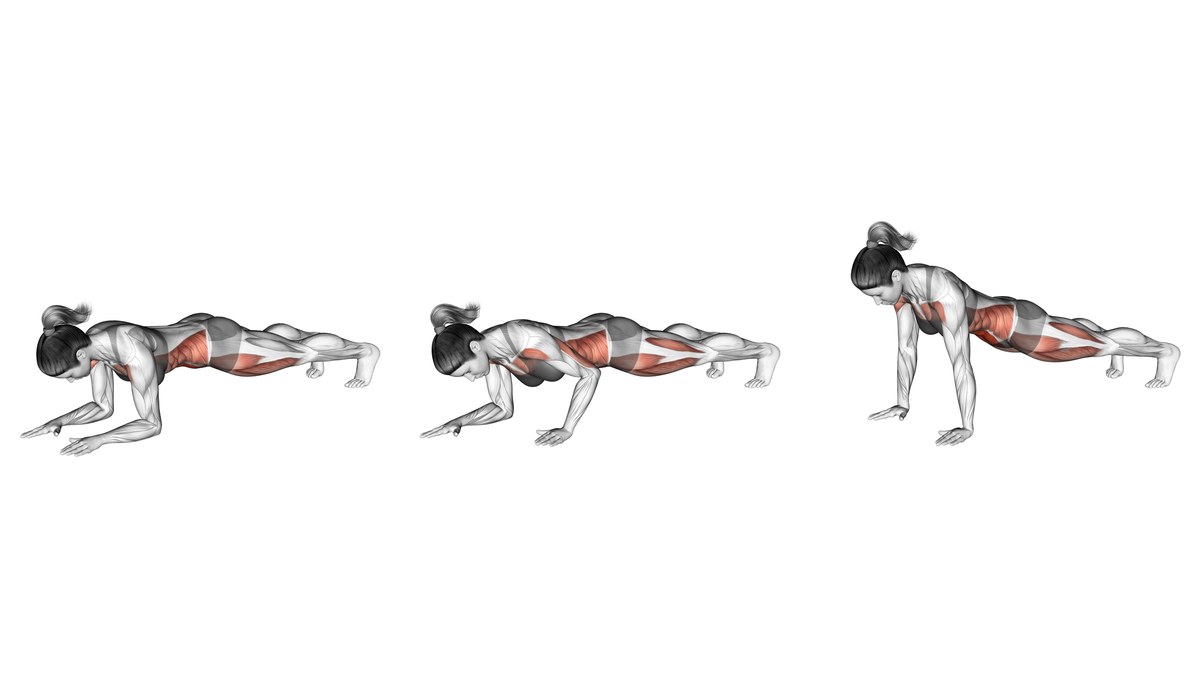
A plank to push-up moves from a forearm plank to a high plank one arm at a time, then returns to the forearms. Also called an up-down plank, it changes your arm support while your body stays facing the floor. This version has no separate chest-lowering push-up.
How do you perform a plank to push-up?
Set up
- On a firm, non-slip floor, set your forearms about shoulder-width apart with your elbows beneath your shoulders. Extend your legs and rest on your toes with your feet about hip-width apart.
- Brace your abdomen and lift your hips into a straight line from your shoulders to your heels. Keep breathing as you hold that shape.
Execution
- Move your weight onto your left forearm and plant your right palm where your right elbow was, with your fingers pointing forward.
- Press through your right hand, then bring your left palm beneath your left shoulder to reach a high plank. Keep your hips facing the floor as you change support.
- Set your right forearm down, then your left, returning both elbows beneath your shoulders. That completes one repetition.
- Start the next repetition with your left arm and keep alternating the lead arm. Lower your knees to the floor when you finish the set.
Common mistakes
Twisting the hips during the change
Slow down and separate your feet a little farther if you cannot keep the pelvis mostly level. Use the knee-supported option if needed.
Reaching too far ahead
Place each palm under its shoulder rather than walking the hands out in front of you.
Dropping onto the forearms
Bend the supporting arm enough to place the other forearm down gently, rather than letting your weight fall onto the elbow.
Always leading with one arm
Alternate which arm starts the rise and return, so the same side does not perform the first transition every time.
Where it fits in a session
Place it where you have planned bodyweight or core work and can still control the hand-to-forearm transitions.
Count a return to both forearms as one repetition. End the set when you cannot place the arms quietly or keep the hips reasonably level.
Muscles worked
Primary
Secondary
Schematic surface view. Some muscles are partly visible or not shown.
Your abdomen holds the plank position while your triceps straighten the elbows as you rise onto your hands.
Variations
- Knee-supported plank to push-up — Keep your knees on the floor with your shoulders, hips and knees in one line. Make the same one-arm-at-a-time changes between forearms and hands.

Frequently asked questions
Is a plank to push-up the same as an up-down plank?
Yes. Both names describe alternating between forearm and high-plank support. A separate standard push-up or dumbbell row is a different sequence.
What muscles does a plank to push-up work?
The rectus abdominis is an abdominal target of the plank position. Your triceps straighten the elbows as you move onto your hands.
How do I make it easier?
Keep the knees down throughout and maintain a straight line from shoulders to knees. Move one arm at a time just as in the toe-supported version.
Should I switch the leading arm?
Yes. Let one arm begin the rise and return for a complete repetition, then start the next repetition with the other arm.
Do I need to lower my chest at the top?
No. Once both hands are planted and your arms are straight, begin the controlled return to your forearms. A separate push-up adds another movement to the sequence.
Sources
- Oliva-Lozano JM, Muyor JM. Core Muscle Activity During Physical Fitness Exercises: A Systematic Review. 2020. https://pmc.ncbi.nlm.nih.gov/articles/PMC7345922/
- Escamilla RF, Lewis C, Pecson A, Imamura R, Andrews JR. Muscle Activation Among Supine, Prone, and Side Position Exercises With and Without a Swiss Ball. 2016. https://pmc.ncbi.nlm.nih.gov/articles/PMC4922527/
- Tiwana MS, Sinkler MA, Bordoni B. Anatomy, Shoulder and Upper Limb, Triceps Muscle. StatPearls. Updated 2023. https://www.ncbi.nlm.nih.gov/books/NBK536996/