
Plate pinch
Also called plate pinch hold.
What is a plate pinch?
A plate pinch is a grip exercise in which you squeeze a weight plate between your thumb and fingers and hold it off the floor. The grip stays on the plate's faces rather than a handle or hole. Your thumb and finger muscles keep the plate from sliding while your arm hangs beside you. This guide uses one plate in one hand and a stationary hold.
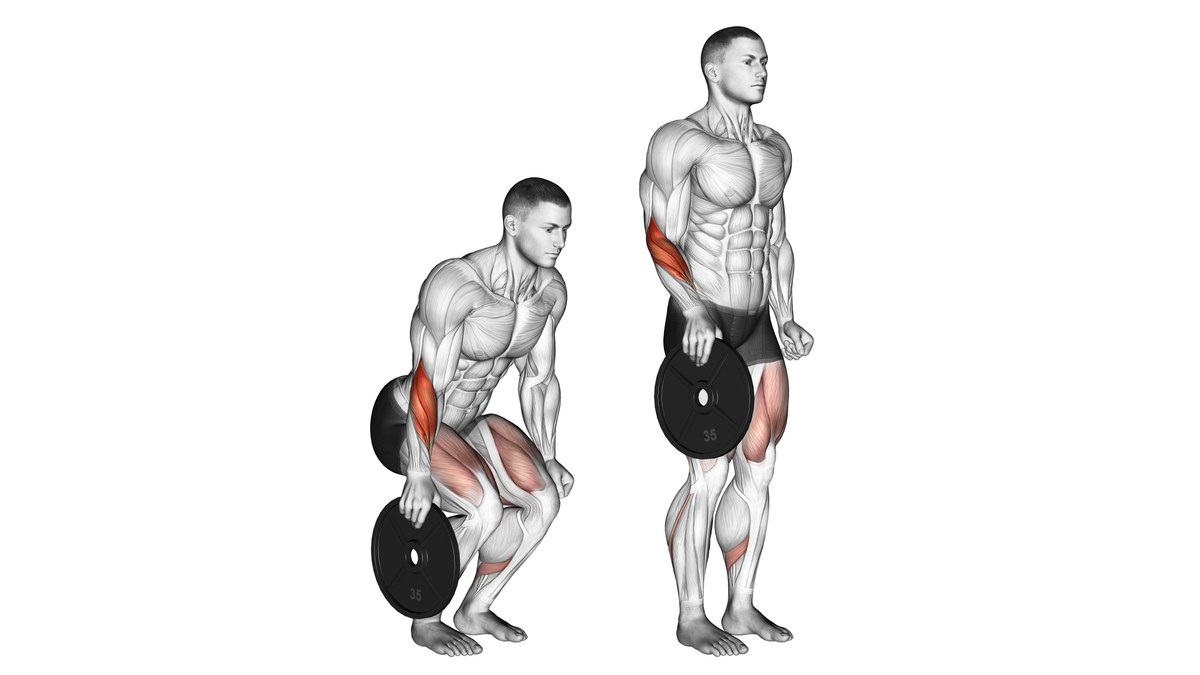
How do you perform a plate pinch?
Set up
- Choose a light plate you can pinch securely. Stand it on edge beside your working hand, outside your foot, with a clear place to set it down away from your toes.
- Bend your hips and knees to reach the plate. Take its top edge with your thumb on the inner face and your fingers on the outer face, without hooking under a rim or through a hole.
- Set your feet firmly, keep your back steady and brace your middle. Squeeze the plate faces before you try to lift it.
Execution
- Stand up with the plate hanging beside your leg. Keep your arm long, your wrist in line with your forearm and the plate clear of your feet.
- Stay in place and maintain the pinch while breathing normally. Finish the hold while you can still lower the plate securely.
- Bend your hips and knees to return the plate to the floor. Let its full weight settle before opening your hand, then repeat on the other side.
Common mistakes
Resting the plate on a ledge in your fingers
A hooked rim or handle supports the plate instead of leaving it held between opposing thumb and finger pressure. Reposition the hand while the plate is on the floor.
Dragging the plate against your thigh
Contact with the leg can prop up the plate. Leave enough space to hold it freely without lifting your arm out to the side.
Waiting until the plate falls
A slipping plate can land on a foot. End the hold early enough to put it down deliberately; use a lighter plate if you cannot control the return.
Where it fits in a session
Put plate pinches after any lifting where you need a fresh grip.
Start with brief holds you can repeat without the plate sliding. Keep the same plate design and hand position when comparing sessions. Increase the time or the load gradually, rather than changing both together.
Muscles worked
Primary
Secondary
- None listed in this guide
Schematic surface view. Some muscles are partly visible or not shown.
The adductor pollicis lies in the hand and helps press the thumb toward the fingers. The finger flexors run through the forearm and keep the fingers gripping. These are cooperating muscle groups, not an activation ranking; the hand muscle is not drawn on this map.
Frequently asked questions
What muscles do plate pinches work?
They involve the thumb muscles within the hand and the finger flexors in the forearm. The adductor pollicis helps the thumb press inward, while the long finger flexors maintain the grip on the opposite face. It is a shared grip task, not a way to isolate a single small muscle.
Can I train both hands at once?
Yes. Hold one plate at each side, keeping both clear of your feet and legs. Use the same pinch grip and controlled return; choose weights you can set down securely with both hands.
Do I need to pinch two plates together?
No. This guide starts with one plate in the working hand. Two plates pressed together, with smooth faces outward, are another option once you can manage that width and load. Pick a combination you can squeeze without catching a rim.
How long should I hold a plate pinch?
Choose a short hold that leaves you in control of the return to the floor. Time the hold from when the plate leaves the floor, and stop before the grip starts slipping. Build from a repeatable time rather than chasing an uncontrolled maximum on every set.
Is a plate pinch the same as a farmer's carry or wrist curl?
No. A plate pinch holds flat plate faces between the thumb and fingers while you stay still. A farmer's carry involves walking with weights held by their handles. A wrist curl moves a weight by bending the wrist; the wrist stays steady during this hold.
Sources
- Acosta JR, Graefe SB, Varacallo MA. Anatomy, Shoulder and Upper Limb, Hand Adductor Pollicis. StatPearls. Updated 2023. https://www.ncbi.nlm.nih.gov/books/NBK526059/
- Okafor L, Varacallo MA. Anatomy, Shoulder and Upper Limb, Hand Flexor Digitorum Superficialis Muscle. StatPearls. Updated 2022. https://www.ncbi.nlm.nih.gov/books/NBK539723/
- Lung BE, Burns B. Anatomy, Shoulder and Upper Limb, Hand Flexor Digitorum Profundus Muscle. StatPearls. Updated 2023. https://www.ncbi.nlm.nih.gov/books/NBK526046/