
Rope climb
What is a rope climb?
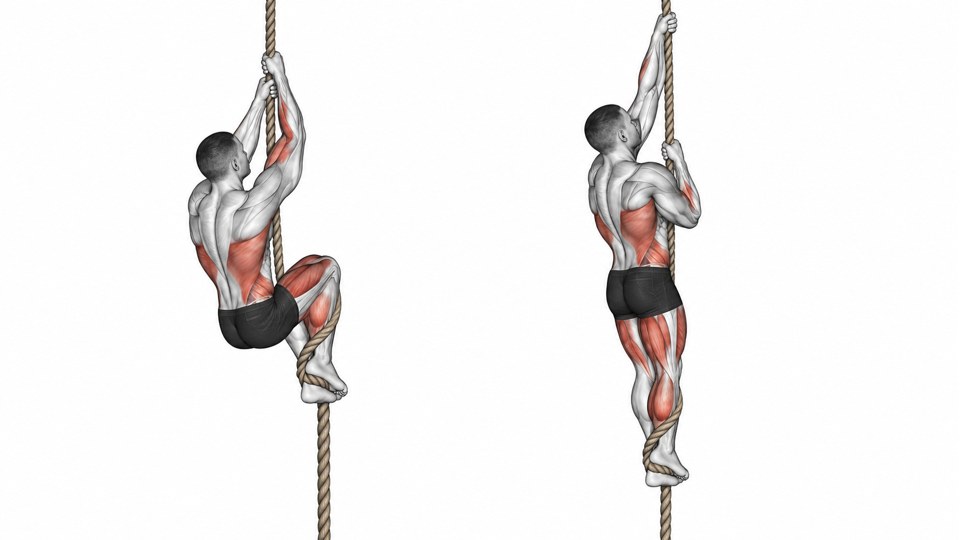
A rope climb moves up and down a suspended rope using the hands and, in this version, a foot lock. The feet trap the rope so the legs can help lift you between hand placements. The descent is part of every repetition.
How do you perform a rope climb?
Set up
- Use a properly anchored climbing rope over a clear landing area with suitable matting. Start low and learn the foot lock and controlled descent with supervision.
- Standing or seated low on the rope, practise an S-wrap: wind the rope once around one lower leg so it crosses the top of that foot. Pin the rope there by placing the other foot on top.
Execution
- Grip overhead with both hands, lift your knees and rebuild the foot lock beneath you.
- Press the feet together to secure the rope, then straighten the legs to stand up on the lock as your hands move higher one at a time.
- Repeat the knees-up, lock-and-stand sequence until your planned height. Stay below the anchor hardware and stop while you can still descend under control.
- To descend, keep both hands engaged, loosen the lock only enough to slide a short distance and move the hands down one at a time. Reapply the foot lock between slides.
- Continue in short controlled stages until the feet reach the floor. Do not jump from the rope or slide rapidly on unprotected skin.
Common mistakes
Pulling repeatedly with the arms while the feet slip
Return to low practice until the lock can support you.
Letting go near the top
Keep hand and foot control throughout the descent; choose a lower turnaround point.
Where it fits in a session
Practice this movement while you can control the required positions and finish each repetition deliberately.
Practise the lock and descent low to the floor with supervision before climbing to height. Turn around while you can still support a controlled return.
Muscles worked
Primary
Secondary
- None listed in this guide
Schematic surface view. Some muscles are partly visible or not shown.
Variations
- J-hook rope climb — Uses a different foot clamp rather than wrapping the rope around the calf; learn the lock separately.
- Legless rope climb — Climbs without foot assistance and should be tracked separately.
Frequently asked questions
How should a beginner practise rope climbing?
Practise the lock seated with the feet near the floor, then stand up on it and return. Add a small height only when you can reliably lock and descend.
Why use the legs on a rope climb?
The foot lock provides a platform to stand on while the hands advance. This guide teaches that coordinated version; a legless climb is a separate exercise.
Sources
- Betts et al. Anatomy and Physiology 2e. OpenStax, 2022. https://openstax.org/books/anatomy-and-physiology-2e/pages/11-5-muscles-of-the-pectoral-girdle-and-upper-limbs