
Side-lying leg raise
Also called side-lying hip abduction, lying side leg lift, side-lying lateral leg raise.
What is a side-lying leg raise?
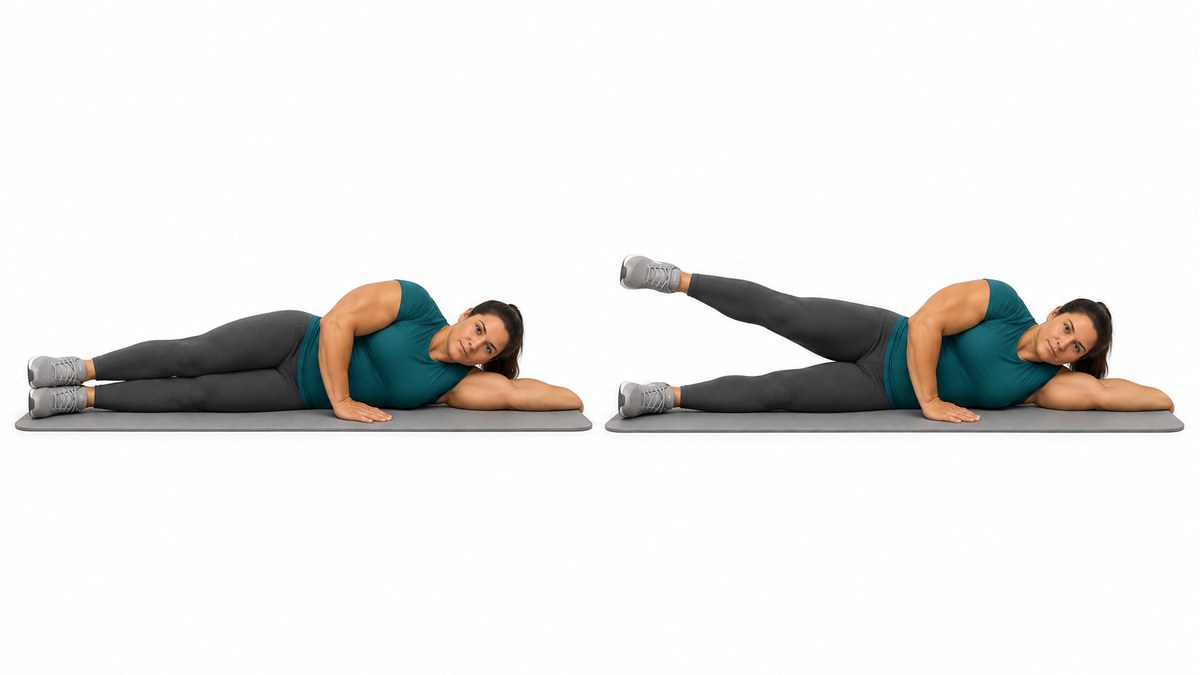
A side-lying leg raise is an outer-hip exercise done on the floor. With your trunk resting on one side, lift the upper leg away from the lower leg, then bring it back without rolling your pelvis. Your leg's weight provides the resistance for this version.
How do you perform a side-lying leg raise?
Set up
- Lie on your side with both legs long and stacked. Rest your head on your lower arm and put your upper palm on the floor in front of your chest.
- Line up your shoulders and hips one above the other. Keep your upper leg in line with your trunk, its knee straight and its kneecap facing forward.
Execution
- Lift the upper leg away from the lower leg in a smooth sideways arc. Keep your chest facing forward and your lower leg resting on the floor.
- End the lift before the top hip rolls back or moves up toward your ribs. Keep the raised kneecap facing forward rather than turning it toward the ceiling.
- Lower until the legs meet gently, then repeat without bouncing them apart.
- Rest the top leg down before rolling onto your other side. Reset your supports and repeat. After both sides, bend your knees and use your hands to push up to sitting.
Common mistakes
Chasing height by rolling backward
Once the pelvis tips, the leg can appear to travel farther without the same hip movement. Shorten the arc until your trunk stays on its side.
Sweeping the leg toward your chest
That changes the direction of the exercise. Bring the thigh back into line with your trunk before starting the next repetition.
Dropping the leg onto the resting leg
Use a quieter return so you can begin the next lift from a settled position rather than a rebound.
Where it fits in a session
Place it with your hip accessory exercises in the session you have planned.
Count repetitions for each leg. Keep the same body position and controlled range when comparing sets.
Muscles worked
Primary
Secondary
- None listed in this guide
Schematic surface view. Some muscles are partly visible or not shown.
The gluteus medius lifts the thigh away from the body's midline. The deeper gluteus minimus also assists; it has no separate outline on this muscle map.
Variations
- Hip abduction machineMoves the thighs apart from a supported seat against a weight stack. It has a different setup and load from this floor exercise.
- Standing cable hip abductionAn ankle cuff adds cable resistance while you stand and hold the machine for balance.
Frequently asked questions
What muscles do side-lying leg raises work?
They train the hip abductors, which move the thigh outward. These include the gluteus medius at the outer hip and the gluteus minimus beneath it. The muscle map shows the medius; it does not separately draw the minimus.
Should my toes point upward or forward?
For this version, keep the kneecap and toes facing the same direction as your chest. Avoid turning the whole leg so that the kneecap faces the ceiling as you lift. You do not need to force the toes toward the floor.
How high should I lift the upper leg?
Use the arc you can complete with your hips stacked and your trunk still. Finish the lift as soon as the pelvis starts to roll or the top hip moves toward your ribs. Reaching a particular foot height is not the goal.
Can I bend my lower leg or change my head support?
Yes. Bending the resting knee can make the side-lying position steadier. You can support your head with a bent lower arm as shown or extend that arm along the floor. Keep the moving leg straight and your shoulders and hips stacked with either support choice.
Is this the same as side-lying hip adduction?
No. Here the upper leg moves away from the resting leg. Side-lying hip adduction lifts the lower leg toward the body's midline with the upper leg placed out of its path. A clamshell also differs: its knees are bent and the feet stay together while the top knee opens.
Sources
- Shah A, Bordoni B. Anatomy, Bony Pelvis and Lower Limb, Gluteus Medius Muscle. StatPearls. Updated February 17, 2023. https://www.ncbi.nlm.nih.gov/books/NBK557509/
- Greco AJ, Vilella RC. Anatomy, Bony Pelvis and Lower Limb, Gluteus Minimus Muscle. StatPearls. Updated May 22, 2023. https://www.ncbi.nlm.nih.gov/books/NBK556144/