
Squat thrust
Also called squat thrusts, four-count burpee, 4-count burpee.
What is a squat thrust?
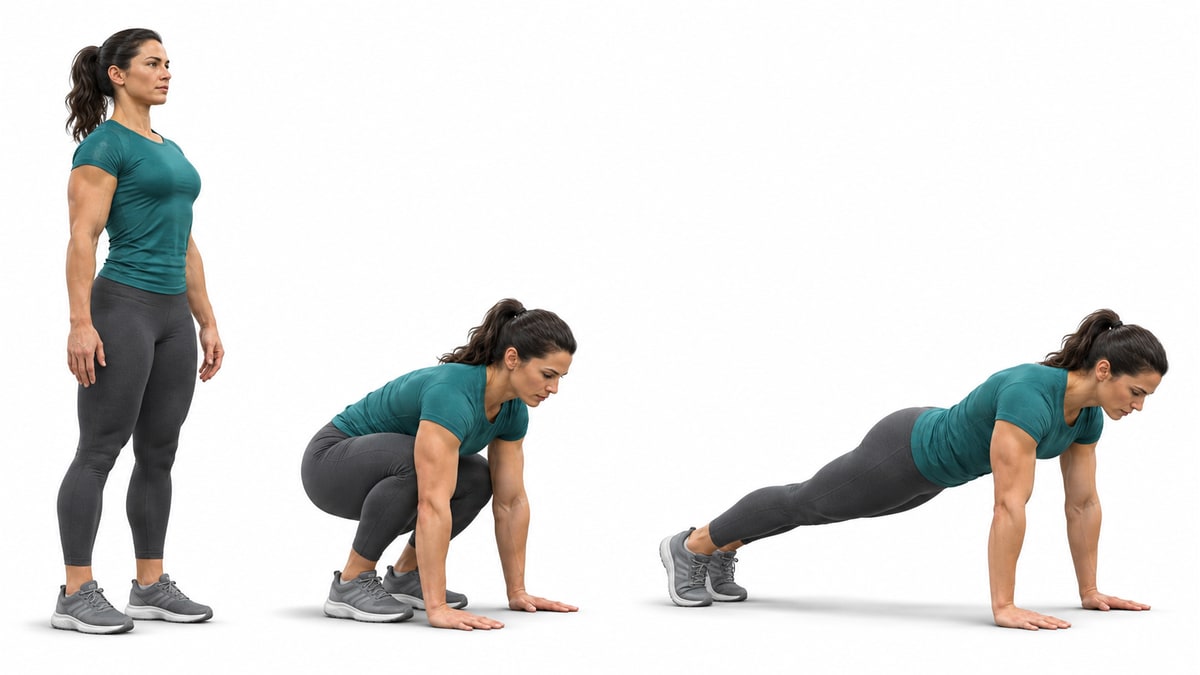
A squat thrust takes you from standing to a crouch, out to a high plank, back into the crouch, and upright again. The feet jump backward and forward while the hands support the body. This guide finishes by standing, with no push-up and no vertical jump. It uses your own bodyweight and needs clear floor space.
How do you do a squat thrust?
Set up
- Choose a firm surface where your hands and shoes will not slip. Clear enough room behind you to extend both legs fully. Stand with your feet roughly hip-to-shoulder width.
- Bend your hips and knees into a crouch. Put both palms down just ahead of your feet, about shoulder width apart, and spread your fingers.
Execution
- Press into your palms and hop both feet backward together, landing on your forefeet with the legs extended. Keep your shoulders above your hands.
- Settle into a high plank with straight arms and your head, trunk and legs broadly aligned. Keep the abdomen firm and continue breathing; do not lower into a push-up.
- Hop both feet forward to a supported crouch near your hands. Bend your knees as the feet land, keeping the hands down until your weight is back over your feet.
- Lift your hands and straighten your hips and knees to stand fully. Stay on the floor at the finish, then reset for the next repetition.
Common mistakes
Dropping the hips when the feet go back
Reduce the pace and re-establish the plank before coming forward. If the trunk keeps collapsing, step the feet back and forward instead of forcing another hop.
Lifting the hands before the feet are settled
Bring your weight onto your feet before rising. Leaving the floor with the hands too early turns the standing return into a scramble.
Adding a push-up or finishing vertical jump without changing the version
Those additions change the repetition. Keep this version consistent, or choose the corresponding burpee variation deliberately.
Where it fits in a session
Within the conditioning or bodyweight session you have planned.
Count one repetition when you return upright. Choose a pace at which each plank and standing finish stays controlled; shorten the set when those positions deteriorate.
Muscles worked
Primary
Secondary
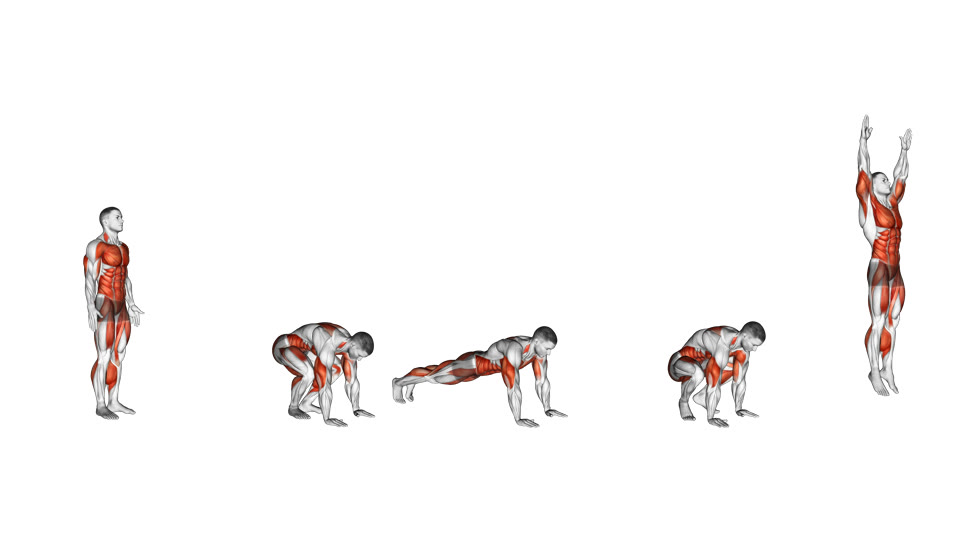
Schematic surface view. Some muscles are partly visible or not shown.
The quadriceps and gluteus maximus help lower and raise the body. The abdominal wall controls the trunk, while the shoulders and triceps help support the straight-arm plank. These are functional roles, not an activation ranking or a claim that this replaces dedicated strength work.
Variations
- Burpee with a vertical jumpAdds a vertical jump after bringing the feet forward. The linked guide also omits a push-up.
Frequently asked questions
Is a squat thrust the same as a burpee?
The names overlap across sources. Here, a squat thrust ends by standing with no push-up or vertical jump. Our burpee guide adds the jump, and some burpee versions also include a push-up. Describe the version you are doing so the repetition stays consistent.
Do you stand up after every squat thrust?
Yes, in this standing-to-standing version. Count the repetition after the feet return and you stand upright. Repeatedly hopping between a crouch and plank without standing is a different sequence.
Which muscles does a squat thrust work?
The quadriceps straighten the knees and the gluteus maximus helps extend the hips as you rise. The abdominal wall steadies the trunk, and the front shoulders and triceps contribute to supporting the straight arms. This describes their jobs in the movement, not a measured ranking of muscle activation.
Can you step the feet instead of jumping them?
Yes. Plant the palms, step each foot back to the plank, then bring each foot forward before standing. Keep the same standing finish. This changes the foot transition while letting you practice the sequence at a more deliberate pace.
Do squat thrusts need weights or a push-up?
Neither is required for this version. Support yourself on open palms and keep the arms straight in the plank. Holding dumbbells or adding a push-up creates a different exercise version; those are not instructions for this bodyweight repetition.
Sources
- Bordoni B, Varacallo MA. Anatomy, Bony Pelvis and Lower Limb: Thigh Quadriceps Muscle. StatPearls, updated 2023. https://www.ncbi.nlm.nih.gov/sites/books/NBK513334/
- Elzanie A, Borger J. Anatomy, Bony Pelvis and Lower Limb, Gluteus Maximus Muscle. StatPearls, updated 2023. https://www.ncbi.nlm.nih.gov/sites/books/NBK538193/
- Betts JG, et al. Anatomy and Physiology 2e, section 11.4. OpenStax, 2022. https://openstax.org/books/anatomy-and-physiology-2e/pages/11-4-axial-muscles-of-the-abdominal-wall-and-thorax
- Betts JG, et al. Anatomy and Physiology 2e, section 11.5. OpenStax, 2022. https://openstax.org/books/anatomy-and-physiology-2e/pages/11-5-muscles-of-the-pectoral-girdle-and-upper-limbs